
Nike Mercurial Sizing Guide
Nike Mercurial soccer cleats are popular with fast players, wingers, forwards, and kids who want a lightweight speed boot. This guide explains how Mercurials fit, whether they run narrow, how Vapor compares with Superfly, and how parents can choose the right size without buying too much growth room.
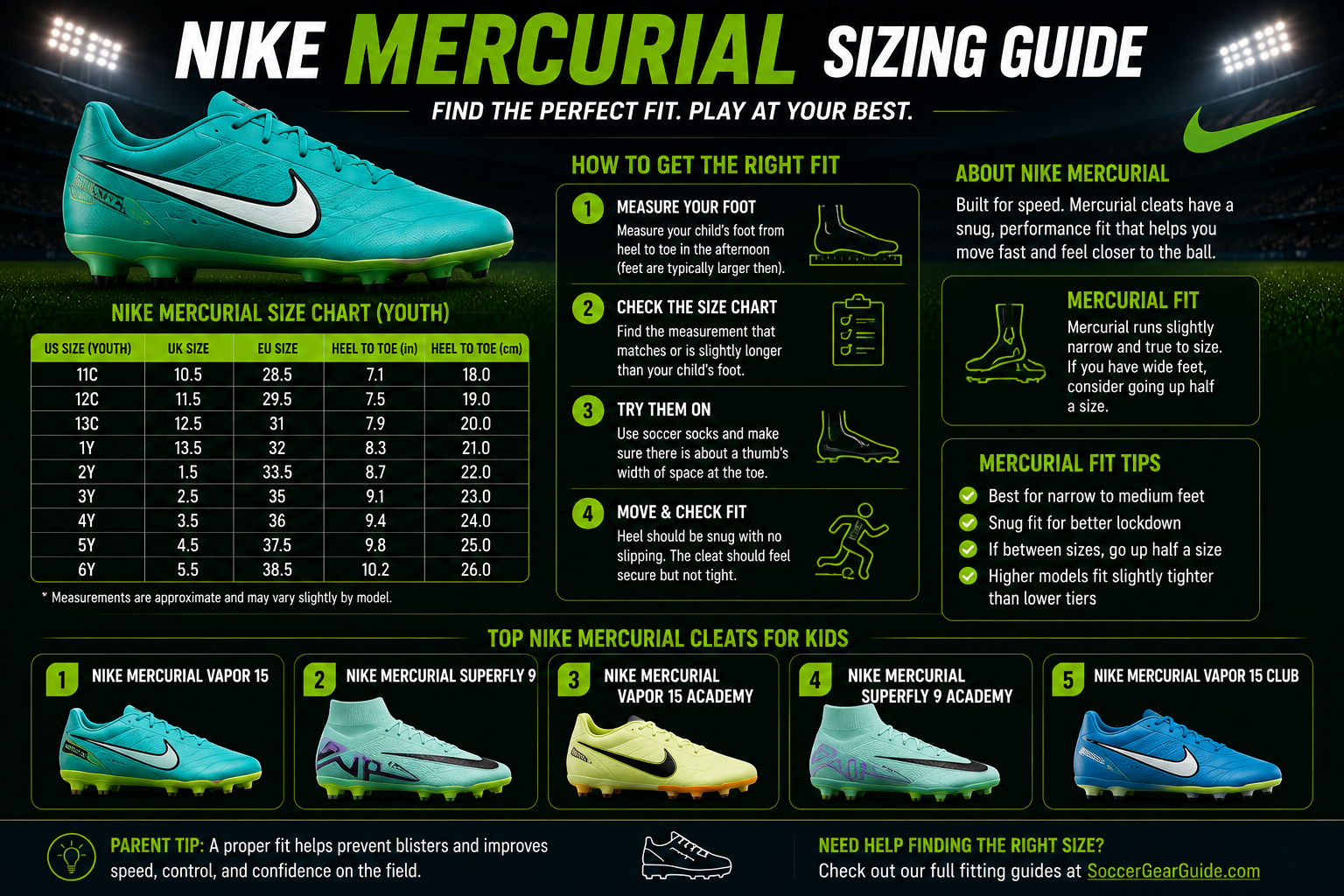
Nike Mercurials usually fit true to size in length but snug and narrow through the heel, midfoot, and forefoot. Narrow and average feet are the best match. Wide-footed players should not add excessive length to solve pressure; a different cleat shape is usually better.
How Nike Mercurial Cleats Fit
Nike Mercurial cleats are designed around a close speed-boot fit. The heel, midfoot, and forefoot should feel secure so the foot does not slide during acceleration, cutting, or shooting. That streamlined shape is one reason Mercurial is popular with wingers and forwards, but it also means the line is less forgiving than many comfort-focused cleats.
Most players should begin true to size in length. The real question is whether the Mercurial shape matches the foot. A player can have the correct length and still experience painful pressure across the forefoot or arch.
- Snug heel with minimal lift.
- Close midfoot without numbness.
- Forefoot held securely but not pinched.
- Toes lying naturally without curling.
- No large empty space in front.
- No sliding during sharp movement.
Nike Mercurial Fit at a Glance
Mercurial Sizing Decision Table
| Foot Type | Starting Size | What to Check |
|---|---|---|
| Narrow | True to size | Heel lockdown and toe length |
| Average | True to size | Forefoot comfort and midfoot pressure |
| Slightly wide | True to size first | Sidewall pressure after movement |
| Very wide | Consider another cleat | Do not solve width by adding excess length |
| Growing child | Current size with slight room | Secure heel and controlled toe space |
Do Nike Mercurials Run True to Size?
Most Mercurial models are true to size in length. A player who normally wears a specific Nike soccer-cleat size should begin there. The snug sensation often comes from width and volume rather than short length.
Sizing up may relieve some pressure, but it can also create heel movement and too much room in front of the toes. When the problem is width, another cleat shape is usually the better solution.
How Much Toe Room Should Mercurials Have?
The longest toe should sit close to the front without pressing against it. A small amount of space is normal, especially for youth players, but the foot should not slide forward during stops and cuts.
| Toe Fit | Meaning | Action |
|---|---|---|
| Toes lie naturally | Good fit | Continue movement testing |
| Toes touch lightly while standing | May be too short | Test carefully or size up |
| Toes curl | Too short | Choose more length |
| Large visible gap | Too long | Try a smaller size |
| Foot slides forward | Too large or poor lockdown | Adjust size or shape |
How the Heel Should Fit
The heel should stay seated during walking, sprinting, and cutting. Slight movement while putting the boot on is not the same as repeated lift during play.
- Walk uphill or on stairs.
- Jog and stop quickly.
- Perform side-to-side cuts.
- Check for rubbing after several minutes.
- Use match socks during testing.
How the Midfoot Should Fit
Mercurials should feel close around the midfoot, but the pressure should be even. Sharp arch pressure, numbness, or discomfort across the top of the foot suggests that the shape or lacing is wrong.
Players with high-volume feet may struggle even when length and width appear correct.
How the Forefoot Should Fit
The forefoot is the most common problem area. The upper should hold the foot without pressing painfully against the little toe or widest part of the foot.
A small amount of softening may occur, but Mercurial should not be purchased with the expectation that it will stretch dramatically.
Are Nike Mercurials Narrow?
Yes. Mercurial is one of Nike's most streamlined cleat lines. That does not mean every version fits identically, but narrow and average-footed players are generally the best match.
The narrow shape helps create a secure speed feel, but it can cause pressure for wide-footed youth players.
Are Mercurials Good for Wide Feet?
Mercurials can work for slightly wide feet when the upper is flexible and the player's foot volume is not excessive. Very wide feet usually need a different cleat family.
Players should compare Best Soccer Cleats for Wide Feet and Best Soccer Cleats for Comfort.
Are Mercurials Good for Narrow Feet?
Narrow feet are often an excellent match for Mercurial. The heel and midfoot can feel more secure than wider comfort-oriented models.
Narrow-footed players should still avoid sizing down too aggressively. Correct length remains important.
Vapor vs Superfly Sizing
Nike Mercurial Vapor and Superfly are usually similar in length and width. The primary difference is the collar. Vapor is low-cut, while Superfly includes a higher knit collar around the ankle.
| Feature | Mercurial Vapor | Mercurial Superfly |
|---|---|---|
| Cut | Low | High collar |
| Length | Usually the same | Usually the same |
| Width | Similar snug shape | Similar snug shape |
| Ankle feel | Open and traditional | Sock-like collar sensation |
| Best choice | Players who dislike collars | Players who enjoy added ankle contact |
Read Nike Vapor vs Superfly.
Does the Superfly Collar Change Size?
The collar does not normally require a different shoe size. It changes the sensation around the ankle and can make the boot harder to put on for some children.
Players with sensitive ankles or who dislike compression around the lower leg may prefer Vapor.
Mercurial Elite vs Pro vs Academy vs Club Fit
| Tier | Typical Upper Feel | Fit Character | Best Buyer |
|---|---|---|---|
| Elite | Thin and anatomical | Closest and most responsive | Advanced players |
| Pro | Performance-focused | Snug with more structure | Competitive players |
| Academy | Thicker and durable | Secure but more forgiving | Most youth players |
| Club | Basic synthetic | Simple and less refined | Beginners and budget buyers |
Best Mercurial Tier for Kids
Academy is usually the best value for youth players because it preserves the Mercurial identity while using more durable and affordable materials. Club is suitable for beginners, while Pro and Elite make more sense for serious players who already know the fit works.
Youth Mercurial Sizing
Youth sizing should be based on current foot length, not age. Children of the same age can have very different feet.
- Measure both feet while standing.
- Use the longer foot.
- Compare with Nike's current size chart.
- Try the cleats with soccer socks.
- Test heel lockdown and forefoot pressure.
- Recheck after growth spurts.
Should Kids Size Up for Growth?
A small amount of growth space is reasonable, but buying a full size larger is usually a mistake. Oversized Mercurials can slide internally and feel unstable during quick movement.
How to Measure a Child's Foot
Measure at the end of the day when the feet may be slightly larger. Have the child stand with full weight on the foot and measure from the heel to the longest toe.
Measure both feet because one is often longer. Use the longer measurement for sizing.
How Growth Spurts Affect Mercurial Fit
Mercurials can become uncomfortable quickly when a child grows because the shape is already snug. Check fit whenever the child reports toe pressure, side pain, numbness, or heel rubbing.
Do not wait for visible damage to replace an outgrown pair.
Mercurial Sizing for Adults
Adults should prioritize exact fit because they do not need growth room. Begin true to size and adjust only when length, heel shape, or width clearly requires it.
Mercurial Sizing with Grip Socks
Grip socks can make Mercurials feel tighter because they reduce sliding and may be thicker than standard socks. Always test with the same socks used in matches.
Mercurial Sizing with Orthotics
Custom insoles can raise the foot and reduce internal volume. Players using orthotics should test the complete setup and avoid forcing the foot into a boot that becomes too shallow.
Mercurial Sizing for High Arches
Players with high arches may feel pressure across the midfoot or top of the foot. Lacing adjustments can help, but persistent pressure indicates a volume mismatch.
Mercurial Sizing for Flat Feet
Flat-footed players can wear Mercurials when the width and midfoot shape are comfortable. The speed-boot label does not determine arch support, so the actual insole and foot shape should be evaluated.
Mercurial FG Sizing and Feel
Firm-ground Mercurials use stud patterns intended for natural grass. The upper fit remains snug, while the soleplate may feel firmer and more aggressive.
Stud pressure should not be confused with the shoe being too small.
Mercurial AG Sizing and Feel
Artificial-grass Mercurials usually use a more pressure-distributing outsole. The upper size is generally similar, but the underfoot feel can be more comfortable on synthetic fields.
Mercurial Turf Sizing and Feel
Turf versions may feel more like training shoes because of the thicker rubber outsole. Some players experience slightly more internal volume, but the upper still follows a streamlined Mercurial shape.
Mercurial Indoor Sizing and Feel
Indoor versions use flat court outsoles and may flex differently from outdoor cleats. Begin true to size and check heel movement during lateral cuts.
Surface Type and Sizing Problems
| Symptom | Possible Cause | What to Check |
|---|---|---|
| Forefoot pressure from studs | Outsole too aggressive | Surface compatibility |
| Sliding on turf | Wrong stud pattern | Use TF rather than FG |
| Difficulty turning on AG | Excess grip | Choose AG or MG |
| Heel movement | Size or shape issue | Lockdown, not surface |
How to Break In Nike Mercurials
Mercurials should feel secure from the first wear. A short break-in may soften the upper, but the player should not endure sharp pain.
- Wear them indoors for a short period.
- Use them for light technical work.
- Check the heel and forefoot.
- Increase training time gradually.
- Stop if numbness or strong pain appears.
Signs Mercurials Are Too Small
- Toes touch or curl.
- Forefoot becomes numb.
- Strong sidewall pressure develops.
- The upper bulges excessively.
- Toenails become sore after play.
- The child removes the cleats immediately after training.
Signs Mercurials Are Too Large
- Heel lifts during movement.
- The foot slides forward.
- The upper folds or bunches.
- Blisters form from repeated friction.
- Touch feels delayed or unstable.
- Laces must be overtightened.
Signs the Shape Is Wrong
Sometimes neither size solves the problem. If the smaller size is too narrow and the larger size slips, the Mercurial shape may not match the player's foot.
Choosing another silo is better than forcing the wrong shape.
Mercurial vs Nike Phantom Fit
| Category | Mercurial | Phantom |
|---|---|---|
| Primary identity | Speed | Control and precision |
| Fit | Narrow and streamlined | Often more accommodating |
| Best feet | Narrow to average | Average and some wider feet |
| Best player | Wingers and forwards | Midfielders and playmakers |
Mercurial vs Adidas F50 Fit
Both are speed boots with close fits. Mercurial often feels narrow and anatomical, while F50 follows Adidas proportions and may feel different through the heel and forefoot.
Mercurial vs Puma Ultra Fit
Puma Ultra is another speed-boot alternative. Some generations may feel more forgiving through the forefoot, but the best choice depends on the player's exact foot shape.
Mercurial vs Nike Tiempo Fit
Tiempo usually offers a softer and more comfort-focused fit than Mercurial. Players who find Mercurial too narrow may prefer Tiempo.
Best Positions for Mercurial
| Position | Why Mercurial Can Work | Fit Priority |
|---|---|---|
| Winger | Acceleration and quick cuts | Secure lateral lockdown |
| Striker | Explosive runs | Heel security |
| Fullback | Repeated wide sprints | Comfort over distance |
| Attacking midfielder | Quick movement in space | Forefoot flexibility |
| Goalkeeper | Light feel and quick set movements | Stable traction |
Mercurial for Wingers
Wingers are a natural Mercurial match because they sprint, cut, and attack defenders repeatedly. The fit must remain comfortable through an entire match, not only during short bursts.
Mercurial for Strikers
Strikers who make runs behind defenders often enjoy the light, direct feel. Toe room and heel lockdown matter during rapid acceleration and shooting.
Mercurial for Defenders
Fast fullbacks and mobile center backs can wear Mercurial successfully. Position does not prevent a defender from choosing a speed boot.
Mercurial for Goalkeepers
Goalkeepers can wear Mercurial when the outsole and fit provide stable movement. The collar choice between Vapor and Superfly is purely personal.
Common Mercurial Sizing Mistakes
- Buying a full size larger for growth.
- Using length to solve a width problem.
- Ignoring heel lift.
- Testing without match socks.
- Assuming every generation fits identically.
- Buying Elite before confirming the shape.
- Confusing stud pressure with shoe size.
- Keeping painful cleats because they look fast.
- Ignoring return policies.
- Using adult sizing assumptions for children.
How to Choose Vapor or Superfly
Choose Vapor if the player prefers a traditional low-cut boot and easy entry. Choose Superfly if the player enjoys a collar around the ankle.
Do not choose based on the belief that the collar provides major ankle protection. It mainly changes feel and style.
Best Mercurial Tier by Player Type
| Player | Recommended Tier | Reason |
|---|---|---|
| Beginner | Club or Academy | Affordable and practical |
| Growing youth player | Academy | Best balance of value and durability |
| Competitive club player | Academy or Pro | Performance without full Elite cost |
| Advanced player | Pro or Elite | Thinner and more responsive materials |
| Backup pair | Academy | Reliable value |
When to Replace Nike Mercurials
- The child outgrows the length or width.
- The heel no longer locks down.
- The outsole separates.
- Studs crack or wear unevenly.
- The upper tears.
- Persistent pain develops.
How to Clean and Store Mercurials
- Brush off loose dirt.
- Use mild soap and cool water.
- Do not soak the cleats.
- Remove insoles when needed.
- Air-dry away from direct heat.
- Store in a ventilated area.
- Do not leave them sealed in a hot car.
Final Mercurial Sizing Checklist
| Question | Good Sign | Warning Sign |
|---|---|---|
| Is the length correct? | Natural toe position | Curling or large empty space |
| Is the heel secure? | Minimal lift | Sliding and blisters |
| Is the width comfortable? | Close without pain | Numbness or side pressure |
| Is the outsole correct? | Matches the surface | Stud pressure or unsafe grip |
| Can the player move naturally? | Confident sprinting and cutting | Constant adjustment |
How Nike Mercurial Sizing Changes by Generation
Nike adjusts the Mercurial upper, heel shape, soleplate, and internal volume from one generation to the next. Even when the listed size stays the same, a new model can feel tighter across the forefoot, lower over the toes, or more secure around the heel.
Players who have worn Mercurials for years should still test every new generation. A previous size is the best starting point, not an automatic guarantee.
How Mercurial Materials Change Fit
Thin premium uppers usually wrap more closely around the foot, while thicker Academy and Club materials may feel more structured. A flexible upper can adapt slightly to the foot, but it does not add major width.
| Upper Type | Typical Feel | Fit Consideration |
|---|---|---|
| Thin synthetic | Close and responsive | Pressure is more noticeable |
| Structured synthetic | Protective and stable | May feel firmer during break-in |
| Textured control zones | More surface detail | Can change flexibility slightly |
| Knit collar construction | Sock-like ankle contact | Does not add foot width |
Mercurial Sizing by Playing Frequency
A player training once per week may tolerate a slightly firmer Academy model, while a competitive player training daily needs precise fit and reliable comfort. Frequent use magnifies even small sizing problems.
| Schedule | Fit Priority | Recommended Approach |
|---|---|---|
| Once weekly | Basic comfort | Start true to size and prioritize value |
| Two to three sessions | Heel and forefoot comfort | Test through a full practice |
| Four or more sessions | Precise fit and rotation | Consider Pro or Elite only after confirming shape |
| Tournament schedule | Swelling and repeated use | Test late in the day and pack backup footwear |
How Feet Change During a Match
Feet can swell slightly during long practices and games. A cleat that feels extremely tight when first put on may become painful later. This is especially important with Mercurial because the line already uses a close fit.
Try new cleats later in the day or after light activity. The goal is a secure fit that remains comfortable after the foot warms up.
Mercurial Fit in Hot Weather
Heat can increase swelling and make a tight upper feel more restrictive. Lightweight socks and proper hydration can help, but a cleat that causes numbness in hot conditions is too tight.
Do not overtighten the laces before kickoff. Recheck pressure after warmup.
Mercurial Fit in Cold Weather
Cold materials can feel stiffer during the first minutes of use. A short dynamic warmup helps the upper flex more naturally. Thick winter socks can also reduce internal room.
Use the same sock thickness during fitting that will be worn in cold matches.
Mercurial Fit for Tournament Days
Multiple games in one day increase the importance of toe room, heel comfort, and dry socks. A fit that feels slightly irritating in one match may become painful by the third.
- Pack extra socks.
- Loosen laces between games.
- Remove insoles to air-dry when appropriate.
- Bring backup footwear.
- Watch for swelling and blisters.
Mercurial Fit by Weather Condition
| Condition | Possible Fit Change | Adjustment |
|---|---|---|
| Hot | More swelling | Avoid overtightening |
| Cold | Stiffer upper | Warm up gradually |
| Wet | Socks become heavier | Use dry backups |
| Tournament day | Accumulated swelling | Monitor comfort between games |
How to Lace Nike Mercurials for Better Fit
Lacing can improve lockdown without changing size. Start with even tension and avoid pulling one section excessively tight.
- Loosen the entire lacing system.
- Seat the heel firmly.
- Tighten from the forefoot upward.
- Use moderate pressure over the arch.
- Secure the top eyelets without cutting circulation.
- Recheck after warmup.
Lacing for Narrow Feet
Narrow-footed players can use slightly firmer tension through the midfoot to reduce movement. The laces should not create sharp pressure points.
Lacing for High-Volume Feet
Players with high-volume feet should use gentler tension over the top of the foot. Skipping an eyelet may reduce pressure, but persistent discomfort suggests the shape is wrong.
Lacing for Heel Slip
A heel-lock lacing technique may help minor movement. If the heel still lifts after adjustment, the size or heel shape is probably incorrect.
How Insoles Affect Mercurial Fit
The stock insole influences volume and heel position. Replacing it with a thicker insole can make the cleat feel shorter and tighter. A thinner insole may reduce support and create more space.
Any replacement should fit the boot correctly and lie flat without curling.
How Sock Thickness Affects Mercurial Fit
Thick socks reduce volume and may increase pressure across the forefoot. Thin socks can improve room but may also reveal heel movement.
| Sock Type | Fit Effect | Best Use |
|---|---|---|
| Thin performance sock | More internal room | Close-fitting Mercurials |
| Standard soccer sock | Balanced fit | Most players |
| Thick cushioned sock | Less room | Only when the boot has enough volume |
| Grip sock | Less sliding and tighter feel | Players wanting more lockdown |
Mercurial Fit for Blister-Prone Players
Blisters usually come from friction, movement, moisture, or pressure. Correct sizing is the first solution. Tape and special socks may help, but they should not be used to hide a poor fit.
- Check heel lift.
- Use dry socks.
- Inspect seam locations.
- Break in gradually.
- Stop if a hot spot develops.
Mercurial Fit for Players with Bunions
Bunions and prominent forefoot joints may conflict with the narrow Mercurial shape. Pressure on the side of the foot is a strong sign that another cleat is more appropriate.
Mercurial Fit for Players with Toe Sensitivity
Players with sensitive toenails or previous toe injuries need enough length and toe-box height. The boot should not press down on the toes during stopping and kicking.
Mercurial Fit for Players with Different-Sized Feet
Most people have one foot slightly larger than the other. Size from the longer foot, then use lacing or a thin insole adjustment on the smaller side if needed.
Do not size from the smaller foot and compress the larger one.
Mercurial Fit for Players Returning from Injury
Players returning from foot, ankle, or lower-leg injury should prioritize stability and comfort rather than choosing the tightest possible speed fit. Professional guidance may be appropriate.
A previously comfortable size may feel different after swelling or changes in mobility.
Common Mercurial Fit Symptoms
| Symptom | Likely Cause | Best Response |
|---|---|---|
| Numb forefoot | Too narrow or overtightened | Loosen and reassess width |
| Heel blister | Movement or heel mismatch | Adjust lacing or change size |
| Black toenail | Too short or sliding forward | Correct length and lockdown |
| Arch pain | Volume or shape mismatch | Try another model |
| Stud pressure | Wrong outsole | Change surface type |
How to Compare Two Mercurial Sizes
When between sizes, compare both with the same socks and movement test. Do not choose by standing comfort alone.
- Check toe length.
- Compare heel movement.
- Perform several cuts.
- Kick a ball.
- Wear each size for several minutes.
- Choose the smaller size only if it remains comfortable.
How to Compare Two Mercurial Tiers
An Academy model in one size may feel different from an Elite model in the same size. Compare both when moving tiers, especially if the player has wide or high-volume feet.
How to Compare Mercurial with Another Nike Silo
Try Mercurial and Phantom in the same size. If Mercurial feels too narrow but Phantom feels secure, the issue is shape rather than length.
Tiempo is another useful comparison for players who prefer softness and comfort.
Parent Checklist Before Buying Mercurials
- Measure both feet.
- Identify the main field surface.
- Choose the correct tier.
- Use current size rather than age.
- Test with soccer socks.
- Check width before adding length.
- Keep the receipt until indoor testing is complete.
Best Mercurial Size Strategy for Fast-Growing Kids
Choose Academy or Club at the correct current size and remeasure regularly. Spending heavily on Elite makes less sense when the child may outgrow the cleats quickly.
A second affordable pair in the next size can be purchased later rather than forcing an oversized pair now.
Mercurial Sizing by Player Group
| Player Group | Starting Approach | Main Risk |
|---|---|---|
| Young beginner | True to size in Academy or Club | Buying too large |
| Competitive youth | True to size with precise width check | Ignoring swelling and frequency |
| Narrow-footed adult | True to size | Sizing down unnecessarily |
| Wide-footed adult | Try carefully or choose another silo | Using length to solve width |
| Goalkeeper | True to size with traction focus | Choosing collar by marketing |
How Mercurial Fit Affects Touch
A close fit can make touches feel direct because there is less movement between the foot and upper. Oversized cleats can delay contact and reduce confidence.
However, excessive tightness can distract the player and reduce natural movement.
How Mercurial Fit Affects Speed
A secure fit can improve confidence during acceleration, but a smaller size does not make a player faster. Speed depends on technique, strength, and conditioning.
How Mercurial Fit Affects Shooting
The foot should remain stable when striking the ball. Sliding inside the boot can reduce consistency, while painful toe pressure can alter mechanics.
How Mercurial Fit Affects Cutting
Lateral lockdown is essential during sharp changes of direction. The forefoot should stay centered over the soleplate without rolling inside the upper.
How Mercurial Fit Affects Comfort Over a Season
A correct fit reduces blisters, toenail pressure, and repeated adjustments. For children, the fit must be checked throughout the season because growth can change quickly.
Final Size Decision Matrix
| Situation | Best Decision |
|---|---|
| True length and comfortable width | Keep true size |
| Correct length but painful width | Choose another cleat shape |
| Heel slips with comfortable width | Try smaller size or different heel shape |
| Toes curl | Increase length |
| Child has slight growth room and secure heel | Acceptable fit |
| Child has large empty toe gap | Too large |
One Final Mercurial Sizing Rule
Start true to size, then judge the width, heel, and toe box separately. Do not size up just because the shoe feels narrow, and do not size down just because Mercurial is marketed as a speed cleat. The correct fit should feel close without forcing the foot into an unnatural position.
For youth players, remeasure regularly and prioritize Academy-level value unless the child already knows the Mercurial shape works. For adults, exact fit matters more than leaving extra room. Across every version, the safest choice is the pair that stays secure during movement, matches the field, and remains comfortable through a full session.
Final Verdict
Most players should begin true to size in Nike Mercurial. Vapor and Superfly generally fit similarly through the foot, while the Superfly collar changes ankle feel. Academy is usually the best value for growing kids.
The correct Mercurial fit is close and secure without numbness, crushed toes, heel slipping, or painful forefoot pressure.
Shop Nike Mercurial CleatsRelated Nike Mercurial Guides
Nike Mercurial Sizing FAQ
Do Nike Mercurial cleats run true to size?
Most players should begin with their normal Nike soccer-cleat size. Mercurials usually feel true to size in length but snug through the heel, midfoot, and forefoot.
Are Nike Mercurials narrow?
Yes. Mercurials are generally one of Nike's narrower and more streamlined cleat families.
Should kids size up in Nike Mercurials?
Usually not. Excess length can cause heel slipping, blisters, poor touch, and instability.
Are Nike Mercurials good for wide feet?
They can work for slightly wide feet in some versions, but very wide-footed players often prefer a more forgiving cleat shape.
Who should wear Nike Mercurials?
They suit wingers, forwards, attacking fullbacks, and any player who prefers a snug speed-boot fit.
Do Nike Mercurial Vapor and Superfly fit the same?
They are usually similar in length and width. The main difference is the Superfly collar, which changes ankle feel more than foot sizing.
Do Nike Mercurial Academy cleats fit differently from Elite?
They can. Academy versions often use thicker, more structured materials, while Elite models usually feel thinner and more anatomical.
Do youth Nike Mercurials fit the same as adult Mercurials?
The general shape is similar, but youth proportions, materials, and size ranges can change the way they feel.
How much toe room should Nike Mercurials have?
There should be enough room for the toes to lie naturally without a large empty gap. The foot should not slide forward.
How should the heel fit in Nike Mercurials?
The heel should stay secure with minimal lift during walking, jogging, sprinting, and cutting.
How should the midfoot fit in Nike Mercurials?
It should feel snug and supportive without numbness, arch pain, or strong pressure across the top of the foot.
Can Nike Mercurials stretch?
The upper may soften slightly, but the cleat will not transform from narrow to wide. Painful width pressure should not be ignored.
Do laceless Nike Mercurials fit differently?
Nike Mercurials are typically laced, but collar and upper construction can still affect lockdown. Laces should be used to fine-tune the fit.
Are Nike Mercurials good for narrow feet?
Yes. Narrow-footed players are often a strong match because the heel and midfoot are designed to feel close and secure.
What size Nike Mercurial should a child wear?
Use current foot length and Nike's size chart rather than age. Measure both feet and size from the longer foot.
Should parents buy Mercurials with room to grow?
Only a small amount of growth room is reasonable. A full size larger usually creates too much internal movement.
How do Nike Mercurial FG cleats fit?
FG models follow the same general snug Mercurial shape, though the soleplate can make the boot feel firmer underfoot.
How do Nike Mercurial AG cleats fit?
AG models usually fit similarly in the upper, but the outsole can feel more forgiving on artificial grass.
How do Mercurial turf shoes fit?
Turf versions may feel slightly different because of the thicker rubber outsole and training-shoe construction.
How do Mercurial indoor shoes fit?
Indoor versions may feel more flexible and shoe-like than outdoor cleats, but they still tend to use a streamlined Mercurial shape.
Are Mercurials good for kids with high arches?
They can be, but pressure over the midfoot should be checked carefully. Some high-volume feet may feel restricted.
Are Mercurials good for flat feet?
They can work if the foot shape matches, but comfort and insole support should be evaluated rather than assumed.
Can orthotics be used in Nike Mercurials?
Sometimes, but custom insoles can reduce internal volume. Test the complete setup before playing.
Do grip socks change Mercurial sizing?
Grip socks can make the fit feel tighter and reduce sliding. Try the cleats with the same socks used in games.
How long does it take to break in Nike Mercurials?
Many models soften after one to three light sessions, but they should not be painfully tight from the start.
What should I do if Mercurials cause heel blisters?
Check size, heel lockdown, socks, and lacing. Persistent heel movement usually means the shape or size is wrong.
What should I do if Mercurials pinch the forefoot?
Loosen the laces slightly and reassess width. If pressure remains, choose a more forgiving cleat instead of sizing up excessively.
When should kids replace Nike Mercurials?
Replace them when the child outgrows them, the sole separates, studs crack, the upper tears, or the fit becomes painful.
Is Mercurial sizing the same across every generation?
No. Small changes in upper material, heel shape, and tier can alter fit, so every new generation should be tested.
What is the best Mercurial tier for growing kids?
Academy is usually the best value because it balances price, durability, and the core Mercurial fit.
As an Amazon Associate, we may earn from qualifying purchases at no extra cost to you.