
Adidas Predator Sizing Guide
Adidas Predator cleats usually fit true to size with a structured, secure feel. This complete guide covers youth sizing, narrow and wide feet, Elite, Pro, League, Club, laced versus laceless models, surfaces, comparisons, and fit troubleshooting.
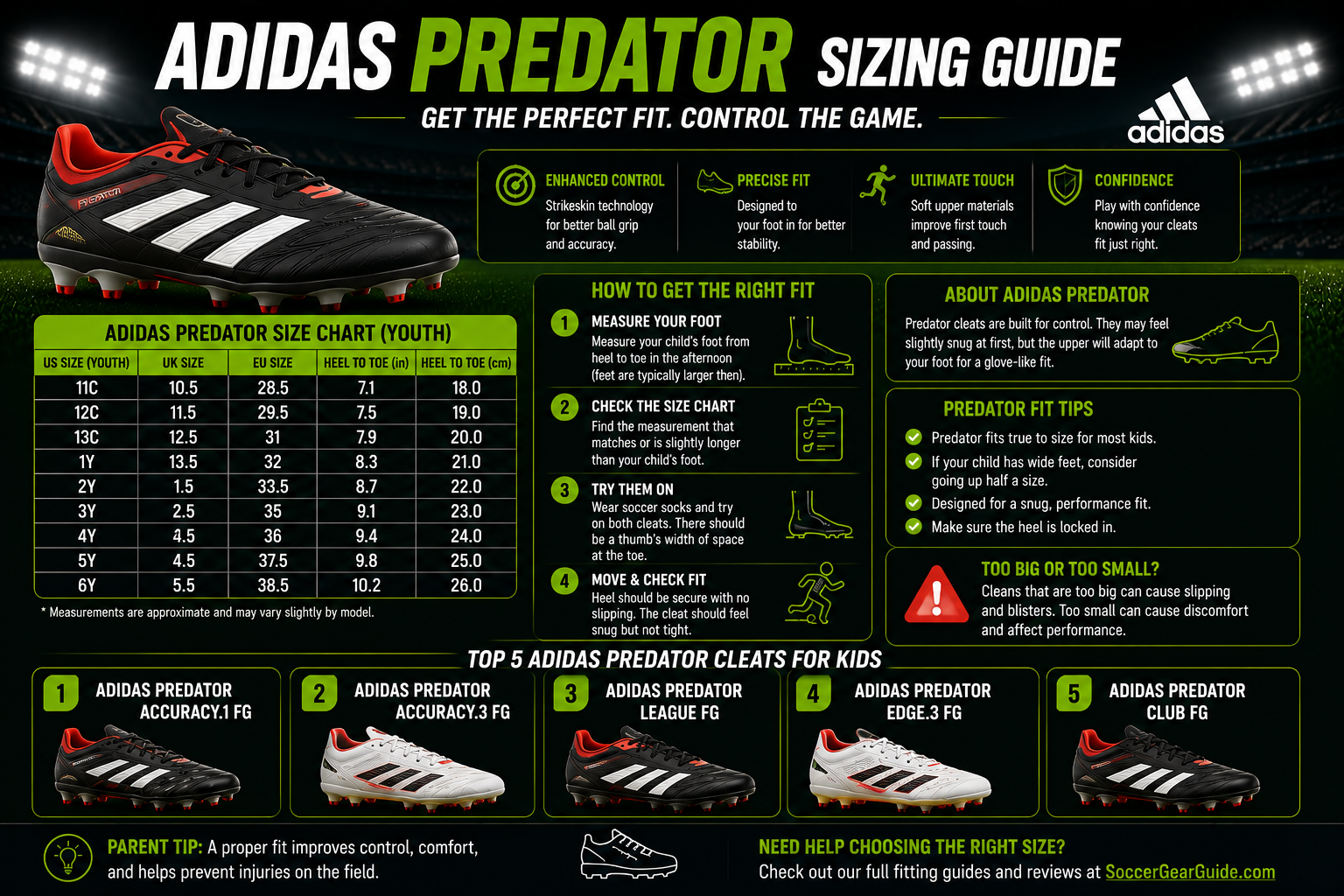
Adidas Predator cleats usually fit true to size. They feel more structured and forgiving than many speed boots, making them a good option for average and slightly wide feet. Very wide feet should compare Adidas Copa or another wider model.
Adidas Predator Sizing at a Glance
Adidas Predator usually fits true to size for average feet and offers a more structured, balanced shape than many pure speed boots.
The best size is the one that keeps the heel secure, allows a small amount of toe room, and avoids side pressure.
| Foot Type | Best Starting Point | Main Check |
|---|---|---|
| Narrow | True to size | Heel lockdown |
| Average | True to size | Balanced snugness |
| Slightly wide | True to size | Forefoot pressure |
| Very wide | Try carefully | Compare Copa or wider models |
| Growing youth player | True to size with slight room | Avoid heel slip |
How Adidas Predator Cleats Fit
Predator cleats are built around a secure, control-focused fit. They usually feel more substantial than Adidas F50 and less soft than Adidas Copa.
The upper should hold the foot confidently without creating numbness or painful compression.
Do Adidas Predator Cleats Run True to Size?
For most players, yes. True to size is the correct starting point, but the exact feel varies by tier, generation, and laced or laceless construction.
Players should judge the fit after walking, jogging, stopping, and making lateral movements.
Predator Fit by Foot Shape
Foot shape matters more than the number printed on the box. Length, width, instep volume, arch shape, and heel width all affect comfort.
| Foot Shape | Likely Predator Experience | Best Advice |
|---|---|---|
| Narrow heel | Usually secure | Prefer laced version |
| Wide forefoot | May feel firm | Test League, Pro, or Copa |
| High instep | Possible top pressure | Loosen lacing and compare tiers |
| Flat foot | Can feel stable | Watch arch pressure |
| High arch | Can work | Check instep volume |
Predator Sizing for Narrow Feet
Narrow-footed players often fit Predator well because the heel and midfoot feel secure.
Laced models are usually safer than laceless versions when precise lockdown is needed.
Predator Sizing for Average Feet
Average-width feet are the easiest match for Predator. Most players should begin true to size and focus on toe room and heel security.
Predator Sizing for Slightly Wide Feet
Slightly wide feet can often wear Predator comfortably, especially in softer or lower-tier uppers.
The player should not feel strong pressure at the little-toe side.
Predator Sizing for Very Wide Feet
Very wide feet may find some Predator models too structured. Sizing up often creates length and heel-slip problems rather than solving width.
Adidas Copa or another wide-friendly cleat may be safer.
Predator Sizing for High-Volume Feet
Players with more volume over the instep should watch for top pressure. Laceless models can feel especially restrictive.
Laced Predators allow better adjustment.
Predator Sizing for Flat Feet
Flat-footed players should check whether the midfoot feels supportive or overly narrow.
Persistent arch pressure means another model shape may work better.
Predator Sizing for High Arches
High-arched players should check instep pressure and heel position. Tightening the laces too much can create discomfort.
How Much Toe Room Should Predators Have?
A small amount of controlled toe room is ideal. The toes should lie naturally without curling, and the foot should not slide forward.
Too much length reduces touch and can create friction.
| Toe Fit | Meaning | Action |
|---|---|---|
| Toes lightly near front | Performance fit | Usually acceptable |
| Small controlled gap | Balanced fit | Ideal for most players |
| Toes curled or pressed | Too small | Size up or change model |
| Large gap and sliding | Too big | Size down |
How the Heel Should Fit
The heel should remain seated during sprinting, stopping, and cutting. Repeated lift indicates excess size, insufficient lockdown, or the wrong shape.
How the Midfoot Should Fit
The midfoot should feel secure without numbness or arch pain. The foot should not move side to side inside the cleat.
How the Forefoot Should Fit
The forefoot should feel supported, not squeezed. Strong pressure at the fifth toe or forefoot edge usually indicates a width mismatch.
Laced vs Laceless Predator Sizing
Laced and laceless Predators can feel different even in the same listed size. Laces provide more adjustability, while laceless models rely on the upper shape.
Hard-to-fit feet usually benefit from laces.
| Feature | Laced Predator | Laceless Predator |
|---|---|---|
| Adjustment | Better | Limited |
| Best for wide feet | Usually safer | Depends heavily on shape |
| Best for narrow heels | Better lockdown | Can vary |
| Convenience | Requires tying | Easy once on |
| Sizing risk | Lower | Higher if foot shape mismatches |
Predator Elite Sizing
Elite models usually feel closest and most performance-focused. The thinner upper can reveal pressure points more clearly.
Players should confirm the shape works before paying premium prices.
Predator Pro Sizing
Pro models often balance a close fit with more forgiveness than Elite. They are a strong option for competitive players.
Predator League Sizing
League is usually the most practical youth tier. The upper is thicker and can feel slightly more forgiving than Elite.
It is often the safest starting point for developing players.
Predator Club Sizing
Club models use simpler, thicker materials. They can feel roomier in some areas but less refined in lockdown.
Beginners should prioritize comfort over a close performance fit.
Do Predator Tiers Fit the Same?
Not exactly. The general last may be similar, but upper thickness, padding, tongue construction, and collar shape change the internal feel.
Players should not assume the same size will feel identical across every tier.
| Tier | Typical Feel | Sizing Note |
|---|---|---|
| Elite | Closest and thinnest | Pressure points are more noticeable |
| Pro | Close but balanced | Best value for many players |
| League | More padded | Often youth-friendly |
| Club | Basic and thicker | Check heel lockdown carefully |
Youth Predator Sizing
Parents should measure both feet and fit the larger one. Youth cleats should feel secure without painful pressure.
A small amount of growth room is enough.
Should Kids Size Up?
Usually no. Buying a full size bigger often causes heel slip, unstable movement, and blisters.
If the correct length feels too tight, the model may be too narrow rather than too small.
How Often Should Kids Be Remeasured?
Measure before each season, after growth spurts, and whenever the child reports toe pressure, numbness, or new blisters.
How to Measure Feet at Home
Measure both feet while standing, late in the day, and while wearing normal soccer socks.
Compare the longer measurement with the current Adidas size chart.
- Use a flat sheet of paper.
- Keep the heel against a wall.
- Mark the longest toe.
- Measure both feet.
- Fit the larger foot.
- Repeat after growth spurts.
Why Soccer Socks Matter
Thick grip socks can reduce internal volume. Thin socks may make the same cleat feel looser.
Always test Predators with the socks used for games.
How Insoles and Orthotics Affect Sizing
Orthotics and thicker insoles raise the foot and reduce space inside the cleat. This can increase instep pressure or heel movement.
Bring the actual insole when trying cleats.
Predator FG Sizing
Firm-ground Predator cleats usually follow standard sizing. Test them with match socks and confirm the forefoot does not feel compressed.
Predator AG and MG Sizing
AG and MG versions generally use the same size, but outsole flex and internal padding can make the feel slightly different.
Players should prioritize pressure distribution and comfort on the synthetic field.
Predator Turf Sizing
Turf Predator shoes can feel more like athletic shoes because of their lower outsole and additional cushioning.
Begin true to size and check heel movement.
Predator Indoor Sizing
Indoor versions may feel more flexible and lower-profile. The size should remain close, but players should confirm toe room and court-specific lockdown.
Predator vs Adidas F50 Sizing
Predator usually feels more structured and accommodating, while F50 feels slimmer and more speed-focused.
Players squeezed in F50 may prefer Predator at the same listed size.
| Category | Predator | F50 |
|---|---|---|
| Main fit | Structured and balanced | Slim and speed-focused |
| Forefoot | More forgiving | Closer |
| Heel | Secure | Very close |
| Best for | Control players | Speed players |
| Wide-foot suitability | Better | More limited |
Predator vs Adidas Copa Sizing
Copa usually feels softer and more accommodating, while Predator feels more structured.
Very wide or comfort-first players may prefer Copa.
Predator vs Nike Phantom Sizing
Both are control-focused, but Phantom often feels lower-profile while Predator feels more substantial.
Players should compare the same listed size and focus on forefoot and instep pressure.
Predator vs Nike Mercurial Sizing
Mercurial is generally narrower and more aggressive. Predator is usually the better option for players who find Mercurial restrictive.
Predator vs Nike Tiempo Sizing
Tiempo feels softer and more comfort-oriented, while Predator feels more engineered and secure.
Wide-footed players should compare both.
Signs Predator Cleats Are Too Small
Too-small cleats create pressure that does not improve through normal wear.
- Toes curl or press the front.
- Little-toe side becomes numb.
- Toenails hurt after play.
- Hot spots develop quickly.
- Instep pressure causes tingling.
- Removing the cleats gives immediate relief.
Signs Predator Cleats Are Too Big
Too-big cleats reduce control and create friction.
- Heel lifts during movement.
- Foot slides forward when stopping.
- Upper folds excessively.
- Laces must be overtightened.
- Blisters form at the heel.
- Touch feels disconnected.
How to Test Predators Indoors
Before wearing them outside, walk, jog, perform lateral steps, stop quickly, and touch a ball indoors.
Return the pair if heel lift, numbness, or sharp pressure appears.
How Long to Break In Predators
Predators should feel secure early, though the upper may soften after one or two light sessions.
Painful pressure should not be treated as normal break-in.
What to Do When Between Sizes
Compare both sizes with the same socks. Choose the smaller only when the toes remain comfortable and the forefoot is not compressed.
If one size pinches and the next slips, the model shape is wrong.
What to Do When Length Is Right but Width Is Wrong
Do not size up automatically. Try a laced version, a softer tier, Adidas Copa, or another wide-friendly model.
What to Do When the Heel Slips
Check lacing, sock thickness, and size. Persistent heel lift usually means the cleat is too large or the rearfoot shape is wrong.
What to Do When the Instep Hurts
Loosen laces over the pressure point and compare laced versus laceless models. High-volume feet may need another shape.
What to Do When the Little Toe Hurts
Little-toe pain usually signals insufficient forefoot width. Extra length rarely solves it safely.
Best Predator Size for Midfielders
Position does not change the numerical size, but midfielders should prioritize all-match comfort because they cover large distances and touch the ball frequently.
Best Predator Size for Defenders
Defenders need secure heel lockdown and stable lateral support. Avoid extra length that allows movement inside the cleat.
Best Predator Size for Strikers
Strikers should balance close touch with toe comfort. A painfully short fit can affect acceleration and striking confidence.
Best Predator Size for Goalkeepers
Goalkeepers should prioritize set-position stability and forefoot comfort. Heel movement can reduce confidence during lateral pushes.
Common Predator Sizing Mistakes
The most common mistakes are buying for growth, solving width with length, and assuming every Predator tier fits identically.
- Buying a full size too large.
- Choosing laceless without testing.
- Ignoring heel lift.
- Assuming Elite is automatically better.
- Using thick socks only after purchase.
- Keeping painful cleats.
- Ordering from a retailer without returns.
Final Predator Sizing Checklist
Use this checklist before keeping the pair.
| Question | Best Answer |
|---|---|
| Did you start true to size? | Yes |
| Did you measure both feet? | Yes |
| Are you wearing soccer socks? | Yes |
| Is heel lift minimal? | Yes |
| Is toe room controlled? | Yes |
| Is the forefoot comfortable? | Yes |
| Can you move without pain? | Yes |
Final Verdict
Most players should start true to size in Adidas Predator cleats. The correct fit combines a secure heel, small controlled toe room, comfortable forefoot width, and no instep pressure.
League is usually the safest youth value tier, Pro offers the best competitive balance, and laced models provide the most reliable adjustment.
Shop Adidas Predator CleatsRelated Adidas Predator Guides
Adidas Predator Sizing FAQ
Do Adidas Predator cleats run true to size?
Most players should begin with their normal Adidas soccer-cleat size, then confirm width, heel lockdown, and toe room.
Are Adidas Predators wider than Nike Mercurials?
Usually yes. Predator often feels more structured and forgiving through the forefoot than Mercurial.
Should kids size up in Adidas Predator cleats?
Usually no. A small amount of growing room is enough; a full size larger often causes heel slip.
Are Adidas Predators good for wide feet?
They can suit average and slightly wide feet, but very wide players should test carefully or compare Adidas Copa.
Are Adidas Predators good for narrow feet?
Yes. Narrow-footed players often appreciate the secure midfoot and heel, especially in laced versions.
How should Adidas Predator cleats fit?
They should feel snug and stable without crushed toes, numbness, or strong side pressure.
How much toe room should Adidas Predator cleats have?
A small controlled amount is ideal, but the foot should not slide forward.
Do Adidas Predator cleats stretch?
The upper may soften slightly, but structured synthetic models will not become dramatically wider.
Are laceless Predators tighter than laced models?
They can feel more restrictive because the fit cannot be adjusted as precisely.
Are laced Predators better for wide feet?
Usually yes, because laces allow pressure to be adjusted through the forefoot and instep.
Do Predator Elite, Pro, League, and Club fit the same?
They share a general shape, but materials, padding, and upper structure can make each tier feel different.
Which Predator tier fits kids best?
League is usually the safest youth value option, while Club suits beginners and Pro suits competitive players.
Are Predator cleats good for high insteps?
They can work, but high-volume feet should check pressure over the top of the foot.
Are Predator cleats good for flat feet?
They can be when the midfoot feels stable and does not create arch pressure.
Are Predator cleats good for high arches?
They can work, but the player should check instep pressure and lacing comfort.
Should I size differently for artificial grass Predators?
Usually no. Use the same size, but confirm the AG or MG version fits comfortably with match socks.
Should I size differently for turf Predators?
Usually no, though turf shoes can feel more shoe-like and may have different internal volume.
Should I size differently for indoor Predators?
Begin with the same size, then check heel lockdown because indoor models can feel more flexible.
How do youth Adidas sizes compare with adult sizes?
Youth and adult sizing use different ranges, so parents should measure the foot and use the current Adidas chart.
Should parents measure both feet?
Yes. Fit the larger foot because small left-right differences are common.
When should kids be remeasured?
Before each season, after growth spurts, and whenever toe pressure or blisters appear.
Can thick grip socks change Predator sizing?
Yes. Thick socks can reduce internal space, so players should try cleats with their actual match socks.
Can insoles change Predator sizing?
Yes. Orthotics and thicker insoles reduce volume and can alter heel position.
How do Predators compare with Adidas F50 sizing?
Predator usually feels more structured and forgiving, while F50 feels slimmer and more speed-focused.
How do Predators compare with Adidas Copa sizing?
Copa generally feels softer and more accommodating, while Predator feels more secure and structured.
How do Predators compare with Nike Phantom sizing?
Both are control-focused, but Phantom often feels lower-profile while Predator feels more substantial.
How do Predators compare with Nike Tiempo sizing?
Tiempo usually feels softer and more comfort-oriented, while Predator feels more engineered and secure.
What are the signs Predator cleats are too small?
Toe pressure, side numbness, hot spots, toenail pain, and curling toes are warning signs.
What are the signs Predator cleats are too big?
Heel lift, forward sliding, excessive upper folding, and friction blisters indicate too much room.
What is the safest Predator sizing rule?
Start true to size, test with soccer socks, and judge heel security, toe room, width, and comfort during movement.
As an Amazon Associate, we may earn from qualifying purchases at no extra cost to you.