
Adidas F50 Sizing Guide
Adidas F50 cleats are designed to feel light, fast, and close to the foot. That performance-focused fit can be excellent for wingers, forwards, and quick youth players, but it also means choosing the correct size matters more than simply ordering the same size as an everyday sneaker. This guide explains how Adidas F50 cleats fit in length and width, whether they run true to size, how much toe room kids need, what wide-footed players should expect, and how to identify the right fit before wearing them in a match.
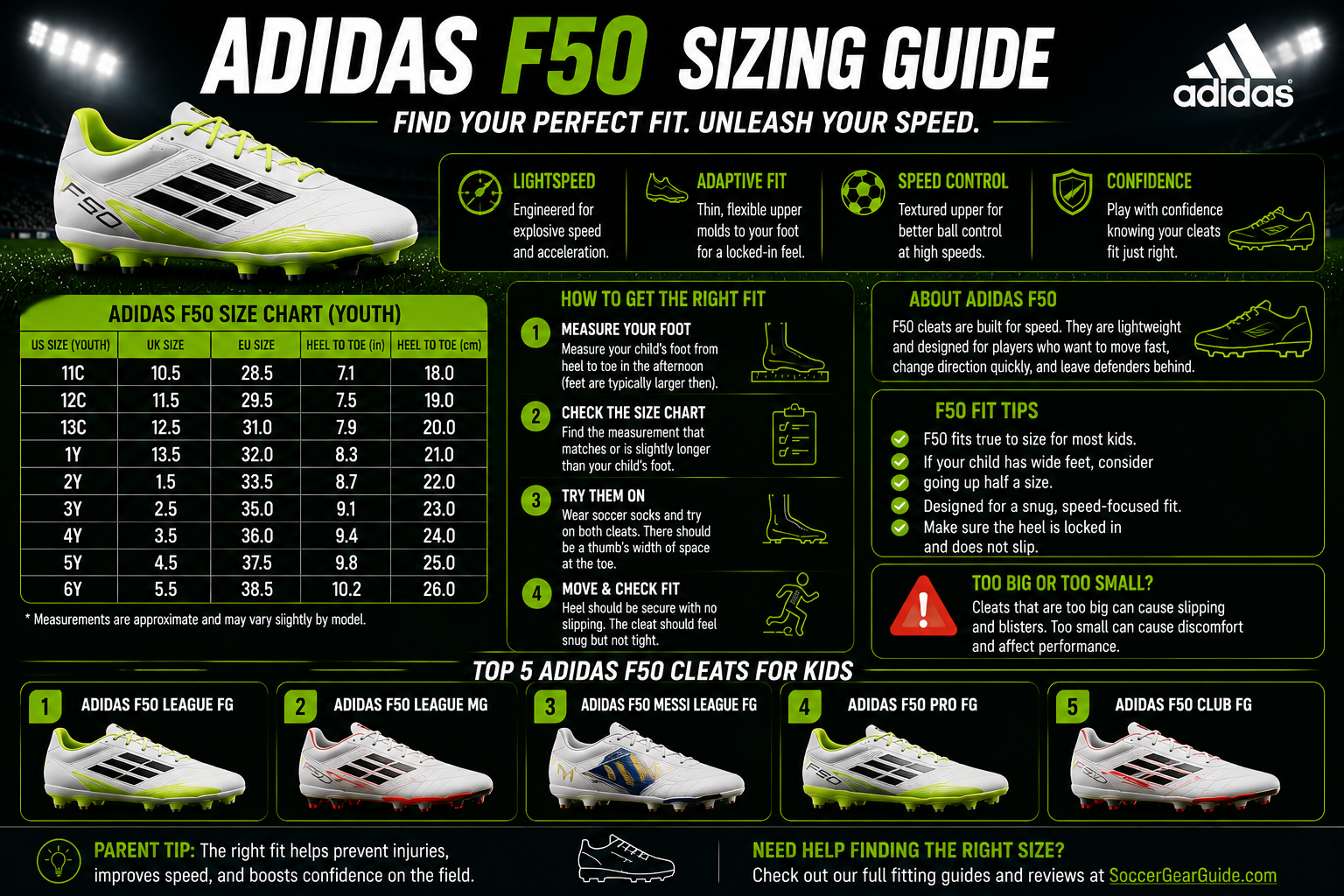
Adidas F50 cleats generally run true to size in length, but they have a snug, speed-oriented shape. Most narrow- and average-footed players should begin with their normal soccer cleat size. Slightly wide feet may fit depending on the specific F50 tier and upper, while very wide feet are usually better served by a more forgiving model. The correct fit should feel secure with minimal heel movement, light toe room, and no painful pressure across the forefoot.
Adidas F50 Fit at a Glance
Adidas F50 Size and Fit Chart
The best starting point is your normal soccer cleat size, not necessarily your casual shoe size. Soccer cleats are designed to fit closer than running shoes or everyday sneakers, so the player’s current cleat size is usually the most useful reference. The chart below summarizes the safest approach by foot shape.
| Foot Type | Recommended Starting Point | What to Check |
|---|---|---|
| Narrow feet | True to size | Confirm the heel stays locked without excessive lace pressure. |
| Average feet | True to size | Look for a secure forefoot fit with no numbness or sharp side pressure. |
| Slightly wide feet | Try true to size first | Check the widest part of the forefoot during standing, jogging, and cutting. |
| Very wide feet | Compare wider alternatives | Do not add unnecessary length just to create width. |
| Growing youth players | Allow only modest extra room | Avoid a full-size growth gap that creates heel slip and poor control. |
| Different-sized feet | Fit the larger foot | Use lacing and socks to fine-tune the smaller foot without crushing the larger one. |
How Do Adidas F50 Cleats Fit?
The Adidas F50 is a speed boot, so its fit is built around responsiveness rather than a relaxed, padded feel. The upper sits close to the foot, the shape is relatively streamlined, and the heel is designed to stay secure during acceleration and rapid changes of direction. Players who enjoy a barefoot-like or connected sensation often appreciate this type of fit because the boot moves with the foot rather than around it.
That close shape should not be confused with pain. A correct F50 fit feels secure across the midfoot and forefoot, but the toes should not be curled and the sides of the foot should not feel compressed. The player should be able to stand, jog, accelerate, and plant the foot without numbness, burning, or sharp pressure.
Compared with Adidas Predator, the F50 usually feels leaner and more speed-focused. Compared with Adidas Copa, it typically has less padding and less natural give. Those differences matter because a player who wears the same numerical size in all three lines may experience very different levels of width, volume, and comfort.
- Overall shape: Streamlined and performance-oriented.
- Length: Usually true to size.
- Forefoot: Snug, especially for players with broad feet.
- Midfoot: Close and supportive when the size is correct.
- Heel: Should feel locked without excessive rubbing.
- Best match: Narrow to average feet and players who prefer a connected speed fit.
For the complete product cluster, visit the Adidas F50 Hub and Best Adidas F50 Cleats.
What a Correct Adidas F50 Fit Should Feel Like
The toes should lie naturally with a small amount of usable room at the front.
The heel should remain stable during jogging, sprinting, and lateral movement.
The sides should feel close but should not create numbness, pinching, or burning.
The boot should wrap the foot without requiring the laces to be overtightened.
Do Adidas F50 Cleats Run True to Size?
For most players, Adidas F50 cleats run true to size in length. A player who normally wears a size 7 in properly fitted soccer cleats will usually begin with a size 7 in the F50. The most important qualification is that “true to size” describes length more reliably than width. Two players with the same foot length can need different models because one has a narrow foot and the other has a broad forefoot.
Sizing up is not automatically the right answer when the F50 feels tight. A larger size creates extra length, and that extra length may cause the foot to slide forward or the heel to lift. If the original size is correct in length but painful across the sides, the shape of the boot is probably the problem. In that situation, changing models is usually more effective than buying a longer boot.
Sizing down is also risky. Some players assume speed cleats should feel extremely tight, but a boot that compresses the toes or creates constant pressure can reduce comfort, affect movement, and make the player less confident. Lockdown should come from the shape, heel structure, and lacing system—not from forcing the foot into a boot that is too small.
- Begin with your normal soccer cleat size.
- Judge length and width separately.
- Do not size down solely for a tighter sensation.
- Do not size up excessively to solve side pressure.
- Check both feet because one is often slightly larger.
- Use the larger foot when making the final choice.
Adidas F50 Fit by Foot Shape
| Foot Shape | Likely F50 Experience | Best Buying Approach |
|---|---|---|
| Narrow heel and narrow forefoot | Usually an excellent match | Start true to size and use normal lacing tension. |
| Average heel and average forefoot | Usually secure and responsive | Start true to size and confirm there are no forefoot hot spots. |
| Narrow heel and wide forefoot | Heel may fit well while the front feels restrictive | Test carefully; a different shape may work better than sizing up. |
| Wide heel and average forefoot | Possible rubbing or difficulty achieving lockdown | Evaluate heel stability during movement, not just while standing. |
| High-volume foot | The upper may feel restrictive across the top of the foot | Loosen the lacing pattern and compare a more accommodating model if pressure remains. |
| Very wide forefoot | Often too narrow for long-term comfort | Prioritize a wider cleat line instead of adding excessive length. |
Are Adidas F50 Cleats Good for Wide Feet?
Adidas F50 cleats are not usually the safest first choice for very wide feet. Their streamlined shape is intended to support speed, quick changes of direction, and a close touch on the ball. That shape works well for many narrow- and average-footed players, but it leaves less room for broad forefeet and high-volume feet.
A player with slightly wide feet may still fit the F50, especially if the upper has enough flexibility and the player does not experience pressure at the widest part of the foot. The key is to distinguish between normal new-boot snugness and structural pressure. Normal snugness feels close but manageable. Structural pressure feels sharp, creates numbness, or causes the foot to bulge aggressively over the soleplate.
Very wide-footed players should not assume the boot will stretch dramatically. Synthetic speed-boot uppers may soften and conform slightly, but they generally do not expand enough to transform a narrow shape into a truly wide one. If the foot is painful during the first fitting, the safer choice is usually a different cleat.
- Strong fit candidate for narrow feet.
- Usually suitable for average-width feet.
- Potentially workable for slightly wide feet after careful testing.
- Less suitable for very wide or high-volume feet.
- Excessive sizing up can create heel slip and unstable movement.
- Comfort-focused alternatives may fit broad feet more naturally.
Helpful comparisons include Best Soccer Cleats for Wide Feet and Best Soccer Cleats for Comfort.
How Much Toe Room Should Adidas F50 Cleats Have?
A properly fitted Adidas F50 should have a small amount of practical toe room without feeling loose. The toes should lie flat, and the longest toe should not be jammed against the front of the boot. At the same time, there should not be enough empty space for the foot to slide forward during a sprint or sudden stop.
For adults, the ideal fit is usually close and performance-oriented. For growing kids, parents may allow slightly more room, but that room should remain modest. Buying a boot one full size too large may seem economical, yet it can reduce touch, create blisters, increase heel movement, and make the player less stable during cuts.
Toe room should also be checked while standing. The foot lengthens and spreads under body weight, so a boot that seems acceptable while seated may feel much tighter once the player stands and moves. Always test both feet with the same socks used for practices and matches.
| Toe-Room Situation | Likely Meaning | Recommended Action |
|---|---|---|
| Toes touch lightly but are not compressed | May be acceptable for an adult performance fit | Test movement and confirm there is no pain. |
| Toes curl or press firmly into the front | Boot is too short | Try the next half size if available. |
| Small usable space with secure heel | Likely correct | Confirm the foot does not slide during acceleration. |
| Large empty gap at the front | Boot is probably too long | Try a smaller size. |
| Length feels right but sides hurt | Width or shape mismatch | Compare a wider model instead of adding length. |
Should Kids Size Up in Adidas F50 Cleats?
Kids should not automatically size up in Adidas F50 cleats. A small growth allowance is reasonable, but the boot must still function as athletic equipment. Soccer requires sprinting, planting, cutting, and striking the ball, and all of those movements become less controlled when the foot slides inside the boot.
A full-size growth gap often creates more problems than it solves. The heel can lift, the toes may grip inside the boot to prevent sliding, and the upper can crease in the wrong places. These issues may lead to blisters, poor touch, and discomfort. Parents should choose a fit that works now while allowing only a modest amount of safe room.
If a child is between sizes, compare both sizes with soccer socks and test basic movement. The smaller size should not compress the toes, while the larger size should not allow heel lift or forward sliding. When neither size works well, the answer may be a different model rather than compromising on fit.
| What You Notice | What It Usually Means | What to Do |
|---|---|---|
| Toe presses firmly into the front | Cleat is too short | Try a half size larger if available. |
| Heel lifts during walking or jogging | Cleat is too long or the heel shape is wrong | Try a smaller size or another model. |
| Strong side pressure with correct length | Cleat is too narrow | Try a wider cleat shape. |
| Foot slides forward when stopping | Too much internal length or weak lockdown | Choose a closer size or different fit. |
| Snug fit with flat toes and stable heel | Likely correct | Test in a light training session before match use. |
Start with the player’s normal soccer cleat size.
Allow modest toe room, especially for kids.
Reject painful forefoot pressure.
Reject noticeable heel slip.
Choose the correct shape before choosing color or tier.
Adidas F50 Youth Sizing Advice for Parents
Youth sizing is where the most common mistakes occur because parents must balance current performance with expected growth. The best approach is to measure both feet, use the larger measurement, and compare it with the brand’s current size chart before ordering. Foot measurements should be taken later in the day when feet are slightly more expanded and while the child is wearing soccer socks.
It is also useful to compare the F50 with the child’s current cleats. Remove the insoles from both pairs if possible and place the child’s foot on the new insole. This does not replace a full fit test, but it can reveal obvious length problems. The foot should remain within the insole’s usable area without hanging over the sides.
Parents should ask the child specific questions instead of simply asking whether the boot feels good. Younger players may say “fine” because they like the color or want to keep the shoes. Better questions include: Do your toes feel pressed? Does your heel move? Do the sides hurt? Can you wiggle your toes slightly? Does one foot feel different from the other?
- Measure both feet while standing.
- Use soccer socks during the fitting.
- Fit the larger foot.
- Check toe room while the child is standing.
- Test heel movement during jogging and quick stops.
- Do not rely only on the child’s casual shoe size.
- Do not buy a full size large solely for future growth.
- Return or exchange boots that cause immediate pain.
Adidas F50 vs Adidas Predator Sizing
Adidas F50 and Adidas Predator cleats can share the same numerical size while feeling noticeably different. The F50 is built around speed and a streamlined connection to the foot. Predator models are generally more control-focused and often feel more substantial or accommodating, depending on the generation and tier.
Players with narrow or average feet who enjoy a close fit may prefer the F50. Players with a broader forefoot, higher instep, or preference for a more forgiving feel may find the Predator easier to wear. The exact difference varies by model, but the general fit personality remains useful when deciding which line to try first.
| Cleat Line | Typical Fit Character | Best Match | Width Consideration |
|---|---|---|---|
| Adidas F50 | Light, snug, and streamlined | Wingers, forwards, and speed-focused players | Best for narrow to average feet |
| Adidas Predator | Secure, structured, and control-focused | Midfielders, defenders, and players prioritizing grip or stability | Often more forgiving than F50 |
| Adidas Copa | Softer and comfort-oriented | Players prioritizing touch, comfort, and a less aggressive fit | Often more accommodating through the forefoot |
Read the Adidas Predator Sizing Guide for a more detailed comparison.
Adidas F50 vs Nike Mercurial Sizing
Adidas F50 and Nike Mercurial are both speed-focused cleat families, so players often compare them directly. Both typically fit closer than comfort-oriented boots, and both reward players who prefer a secure, low-bulk feel. However, the shape through the heel, arch, toe box, and forefoot can differ enough that one may fit significantly better than the other.
A player should not assume the same numerical size will feel identical across brands. Manufacturing shape, upper construction, and internal volume all influence fit. The most reliable method is to begin with the normal soccer cleat size in each brand, then evaluate length, width, and heel stability separately.
- Both lines are designed for speed and close contact.
- Both can feel restrictive on very wide feet.
- Heel shape may decide which boot feels more secure.
- Toe-box shape may matter more than overall length.
- Players should compare fit before choosing based on brand loyalty.
See the full Adidas F50 vs Nike Mercurial comparison.
How to Test Adidas F50 Cleats at Home
A home fitting should imitate the movements that matter on the field without damaging the boots. Test them indoors on a clean surface so they remain returnable. Begin by standing normally, then walk, jog lightly in place, perform controlled lateral steps, and rise onto the balls of the feet.
Watch for heel lift, toe impact, pressure across the forefoot, and any asymmetry between the two feet. A small difference is normal, but pain is not. The laces should secure the boot without needing to be pulled so tight that they create pressure across the top of the foot.
- Test indoors on a clean surface.
- Wear normal soccer socks.
- Stand and shift weight from side to side.
- Jog lightly and perform controlled cuts.
- Check heel stability during forward movement.
- Check side pressure when the foot spreads.
- Do not remove tags or use outdoors until the fit is confirmed.
Who Should Wear Adidas F50 Cleats?
The F50 is best suited to players who value acceleration, lightness, and a close relationship between the foot and the ball. Wingers often appreciate the streamlined feel during wide runs and quick changes of direction. Forwards may enjoy the responsive fit when pressing, making runs behind defenders, and finishing at speed.
Fast midfielders can also benefit from the F50, particularly those who carry the ball through space or transition quickly from defense to attack. Position alone does not determine the best boot, though. Foot shape, comfort preference, surface, and playing style are more important than the position printed in a product description.
- Wingers who accelerate repeatedly and cut inside.
- Forwards who make direct runs behind defenders.
- Attacking midfielders who carry the ball at speed.
- Youth players who prefer light, close-fitting cleats.
- Narrow- and average-footed players who value lockdown.
- Players who dislike heavily padded or bulky boots.
Related guides include Adidas F50 for Speed Players and Adidas F50 for Wingers.
Adidas F50 Fit by Playing Surface
The upper size may remain the same across surface versions, but the outsole changes how the boot feels underfoot. A firm-ground plate on a hard artificial surface can create uncomfortable stud pressure even when the upper fits correctly. Choosing the correct outsole is therefore part of choosing the correct fit.
| Surface | Recommended F50 Outsole | Fit and Comfort Note |
|---|---|---|
| Firm natural grass | FG | Designed for traditional outdoor grass conditions. |
| Mixed natural and artificial fields | MG or FG/MG when available | Often the most practical option for youth players using several field types. |
| Artificial grass | AG or appropriate MG | A suitable stud layout can reduce pressure and improve stability. |
| Short-pile turf | TF | Numerous small rubber studs distribute pressure more evenly. |
| Indoor court or futsal floor | IC | Flat rubber outsole designed for smooth indoor surfaces. |
Does the F50 Tier Affect Fit?
Adidas F50 Elite, Pro, and League models share the same general speed-boot identity, but they may not feel identical. Differences in upper materials, lining, padding, tongue construction, and internal reinforcement can affect flexibility and perceived volume. A softer premium upper may conform more closely, while a more structured entry-level upper may feel stiffer during the first few wears.
This does not mean players should automatically change size between tiers. Start with the same normal soccer cleat size, then evaluate the fit of the exact model. A player who fits an Elite model well may still need to test the League version rather than assuming it will feel exactly the same.
| F50 Tier | Typical Fit Impression | What to Evaluate |
|---|---|---|
| Elite | Closest, lightest, and most responsive feel | Check whether the thin upper creates pressure over broad areas of the foot. |
| Pro | Performance-focused with slightly more structure | Evaluate forefoot flexibility and heel security. |
| League | More structured and often less adaptive initially | Check whether stiffness creates pressure during bending. |
For a complete tier breakdown, visit Adidas F50 League vs Pro vs Elite.
Laced vs Laceless Adidas F50 Fit
Laced and laceless versions can feel different even when the listed size is the same. Laces allow the player to adjust pressure through the midfoot and instep, making them easier to fine-tune for many foot shapes. Laceless designs rely more heavily on the natural shape and elasticity of the upper, so the initial match between boot and foot becomes more important.
Players with low-volume or narrow feet may find it easier to achieve a secure fit in a laced model because the midfoot can be tightened. Players with high insteps may also prefer laces because pressure can be adjusted selectively. Laceless models can provide a smooth striking surface, but they should not require the player to accept heel movement or excessive pressure.
| Version | Main Fit Advantage | Main Fit Risk |
|---|---|---|
| Laced F50 | More adjustable lockdown and instep pressure | Overtightening can create discomfort across the top of the foot. |
| Laceless F50 | Clean feel and fewer pressure points from laces | Less ability to correct a shape mismatch or loose midfoot. |
Adidas F50 Break-In Expectations
A new F50 may feel firmer during the first few wears, especially in more structured tiers. The upper can soften and begin to follow the foot more naturally, but break-in should improve comfort—not rescue a clearly incorrect fit. Sharp pain, numbness, crushed toes, or severe side pressure are signs that the size or shape is wrong.
The safest break-in process is gradual. Wear the boots briefly indoors, then use them for a light training session before a competitive match. Increase wear time only if the fit remains comfortable. Avoid soaking the boots in hot water, applying direct heat, or using aggressive stretching methods that can damage adhesives and materials.
- Wear the boots indoors for short periods first.
- Use soccer socks during every break-in session.
- Begin with light training rather than a full match.
- Stop if pain, numbness, or blistering begins.
- Do not use heat, boiling water, or aggressive stretching.
- Let wet boots dry naturally away from direct heat.
Common Adidas F50 Sizing Mistakes
- Using casual sneaker size without checking soccer cleat fit.
- Buying a full size too large for a growing child.
- Sizing down because a speed boot is expected to feel painfully tight.
- Adding length to solve a width problem.
- Ignoring differences between narrow, wide, and high-volume feet.
- Assuming every F50 tier fits exactly the same.
- Assuming laced and laceless versions provide identical lockdown.
- Testing the boots with thin everyday socks instead of soccer socks.
- Evaluating fit only while sitting down.
- Using the wrong outsole and blaming the upper size for discomfort.
- Expecting the upper to stretch enough to fix a major shape mismatch.
- Choosing color or price before confirming comfort and stability.
Signs Adidas F50 Cleats Are the Wrong Size
Heel lift, forward sliding, extra toe space, blisters, and reduced touch.
Curled toes, toe impact, numbness, or pain after only a few minutes.
Burning, side pressure, bulging over the soleplate, or forefoot numbness.
Correct length with persistent heel movement or pressure in specific areas.
When to Choose a Different Cleat Instead
The F50 is a strong speed boot, but it is not the right shape for every player. A different model is the better choice when the player cannot achieve a secure heel without crushing the forefoot, when the sides remain painful at the correct length, or when the upper creates too much pressure over a high instep.
Choosing another cleat is not a performance downgrade. A comfortable, stable boot allows the player to sprint, turn, and strike the ball with confidence. A fashionable speed boot that causes pain will usually perform worse than a slightly heavier model that fits correctly.
- Choose Predator if you want a more structured, control-focused feel.
- Choose Copa if softness and comfort are the main priorities.
- Consider Nike Tiempo for a more accommodating traditional fit.
- Consider wider-foot guides when the F50 is correct in length but painful in width.
- Prioritize fit and surface compatibility over the advertised player position.
Final Verdict: How Should Adidas F50 Cleats Fit?
Adidas F50 cleats should fit close, secure, and responsive without crushing the foot. Most players should begin with their normal soccer cleat size because the line generally runs true to size in length. Narrow and average feet are the strongest match, while slightly wide feet require careful testing and very wide feet may need a more forgiving shape.
The correct pair will provide modest toe room, stable heel lockdown, and a snug forefoot without numbness or pain. Kids should receive only a small growth allowance rather than a full extra size. When length is correct but width remains painful, changing models is usually safer than buying a longer boot.
Check Prices on AmazonRelated Adidas F50 Guides
Adidas F50 Sizing Guide FAQ
Do Adidas F50 cleats run true to size?
Yes. Adidas F50 cleats generally run true to size in length for most youth and adult players. Width is the bigger concern because the line has a close, streamlined shape.
Are Adidas F50 cleats narrow?
They usually feel narrower and more speed-focused than comfort-oriented cleats. Narrow and average feet tend to fit best, while very wide feet may need a different model.
Should kids size up in Adidas F50 cleats?
Kids can have a modest growth allowance, but parents should avoid buying a full size too large. Excess space can cause heel slip, blisters, and reduced control.
How much toe room should Adidas F50 cleats have?
The toes should lie naturally with a small amount of usable room at the front. There should not be enough empty space for the foot to slide forward.
Are Adidas F50 cleats good for wide feet?
They may work for slightly wide feet, but they are not usually the best first choice for very wide or high-volume feet. Painful side pressure is a sign to try a different shape.
Do Adidas F50 cleats stretch?
The upper may soften and conform slightly, but players should not expect it to stretch enough to correct a major width or shape mismatch.
Should I size down for a tighter F50 fit?
No. A speed boot should feel secure, not painfully small. Sizing down can compress the toes and create unnecessary pressure.
Should I size up if Adidas F50 feels narrow?
Not automatically. Sizing up adds length and may create heel slip. If length is correct but width is painful, a wider cleat model is usually the better solution.
Are Adidas F50 cleats good for narrow feet?
Yes. Their streamlined shape often works especially well for narrow-footed players who prefer a close and responsive fit.
Are Adidas F50 cleats good for kids?
Yes. They can be a strong option for quick youth players as long as the size, width, and outsole match the player’s foot and primary field surface.
Do Elite, Pro, and League F50 cleats fit the same?
They share a similar overall shape, but differences in materials, padding, and structure can change how snug or flexible each tier feels. Test the exact model whenever possible.
Do laced and laceless F50 cleats fit differently?
They can. Laced models offer more adjustment through the midfoot, while laceless models depend more heavily on the natural shape and elasticity of the upper.
What should I do if my heel slips in Adidas F50 cleats?
First confirm the boot is not too long and that the laces are adjusted correctly. Persistent heel slip can indicate the wrong size or an incompatible heel shape.
What should I do if Adidas F50 cleats hurt on the sides?
Side pain usually indicates a width or volume mismatch. Try a more accommodating cleat rather than relying on a longer size to create space.
Which Adidas cleat fits wider than the F50?
Depending on the generation and model, Adidas Predator or Adidas Copa may feel more forgiving. Players should still test the exact boot because fit can vary by tier and construction.
What outsole should I choose for Adidas F50 cleats?
Choose FG for suitable natural grass, AG or appropriate MG for artificial grass, TF for short-pile turf, and IC for flat indoor courts.
We may earn a commission from qualifying purchases at no extra cost to you.