Best Soccer Cleats Under $50
Finding good soccer cleats under $50 is possible when you focus on fit, comfort, surface compatibility, traction, and durability instead of marketing hype. This guide compares the strongest budget options for kids, beginners, youth players, recreational adults, and families trying to get the most value from every pair.
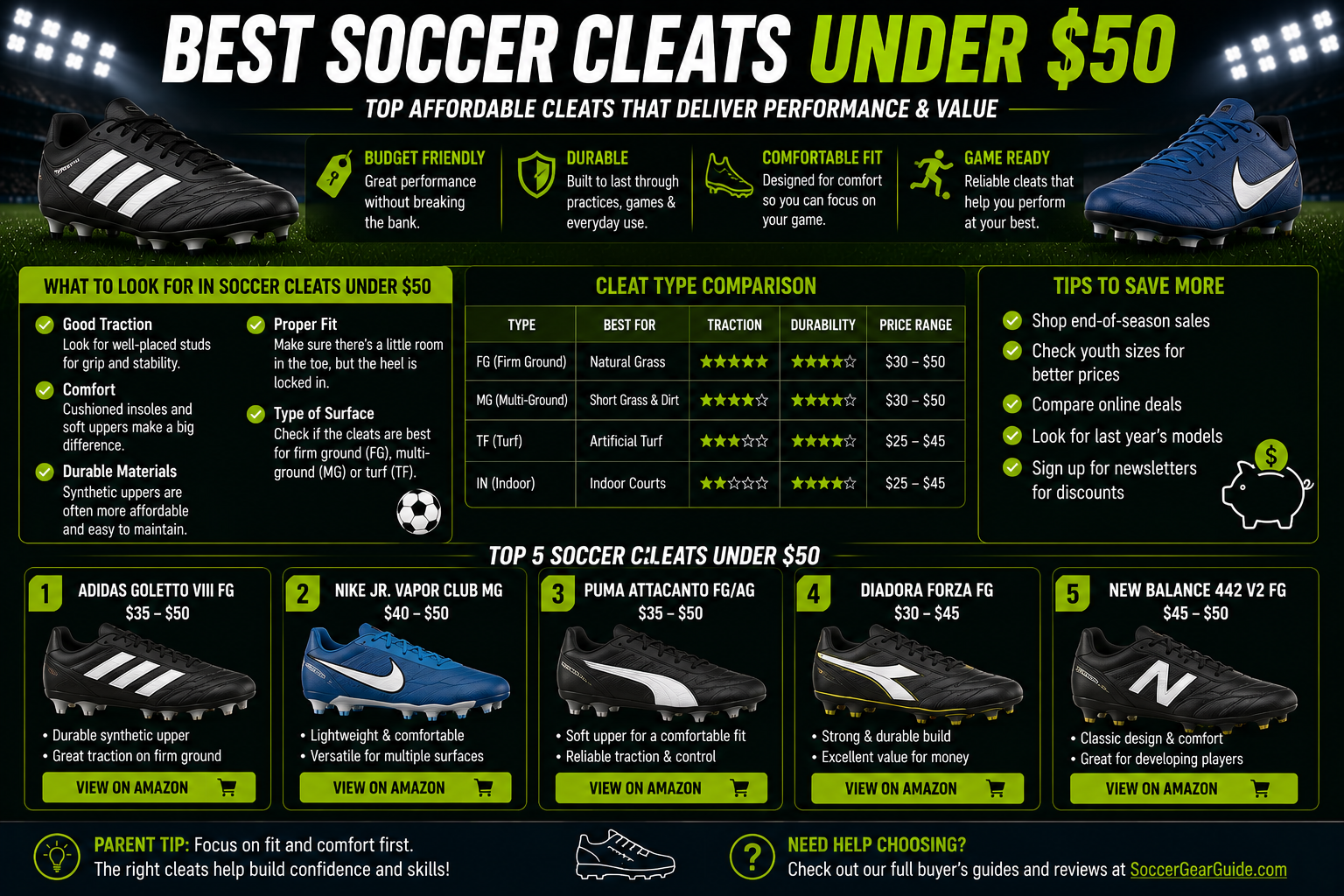
Adidas Goletto is one of the best overall budget cleats, Nike Jr. Legend Club is a strong Nike option, Adidas F50 Club works well for speed-focused players, and Puma Attacanto is worth comparing for comfort. The best choice is always the model that fits correctly and matches the playing surface.
Best Soccer Cleats Under $50 at a Glance
Budget cleats can be reliable when buyers prioritize fit, surface compatibility, comfort, and durability instead of premium branding. The strongest value choices are usually simple laced models from established cleat families.
| Pick | Best For | Main Strength | Main Tradeoff |
|---|---|---|---|
| Adidas Goletto | Beginners and recreational players | Simple durability and value | Heavier and less refined |
| Nike Jr. Legend Club | Players who prefer Nike fit | Comfort and familiar shape | Basic materials |
| Adidas F50 Club | Wingers and speed players | Speed-inspired profile | Narrower fit |
| Puma Attacanto | Comfort-focused buyers | Forgiving feel for the price | Less premium structure |
What Makes a Good Budget Soccer Cleat?
A good cleat under $50 needs to hold the foot securely, match the playing surface, and remain comfortable through a full practice. Premium knit, carbon plates, and professional-level finishes are optional; correct fit is not.
At this price, simple construction can be an advantage. Thicker synthetic uppers may feel less refined, but they can handle rough youth use and repeated training.
- Correct size and width
- Right outsole for the main field
- Secure heel and midfoot
- Comfortable toe box
- Stable stud pattern
- Durable upper and sole bond
Best Overall: Adidas Goletto
Adidas Goletto is one of the easiest budget cleats to recommend because it is affordable, practical, and widely available. It works especially well for beginners, recreational players, school teams, and children who may outgrow their shoes quickly.
The upper is usually thicker than premium models, and the soleplate is simple rather than highly responsive. Those tradeoffs are acceptable for players who mainly need dependable traction and a stable fit.
| Best For | Why It Works | Watch For |
|---|---|---|
| Beginners | Straightforward fit and construction | May feel stiff initially |
| Growing kids | Low replacement cost | Do not oversize |
| Recreational leagues | Reliable basic traction | Check outsole label |
| Value buyers | Strong price-to-use ratio | Less refined touch |
Best Nike Option: Nike Jr. Legend Club
Nike Jr. Legend Club is a strong option for players who prefer Nike sizing and want a familiar laced entry-level cleat. It is suitable for practices, games, and first-time players who value comfort.
The Club version is not the same as Academy, Pro, or Elite. Materials are simpler and the outsole is less responsive, but the basic shape may fit some players better than competing models.
Related comparison: Adidas Goletto vs Nike Legend Club.
Best Budget Speed Cleat: Adidas F50 Club
Adidas F50 Club gives youth players a speed-inspired profile without premium pricing. It suits wingers, forwards, and players who prefer a slimmer shape.
The Club tier is heavier and less flexible than higher F50 levels, but the design still offers an attacking feel. Wide-footed players should try it carefully.
Helpful guide: Adidas F50 Sizing Guide.
- Best for narrow or average feet
- Good for wingers and forwards
- Affordable alternative to premium speed cleats
- Laced versions provide better adjustment
- Choose the correct outsole
Best Comfort Value: Puma Attacanto
Puma Attacanto is worth comparing when Nike or Adidas budget models feel too narrow or stiff. It offers an affordable route into Puma and can work well for beginners and recreational players.
Fit still varies by exact model, so buyers should not assume every Puma cleat is automatically wide.
Budget Cleats by Position
| Position | Best Budget Profile | Why |
|---|---|---|
| Goalkeeper | Stable heel and balanced traction | Supports lateral movement |
| Center back | Durable upper and secure lockdown | Handles tackles and blocks |
| Fullback | Balanced comfort and speed | Supports repeated sprinting |
| Midfielder | Comfort-focused fit | Reduces fatigue |
| Winger | Light speed-inspired model | Supports acceleration |
| Forward | Secure forefoot and responsive outsole | Supports cuts and shooting |
Best Under-$50 Cleats for Kids
Kids are often ideal candidates for budget cleats because their feet grow quickly. Spending heavily on premium footwear makes less sense when a child may need a new size within months.
Parents should buy the size that fits now. A lower-priced cleat that fits correctly is better than an expensive cleat bought too large.
Related guide: Best Soccer Cleats for Kids.
Best Under-$50 Cleats for Beginners
Beginners need confidence more than elite technology. A comfortable laced cleat with a stable outsole allows the player to focus on learning the game.
- Choose laces for adjustment
- Avoid ultra-narrow shapes when fit is uncertain
- Use MG for mixed outdoor schedules
- Use TF for short turf
- Break in gradually
Best Under-$50 Cleats for Wide Feet
Wide-footed players should avoid choosing only by price or brand. Some budget speed cleats combine a narrow last with a stiff synthetic upper, creating painful pressure.
Look for rounder toe boxes, traditional lacing, and flexible materials. Related guide: Best Soccer Cleats for Wide Feet.
Best Under-$50 Cleats for Narrow Feet
Narrow-footed players may appreciate speed-inspired Club models. The key is secure heel and midfoot lockdown without toe compression.
Do not size down merely to create a tighter fit.
FG, AG, MG, Turf, and Indoor Options
Surface guide: FG vs AG Soccer Cleats.
| Outsole | Use It On | Budget Advice |
|---|---|---|
| FG | Firm natural grass | Buy only if most use is grass |
| AG | Artificial grass | Better for frequent synthetic use |
| MG / FG-MG | Mixed outdoor fields | Best one-pair compromise |
| TF | Short hard turf | Excellent value for training centers |
| IC | Indoor courts | Required for flat indoor surfaces |
Are Budget Cleats Good on Artificial Grass?
They can be, but the outsole must be correct. An inexpensive AG or MG cleat is better than a premium FG-only cleat used repeatedly on synthetic grass.
Surface match affects comfort, stud pressure, traction, and durability.
Laced vs Laceless Budget Cleats
Laced cleats are usually the better choice under $50 because they allow pressure and lockdown adjustments. Cheap laceless designs may look modern but depend heavily on exact foot shape.
| Feature | Laced | Laceless |
|---|---|---|
| Adjustment | Strong | Limited |
| Lockdown | Customizable | Shape-dependent |
| Value | Usually better | Often style-driven |
| Beginner suitability | Excellent | Mixed |
Club vs Academy vs Pro vs Elite
Budget cleats are usually Club or entry-level models. Academy or League tiers sometimes fall under $50 during sales. Pro and Elite rarely do unless heavily discounted.
| Tier | Strength | Tradeoff |
|---|---|---|
| Club | Lowest cost and simple durability | Heavier and less refined |
| Academy / League | Better balance | Often above $50 |
| Pro | Improved materials | Higher price |
| Elite | Lightest and most advanced | Highest price |
When a Sale Is Better Than a Cheap Model
A previous-generation Academy or League cleat can be better value than a current Club model when discounted below $50. Buyers may get softer materials, better lockdown, and a stronger soleplate for the same money.
Verify size, outsole, and return policy before purchasing a clearance pair.
How Budget Cleats Usually Feel
Entry-level cleats often feel stiffer, thicker, and heavier than premium versions. The upper may take longer to soften and the soleplate may flex less naturally.
For many kids and recreational players, the durability of thicker synthetic construction is useful.
Durability Under $50
Durability depends on field surface, frequency, fit, and care. Budget cleats can last well when used correctly. Artificial grass, pavement, toe dragging, and oversized fit accelerate damage.
- Avoid long walks on concrete
- Remove dirt and infill
- Air-dry away from heat
- Rotate pairs when training often
- Replace cracked studs or plates
How Long Should Budget Cleats Last?
These are general expectations rather than guarantees.
| Use Pattern | Possible Lifespan | Main Limiting Factor |
|---|---|---|
| One session weekly | One season or longer | Growth or outsole wear |
| Two to three sessions | Several months to a season | Surface and upper separation |
| Four or more sessions | May wear faster | Heavy repetition |
| Rapidly growing child | Often outgrown first | Foot growth |
How Budget Cleats Should Fit
The heel should remain secure, the midfoot should feel supported, and the toes should not strike the front. A little natural toe room is acceptable, but the foot should not slide.
Use the Soccer Cleat Size Chart and Should Soccer Cleats Be a Size Bigger?.
Common Buying Mistakes
- Buying too large for growth
- Choosing the wrong outsole
- Ignoring width and heel fit
- Buying by color
- Expecting elite-level weight
- Using FG on short turf
- Choosing cheap laceless models without testing
- Keeping painful cleats because they were discounted
- Ignoring return policies
- Assuming brand sizes match
Budget Cleat Myths
Cheap does not automatically mean unusable, and premium does not automatically mean better fit. Professional players wear sponsored products under very different conditions from youth and recreational players.
The most important truth is that correct fit and surface compatibility matter at every price.
When to Spend More Than $50
Spending more makes sense when a player trains frequently, has difficult fit needs, needs a dedicated AG outsole, or repeatedly wears through entry-level models.
Move up for a clear reason such as comfort, fit, surface match, or durability—not branding alone.
When Staying Under $50 Makes Sense
- The player is new
- The child is growing quickly
- The schedule is recreational
- The pair is a backup
- A second surface-specific shoe is needed
- A previous-generation model is discounted
- Multiple siblings need cleats
How to Shop Sales Without Mistakes
A large discount is not useful when the shoe is the wrong width or surface type. Compare the exact model tier, outsole label, and return policy.
- Search previous colorways
- Compare Club with discounted Academy models
- Check youth and adult sizing
- Verify outsole code
- Avoid final sale unless fit is known
Best Budget Strategy for Growing Kids
Buy the correct size now and recheck fit every few months. Keep a small replacement budget instead of buying oversized shoes.
For mixed surfaces, MG may be more cost-effective than separate FG and AG pairs.
Maintenance Guide
| Task | How Often | Why |
|---|---|---|
| Brush off dirt and infill | After every session | Prevents abrasion |
| Air-dry naturally | After wet use | Protects glue |
| Inspect studs | Weekly | Finds cracks |
| Check fit | Monthly for kids | Prevents undersizing |
| Clean insoles lightly | As needed | Reduces odor |
Budget Cleats for Defenders
Defenders need stability more than minimum weight. A durable upper can help when blocking shots and entering tackles, while secure heel lockdown supports lateral recovery steps. Budget defenders should avoid flimsy shoes that twist excessively.
Choose a balanced stud pattern and enough upper structure. The lightest cleat is not automatically the best defensive option.
Budget Cleats for Midfielders
Midfielders cover large distances and need comfort over ninety minutes or repeated youth games. A forgiving upper, stable outsole, and secure lacing matter more than a thin barefoot touch.
Comfort-focused entry models often work better than narrow speed shoes for central players.
Budget Cleats for Wingers
Wingers may prefer a streamlined Club-tier speed model. The shoe should feel secure during acceleration and sharp cuts without crushing the forefoot.
A correctly fitted F50 Club-style option can provide the desired profile without premium cost.
Budget Cleats for Goalkeepers
Goalkeepers need lateral stability, clean push-off, and comfortable fit for repeated set positions. A balanced FG or MG outsole is often more practical than an aggressive speed plate.
The upper should also feel secure when striking long passes and goal kicks.
Budget Cleats for Recreational Adults
Adults playing once or twice per week can get excellent value from entry-level models. Comfort and surface match matter more than having the latest silo.
Older players or those with sensitive feet should prioritize cushioning, width, and stud pressure.
Budget Cleats for School Teams
School teams often need affordable, durable shoes that can handle practices and games. Simple black or neutral colorways may also satisfy uniform rules.
Families should confirm the school field surface before buying.
Budget Cleats as a Backup Pair
An under-$50 pair can be an excellent backup for rain, travel, tournaments, or a second surface. Backup shoes should still fit correctly and be broken in before an emergency.
Keeping a reliable MG or TF pair can prevent last-minute problems.
Budget Cleats for Tournament Weekends
Multiple matches increase pressure, heat, and friction. Comfort becomes more important than small weight savings. Players should not wear a brand-new budget pair for the first time at a tournament.
Break them in gradually and bring an older trusted pair when possible.
How Socks Change Budget Cleat Fit
Sock thickness can change heel lockdown and forefoot pressure. Test cleats with the same grip socks or team socks used in matches.
Do not solve a poor fit by layering excessively thick socks.
How Insoles Affect Fit
Replacement insoles can improve cushioning, but they also reduce internal volume. A thick insole may make a correctly sized cleat feel tight.
Use insoles only when needed and retest heel and toe space.
Synthetic vs Textile Uppers Under $50
Most budget cleats use synthetic uppers because they are affordable and durable. Textile or knit elements may appear, but they are usually simpler than premium versions.
A soft synthetic upper is often the best compromise for value buyers.
Stud Pressure in Cheap Cleats
Simple soleplates can create noticeable stud pressure on hard fields. The wrong outsole exaggerates this problem.
Players on artificial grass should prioritize AG or MG even if another FG model looks cheaper.
Heel Lockdown and Blister Prevention
Heel movement creates friction and blisters. Laces should secure the midfoot without crushing the toes.
If the heel still lifts after proper lacing, choose a different model rather than a smaller size.
Breaking In Budget Cleats
Wear new cleats for short training periods before full matches. The upper may soften slightly, but painful pressure should not be treated as normal.
A correct cleat should feel reasonably comfortable from the start.
Cleaning Budget Cleats Properly
Use a soft brush, cool water, and mild soap when necessary. Avoid washing machines, dryers, heaters, and direct high heat.
Stuffing the shoes lightly with paper can help absorb moisture.
Recognizing False Economy
The cheapest pair is not good value if it causes pain, wears out immediately, or is wrong for the surface.
Sometimes spending a little more on the correct model prevents a second purchase.
Comparing Cost Per Use
A $45 cleat used comfortably for sixty sessions costs less per use than a $30 cleat replaced after fifteen sessions.
Evaluate expected use, growth, and durability—not price alone.
When Kids Outgrow Cleats
Check toe room, width, and heel fit after growth spurts. Children may complain about pressure or suddenly avoid wearing the shoes.
Replace cleats before cramped fit causes pain or altered movement.
Signs Budget Cleats Need Replacement
Cracked studs, sole separation, torn uppers, collapsed heel counters, and uneven outsole wear are clear replacement signs.
Do not continue using a shoe when traction becomes unpredictable.
Final Value Ranking
Adidas Goletto is the safest overall value recommendation, Nike Jr. Legend Club suits Nike-preferring players, F50 Club is the speed pick, and Puma Attacanto is the comfort alternative.
The final ranking should always be adjusted for fit and field surface.
How to Compare Two Budget Cleats in a Store
Start by removing price and color from the decision. Put both shoes on with match socks, lace them firmly, and compare heel movement, forefoot pressure, toe clearance, and soleplate flex. Walk, jog, and make small cuts if the store allows it. The model that feels more secure and natural is usually the better choice even if the other pair has a more famous name.
Check whether either shoe creates pressure on the little toe, arch, or heel. Budget uppers may not stretch much, so painful pressure should not be dismissed as normal break-in. A snug but comfortable fit is the goal.
How to Compare Online Reviews Carefully
Online reviews can reveal recurring problems, but they should be interpreted carefully. Look for patterns involving sizing, width, outsole separation, or comfort rather than relying on a single extreme review. Make sure the reviewer bought the same model tier and outsole because Club, Academy, FG, MG, and TF versions may differ.
Reviews from players with similar age, foot width, and surface use are more useful than general star ratings. Product photos can also help confirm whether the exact outsole matches the listing description.
Budget Cleats for Natural Grass
For firm natural grass, choose an FG or approved FG/MG outsole with molded studs. The studs should provide enough penetration for acceleration and braking without creating harsh pressure on dry, compact fields. Conical or mixed stud patterns can feel more forgiving for younger players.
Avoid buying turf shoes for full-size grass fields simply because they are cheaper. Turf outsoles may not provide enough bite, especially when the grass is wet or longer than usual.
Budget Cleats for Artificial Grass
Artificial grass is firmer and more abrasive than natural grass. A dedicated AG or MG budget cleat can provide better pressure distribution and durability than a traditional FG-only model. More studs and shorter geometry often reduce the harsh feeling under the forefoot.
If a child practices on AG several times per week, prioritize the correct outsole over a more fashionable upper. Surface compatibility can have a bigger effect on comfort than the difference between Club and Academy tiers.
Budget Cleats for Short Turf
Short, hard turf requires TF shoes with many small rubber nubs. These outsoles spread pressure across the foot and provide controlled grip on compact surfaces. Budget turf shoes are often excellent value because the outsole match matters more than premium upper technology.
Do not confuse modern artificial grass with short turf. A field with longer synthetic blades and infill usually needs AG or MG, while carpet-like training surfaces need TF.
Budget Indoor Soccer Shoes
Indoor soccer and futsal shoes use flat rubber outsoles designed for courts. Outdoor cleats should never be used indoors. Under $50, buyers can find practical indoor models with durable synthetic uppers and non-marking rubber soles.
Prioritize grip, toe reinforcement, and a secure heel. Indoor play creates frequent stopping and lateral movement, so a loose shoe can cause sliding and blisters.
How Playing Frequency Changes Value
A player practicing once per week may get excellent value from a basic Club model. A player training four or five times per week puts far more stress on the upper, outsole, and internal lining. In that case, a discounted Academy or League model may provide better long-term value even if it costs slightly more.
Estimate cost per use rather than judging price alone. A comfortable pair used for an entire season may be cheaper in practice than a very low-cost pair that fails early.
How Foot Shape Changes the Best Pick
Foot shape matters as much as length. Players with wide forefeet, high insteps, narrow heels, or flat arches may react differently to the same model. Traditional lacing is especially valuable in budget cleats because it allows more adjustment than a fixed laceless upper.
Try several brands when possible. Brand reputation is less important than finding a shape that holds the heel and gives the toes enough room.
How to Avoid Heel Blisters
Heel blisters usually come from movement, rough internal seams, or a poor sock combination. Lace the shoe securely from the bottom upward and make sure the heel sits fully back before tightening. Use the same socks for fitting that will be used in games.
If the heel still lifts, do not simply size down because that may crush the toes. A different model with a narrower heel cup is the better solution.
How to Avoid Toe Pressure
The toes should not hit the front during stopping or downhill walking. Budget synthetic uppers may soften slightly, but they rarely gain meaningful length. Persistent toe pressure is a sizing problem, not a break-in issue.
Check both feet because one is often slightly larger. Fit the larger foot and use lacing adjustments for the smaller side.
How to Break In Cleats Safely
Start with short sessions at home, then light training, before using new cleats in a full match. Increase wear time gradually while monitoring hot spots, heel movement, and toe pressure. The goal is to confirm fit, not force a painful shoe to become tolerable.
Avoid soaking cleats in hot water, using heaters, or bending the soleplate aggressively. Those shortcuts can damage glue, shape, and outsole integrity.
Budget Cleats for Rainy Conditions
Rain changes field grip but does not automatically require a different price tier. The outsole still matters most. On wet firm grass, FG studs can provide useful penetration, while TF shoes may slip. On synthetic fields, AG or MG remains the appropriate choice.
Dry wet cleats naturally after play. Remove the insoles, loosen the laces, and allow airflow. Direct heat can cause separation and material warping.
Budget Cleats for Hot Artificial Turf
Synthetic fields can become extremely hot in direct sun. Heat increases foot fatigue and can make stiff soleplates feel harsher. A correctly designed AG or MG outsole with distributed pressure is especially valuable under these conditions.
Players should use moisture-managing socks, hydrate properly, and avoid leaving cleats inside hot vehicles where glue and materials can weaken.
How Colorways Affect Price
Cleat prices often drop because a colorway is being replaced, not because the shoe is defective. This creates opportunities to buy a better model under $50. Performance is usually identical across colors within the same exact model and outsole.
Confirm that the listing is not a different tier disguised by similar graphics. Club, Academy, League, Pro, and Elite versions can share nearly identical color schemes.
How Previous-Generation Models Create Value
When a new generation launches, retailers often discount the previous version. These older models may still offer excellent fit, traction, and materials. For value buyers, this can be the best route to an Academy or League cleat under $50.
Check manufacturing age, return policy, and outsole condition. Very old stock stored poorly can have dried glue or stiff materials, although this is uncommon from reputable sellers.
Budget Cleats for Multiple Children
Families buying for several children should prioritize models with predictable sizing and easy returns. Keep notes on each child’s brand, size, width, and preferred outsole. This makes future purchases faster and reduces costly mistakes.
Do not automatically hand down cleats if the outsole is worn unevenly or the upper has molded to another player’s foot. Inspect every pair before reuse.
Are Used Cleats a Better Value?
Used cleats can save money, but they require careful inspection. Look for cracked studs, sole separation, compressed insoles, heel wear, and odor. A heavily molded upper may fit the previous owner rather than the new player.
For young beginners, a new budget cleat is often safer and more comfortable than a worn premium model.
Budget Cleats and Orthotics
Players using orthotics or custom insoles need enough internal volume. Removing the factory insole may be necessary, but the replacement should sit flat and keep the heel secure. Some narrow speed models become too tight with thicker orthotics.
Bring the orthotic when trying shoes and test the complete setup. Do not assume a larger size will solve a volume problem.
How to Store Cleats Between Seasons
Clean the shoes, remove loose dirt, dry them completely, and store them in a cool ventilated place. Do not leave them in a sealed wet bag, hot garage, or car trunk. Stuffing them lightly with paper can help preserve shape.
Before the next season, inspect the glue lines, studs, upper, and fit. Children may have outgrown stored cleats even when the shoes still look new.
Final Decision Framework
Choose the surface first, then the correct size and width, then compare comfort, lockdown, durability, and price. Brand, color, and professional endorsements should come last. This order prevents most expensive mistakes.
For most beginners and growing kids, Adidas Goletto, Nike Jr. Legend Club, Adidas F50 Club, and Puma Attacanto provide useful starting points. The best final choice is the pair that fits the individual player and field.
Budget Cleats for Different Training Loads
A player who attends one recreational practice each week places very different demands on footwear than an academy player training five times weekly. Light-use players can often rely on basic Club models for an entire season. High-use players create repeated flex, heat, sweat, and outsole stress, so a slightly better tier may reduce replacement frequency.
Parents should estimate weekly hours, surface type, and expected growth. If the child is likely to outgrow the shoes quickly, staying under $50 is sensible. If the player will accumulate hundreds of training hours, a discounted mid-range pair may deliver better comfort and cost per use.
Budget Cleats for Coaches Buying Team Gear
Coaches purchasing cleats for several players should avoid choosing a single size formula or model for everyone. Collect each player’s current size, width, and primary field surface. When possible, order from a seller with simple exchanges because youth sizing errors are common.
Neutral colors, traditional lacing, and MG outsoles are practical for team purchases. However, players with very wide or narrow feet may still need different models. Team consistency should never override safe fit.
How to Evaluate Soleplate Flex
A soleplate should bend naturally near the forefoot while remaining stable through the midfoot. Extremely rigid budget plates can feel harsh, while overly soft plates may lack support. Hold the shoe at the heel and forefoot and apply gentle pressure rather than twisting it aggressively.
Youth players generally benefit from a moderate, forgiving flex. The soleplate should not crack, crease sharply, or separate from the upper. Different outsole versions of the same model may flex differently, so test the exact FG, MG, AG, or TF version being purchased.
How to Evaluate Upper Quality
Inspect stitching, bonding, lace eyelets, toe reinforcement, and the connection between the upper and outsole. A budget upper can be simple and still be well constructed. Uneven glue, loose stitching, or sharp internal seams are warning signs.
Press the forefoot gently to judge flexibility. A slightly padded synthetic upper may be more comfortable for beginners than a very thin, stiff speed upper. The upper should return to shape and hold the foot without excessive wrinkling.
How to Evaluate Traction Before a Match
New cleats should be tested in training before competition. Begin with jogging, acceleration, controlled stops, and gentle changes of direction. The player should feel enough grip without the studs catching or the foot sliding inside the shoe.
If traction feels wrong, confirm the field surface and outsole label. Do not assume the problem is simply because the shoe is inexpensive. Even premium cleats perform poorly on the wrong surface.
Budget Cleats and Player Confidence
Players perform better when they trust their equipment. A comfortable $40 cleat that feels stable can create more confidence than a $250 model that is narrow, painful, or wrong for the field. Young players especially need footwear they can forget about once the game starts.
Parents should listen when a child reports rubbing, pressure, slipping, or fear during cuts. These complaints often indicate a real fit or surface problem rather than resistance to new equipment.
Complete Under-$50 Purchase Plan
First identify the main field surface. Second measure both feet and confirm width. Third shortlist two or three laced models in the correct outsole. Fourth compare fit with match socks. Fifth inspect the outsole, upper, heel, and return policy. Finally, break the chosen pair in during short training sessions.
This process is more reliable than searching for one universal winner. Adidas Goletto, Nike Jr. Legend Club, Adidas F50 Club, and Puma Attacanto are useful starting points, but individual fit determines the real best value.
Final Verdict
The best soccer cleats under $50 are comfortable, correctly sized, and matched to the right surface. Adidas Goletto is a practical overall choice, Nike Jr. Legend Club is a solid Nike option, Adidas F50 Club suits speed-focused players, and Puma Attacanto offers good comfort value.
For beginners and growing kids, budget cleats often make more sense than premium models. For frequent competitive training, compare discounted Academy or League tiers before buying another entry-level pair.
Shop Soccer CleatsRelated Soccer Cleat Guides
Best Soccer Cleats Under $50 FAQ
Are soccer cleats under $50 good?
Yes. Many budget cleats work well for kids, beginners, recreational players, and fast-growing youth players when the fit and outsole are correct.
What are the best soccer cleats under $50 for kids?
Adidas Goletto, Nike Jr. Legend Club, Adidas F50 Club, and Puma Attacanto are strong budget options to compare by fit, surface, and availability.
Should beginners buy expensive soccer cleats?
Not usually. Beginners benefit more from correct sizing, comfort, and the right surface outsole than premium materials.
Do cheap soccer cleats last long?
Budget cleats can last a season or longer for many players, but heavy training, artificial grass, toe dragging, and poor care can shorten their life.
What matters most in budget soccer cleats?
Fit, width, comfort, heel lockdown, outsole type, and traction matter more than branding.
Are budget cleats good for competitive youth soccer?
They can be, although players training several times per week may eventually benefit from a discounted mid-range model.
Are Adidas Goletto cleats good for beginners?
Yes. Goletto is simple, affordable, durable, and widely available.
Are Nike Club cleats worth buying?
Nike Club models can be good value for players who like Nike fit and want an entry-level option.
Are Adidas F50 Club cleats good for speed players?
They provide a speed-inspired shape at a low price, though they are simpler than premium F50 models.
Are Puma Attacanto cleats good for wide feet?
Some players find them more forgiving than narrow speed cleats, but the exact fit should still be tested.
Can adults wear soccer cleats under $50?
Yes. Recreational adults can use budget cleats if the fit and outsole match their needs.
Are budget cleats heavier than expensive cleats?
Usually. Entry-level models often use thicker synthetic materials and simpler soleplates.
Do expensive cleats improve performance?
Premium cleats may improve weight, flexibility, and touch feel, but they do not replace skill or correct fit.
Should I buy cleats a size bigger for growth?
No. Oversized cleats can cause sliding, blisters, poor touch, and instability.
What outsole should I choose under $50?
Choose FG for natural grass, AG or MG for artificial grass, TF for short turf, and IC for indoor courts.
Are FG/MG cleats good for mixed youth schedules?
Yes. They are often the most practical one-pair solution for mixed outdoor fields.
Can budget cleats be used on artificial grass?
Only when labeled AG, MG, or approved FG/MG. Traditional FG-only studs may feel harsh or wear faster.
How should budget soccer cleats fit?
They should feel snug through the heel and midfoot without painful pressure or excessive toe movement.
Are laced budget cleats better than laceless budget cleats?
At lower prices, laces usually provide more reliable adjustment and lockdown.
How often should kids replace budget cleats?
Replace them when outgrown, cracked, separated, worn unevenly, or uncomfortable.
Can I find premium cleats under $50 on sale?
Sometimes. Clearance colors and previous-generation models may drop below $50.
What is the best cleat under $50 for wide feet?
Comfort-oriented models with flexible uppers and rounder toe boxes are usually better than narrow speed shapes.
What is the best cleat under $50 for defenders?
A durable upper, stable soleplate, and secure heel are more important than minimum weight.
What is the best cleat under $50 for wingers?
A speed-inspired club model can work well when the fit is secure.
Are cheap turf shoes worth it?
Yes. Budget turf shoes can be excellent on short, hard artificial surfaces.
Can one pair under $50 cover every surface?
No. MG can cover many outdoor surfaces, but short turf and indoor courts need different outsoles.
As an Amazon Associate, we may earn from qualifying purchases at no extra cost to you.