
FG vs AG Soccer Cleats
FG and AG soccer cleats are built for different playing surfaces. FG cleats are designed for firm natural grass, while AG cleats are designed for modern artificial grass. The outsole choice changes traction, underfoot pressure, stud release, durability, comfort, and how controlled the shoe feels during cuts, sprints, stops, tackles, and repeated training sessions.
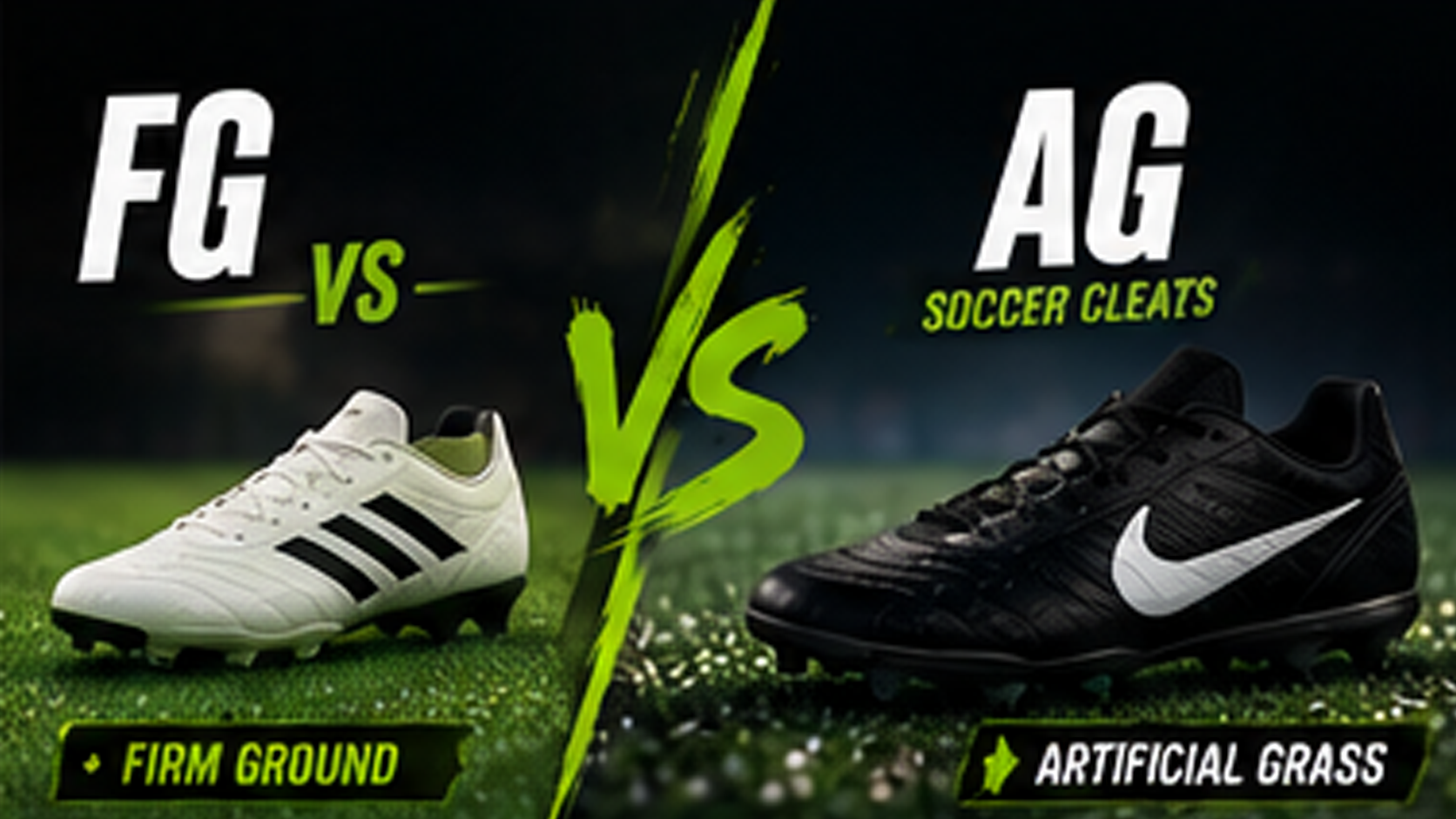
FG cleats are best for natural grass fields. AG cleats are best for artificial grass fields. If your child plays mostly on synthetic grass, AG or MG cleats are usually better than traditional FG cleats. If your player switches between grass and artificial grass, MG cleats can be the most practical choice.
FG vs AG Soccer Cleats at a Glance
FG vs AG Soccer Cleats Quick Comparison
| Feature | FG Soccer Cleats | AG Soccer Cleats |
|---|---|---|
| Best Surface | Natural grass | Artificial grass |
| Stud Design | Longer molded studs for grass and soil | Shorter, more evenly spread studs for synthetic grass |
| Grip Feel | Strong bite on firm natural fields | Controlled grip on artificial grass |
| Pressure Under Foot | Can feel aggressive on synthetic surfaces | Usually spreads pressure more evenly |
| Best Buyer | Players mostly on natural grass | Players mostly on artificial grass |
| Youth Soccer Tip | Good if league games are on grass | Better if practices and games are mostly synthetic |
What Parents Should Check First
Buy cleats for the surface your child uses most often, not the rarest field.
FG studs are usually longer; AG studs are usually shorter and more evenly spread.
If cleats feel harsh under the foot on synthetic fields, the outsole may be wrong.
MG cleats can be useful for kids who play on both grass and artificial grass.
What Are FG Soccer Cleats?
FG stands for firm ground. Firm ground soccer cleats are made for natural grass fields that are dry, short, and not too muddy. They are one of the most common outdoor soccer cleat types for kids, youth players, high school players, and adult players.
FG cleats usually have molded studs that dig into grass and soil. This helps players sprint, stop, cut, pass, shoot, and change direction on natural fields. On the right surface, FG cleats can feel stable and responsive.
- Best for natural grass soccer fields.
- Good for outdoor games and practices on firm grass.
- Usually stronger grip than turf shoes on grass.
- Common choice for youth soccer leagues.
- Not always ideal for artificial grass or hard turf.
Helpful guide: Best Soccer Cleats for Firm Ground.
What Are AG Soccer Cleats?
AG stands for artificial grass. AG soccer cleats are made for synthetic grass soccer fields. These fields can be firmer than natural grass and may create more pressure under the foot if players use the wrong stud pattern.
AG cleats usually use shorter or more evenly distributed studs. This helps reduce pressure, avoid overly aggressive grip, and make the cleat feel more stable on synthetic surfaces.
- Best for artificial grass soccer fields.
- Usually more comfortable than FG on synthetic grass.
- Designed to spread pressure more evenly.
- Good for players who train mostly on AG fields.
- Often safer-feeling for repeated cutting on artificial grass.
Helpful guide: Best Soccer Cleats for Artificial Grass.
Natural grass = FG cleats
Artificial grass = AG or MG cleats
Short turf = TF turf shoes
Indoor court = IC indoor soccer shoes
Can Kids Wear FG Cleats on AG Fields?
Some kids wear FG cleats on artificial grass, especially when the cleats are labeled FG/MG or multi-ground. But traditional FG cleats are not always ideal for synthetic fields.
On artificial grass, some FG studs can grip too aggressively, feel uncomfortable, or create more pressure under the foot. If your child plays most practices and games on artificial grass, AG or MG cleats are usually the smarter choice.
- FG/MG cleats may work on both grass and artificial grass.
- Traditional FG cleats can feel too aggressive on synthetic fields.
- AG cleats are usually better if the player mostly uses artificial grass.
- Turf shoes are better for short, hard artificial turf.
- Parents should check the outsole label before buying.
What Are MG Soccer Cleats?
MG stands for multi-ground. Multi-ground soccer cleats are designed to work on more than one outdoor surface, usually firm ground and artificial grass. For many youth players, MG cleats are a practical option because kids often practice and play on different fields.
MG cleats are not always perfect for every surface, but they can be a smart compromise for families who do not want to buy separate FG and AG cleats.
| Cleat Type | Best Surface | Best For |
|---|---|---|
| FG | Natural grass | Outdoor grass games and firm fields |
| AG | Artificial grass | Synthetic grass fields with longer blades and infill |
| MG | Mixed outdoor fields | Kids who play on both grass and artificial grass |
| TF | Short turf or hard artificial fields | Training centers, small-sided fields, and turf leagues |
| IC | Indoor court | Futsal and flat indoor surfaces |
FG vs AG vs MG vs TF vs IC
Soccer cleat surface labels can be confusing, but they matter. A shoe that is perfect for grass may feel uncomfortable on turf. A turf shoe may not grip enough on grass. The best option depends on the field your child uses most often.
| Label | Meaning | Use It On | Avoid On |
|---|---|---|---|
| FG | Firm Ground | Natural grass | Short turf and many synthetic fields |
| AG | Artificial Grass | Artificial grass fields | Indoor courts |
| MG | Multi-Ground | Grass and artificial grass | Indoor courts |
| TF | Turf | Short turf and hard artificial surfaces | Natural grass match fields |
| IC | Indoor Court | Flat indoor courts | Grass, AG, and turf fields |
FG vs AG Cleats for Youth Soccer
For youth soccer players, the best cleat is usually the one that matches the main field surface. Many parents buy cleats by color, brand, or price first, but surface type should come before all of that.
If a child plays on grass once per week but trains on artificial grass three times per week, AG or MG may be more practical than FG. If the child plays mostly outdoor league games on natural grass, FG can be the better choice.
- Buy for the surface used most often.
- Ask the club or coach what field type the team uses.
- Do not assume every outdoor field is natural grass.
- Use MG if the schedule is mixed.
- Use TF if the field is short, hard turf instead of modern artificial grass.
Best Cleat Surface Type by Player Situation
| Player Situation | Best Choice | Why |
|---|---|---|
| Mostly natural grass games | FG | Best traction for firm outdoor grass fields. |
| Mostly artificial grass practices | AG or MG | Better pressure distribution and traction on synthetic grass. |
| Equal grass and artificial grass | MG | Good compromise for mixed youth soccer schedules. |
| Short turf training center | TF | Rubber turf outsole is more comfortable on hard turf. |
| Indoor futsal court | IC | Flat outsole is made for court surfaces. |
| Beginner with unknown schedule | MG or ask the coach | Multi-ground can be practical if field type changes often. |
FG Cleats: Pros and Cons
| FG Cleats Pros | FG Cleats Cons |
|---|---|
|
Strong traction on natural grass Common and easy to find Good for outdoor league games Many models and price ranges |
Can feel aggressive on artificial grass May create more pressure on synthetic fields Not ideal for short turf Can wear faster on the wrong surface |
AG Cleats: Pros and Cons
| AG Cleats Pros | AG Cleats Cons |
|---|---|
|
Better for artificial grass Often spreads pressure more evenly Controlled grip on synthetic fields Good for players who train on AG often |
Less useful if the player only plays on natural grass Some models can be harder to find Not the same as turf shoes May not be needed for mixed schedules if MG works |
Common Mistakes Parents Make
- Buying FG cleats for every field: Not all soccer fields are natural grass.
- Ignoring surface labels: FG, AG, MG, TF, and IC shoes are different.
- Using aggressive studs on synthetic grass: This can feel uncomfortable and unstable.
- Buying too big: Loose cleats can cause slipping, blisters, and poor touch.
- Choosing by brand only: Surface compatibility matters more than the logo.
- Using turf shoes on grass: Turf shoes may not grip enough for natural grass games.
- Using indoor shoes outside: Indoor shoes are not made for grass or turf traction.
- Ignoring practice fields: Kids often spend more time practicing than playing games.
Signs Your Child Is Wearing the Wrong Surface Cleats
The studs feel harsh under the foot, especially on synthetic fields.
The cleat catches too aggressively during turns or cuts.
The player slips because the outsole does not match the field.
The studs or outsole wear down quickly from being used on the wrong surface.
Why the FG vs AG Choice Matters
The soleplate is the part of a soccer cleat that interacts with the ground. It determines how the shoe enters the surface, how quickly the studs release, how pressure is distributed under the foot, and how stable the player feels when changing direction. FG and AG outsoles are designed around different types of ground, so using the wrong one can change the entire feel of the cleat.
Natural grass gives way under pressure. Studs can enter soil and release as the player turns. Artificial grass is usually firmer and more consistent. It may provide less give beneath the studs, which can make a traditional FG pattern feel harsher or more aggressive. That is why AG patterns often use more studs, shorter studs, or shapes designed to distribute load and release more smoothly.
For parents, the simplest rule is to buy for the surface used most often. Practice matters as much as games. If a child trains three times per week on synthetic grass and plays one match on natural grass, AG or MG may be more practical than a traditional FG outsole.
How FG and AG Stud Patterns Differ
| Design Feature | FG Cleats | AG Cleats |
|---|---|---|
| Stud length | Usually longer for grass and soil penetration | Usually shorter for firmer synthetic surfaces |
| Stud count | Often fewer studs | Often more studs to spread pressure |
| Stud shape | Bladed, chevron, conical, or mixed | Often rounder, hollow, or less aggressive |
| Pressure distribution | Focused through fewer contact points | Spread across more of the outsole |
| Release on turns | Designed for natural ground give | Designed for controlled release on synthetic grass |
| Outsole durability | Best when used on natural grass | Built for repeated synthetic-field abrasion |
Not every brand uses the same formula. Some FG models use conical studs and may feel less aggressive than heavily bladed designs. Some AG models look similar to FG from a distance but use additional studs or different geometry. Always check the official outsole label instead of judging by appearance alone.
Traction, Pressure, and Stud Release
The outsole must grip enough for acceleration without feeling locked into the surface.
More contact points can reduce harsh stud pressure on firm synthetic fields.
Studs should disengage predictably when the player turns or pivots.
The foot should remain supported without excessive slipping or catching.
FG Cleats on Natural Grass
FG cleats are at their best on firm natural grass with enough soil give for the studs to enter and release. On this surface, longer molded studs provide traction for acceleration, stopping, and changing direction. The field does not need to be perfectly dry, but it should not be soft enough to require soft-ground studs.
The player should feel connected to the ground without excessive stud pressure. If the field is very hard, dry, or compacted, an aggressive FG soleplate may still feel uncomfortable. In those conditions, a conical FG or MG option may feel more forgiving.
AG Cleats on Artificial Grass
AG cleats are designed for synthetic grass systems with plastic blades and infill. These fields are usually firmer and more uniform than natural grass. AG outsoles aim to provide reliable grip without creating excessive bite or pressure.
The best AG cleats usually feel stable through repeated cuts and comfortable during long practices. They may also use materials designed to tolerate the additional heat and abrasion created by synthetic surfaces.
Can FG Cleats Be Used on Artificial Grass?
Some players use FG cleats on artificial grass, but suitability depends on the exact outsole and field. FG/MG models are specifically designed for mixed use and are different from traditional FG-only soleplates. Aggressive bladed FG studs may grip too strongly or create concentrated pressure on firm synthetic fields.
If a player uses artificial grass regularly, a dedicated AG or well-designed MG outsole is usually the better long-term choice. Occasional emergency use is not the same as repeated weekly training.
- Check whether the shoe is labeled FG, FG/MG, MG, or AG.
- Avoid assuming every molded outsole works on every outdoor field.
- Pay attention to harsh stud pressure.
- Watch for cleats catching during turns.
- Check the brand’s surface guidance and warranty language.
- Replace the outsole choice if discomfort appears repeatedly.
Can AG Cleats Be Used on Natural Grass?
Some AG cleats can work on firm natural grass, especially when the surface is dry and compact. However, AG studs may not penetrate soft or long grass as effectively as FG studs. The player may feel less bite during acceleration or cutting.
A dedicated AG shoe is best for synthetic fields. Players who use both surfaces equally may prefer MG. Players who compete mostly on natural grass usually receive better traction from FG.
FG vs AG for Youth Players
Choose based on where the child spends the most total playing time.
Do not oversize cleats simply to extend use across seasons.
Youth players should not ignore stud pressure or foot soreness.
MG can be practical when the schedule changes between grass and AG.
FG vs AG for Adult Players
Adult players generate more force through the outsole and may notice surface mismatch more clearly. Strong acceleration and cutting can make aggressive FG studs feel locked on artificial grass. Repeated synthetic use may also increase outsole wear.
Adults who train mostly on AG should consider a dedicated AG pair. Players with separate match and training shoes can keep FG for grass games and AG for synthetic practice.
FG vs AG for Wide Feet
Surface compatibility comes first, but width still matters. A player should not choose the correct outsole in a shoe that compresses the forefoot. Some AG models are built on the same upper as FG models, while others fit differently because of soleplate construction.
Try both the correct size and width. Artificial grass can feel harsh enough without adding pressure from an overly narrow upper. Wide-footed players may prefer flexible materials, rounder toe boxes, and less rigid soleplate edges.
FG vs AG for Speed Players
Speed players often prefer aggressive traction, but more bite is not always better. On natural grass, FG studs can create strong push-off. On artificial grass, a dedicated AG outsole can provide enough grip while releasing more predictably during high-speed turns.
The best speed cleat is the one that feels fast without feeling trapped. Players should test acceleration, deceleration, and curved runs rather than judging traction from straight-line sprints only.
FG vs AG for Defenders and Midfielders
Defenders and midfielders make frequent lateral movements, tackles, pivots, and recovery runs. Stud release is especially important. A soleplate that grips too aggressively may feel uncomfortable during repeated changes of direction.
On AG, more evenly distributed studs often provide a stable base for passing and defending. On natural grass, FG traction supports stronger push-off and stopping when the field has enough give.
FG vs AG by Playing Frequency
| Schedule | Best General Choice | Reason |
|---|---|---|
| Grass once per week | FG | Main use is natural grass |
| AG three or more times per week | AG | Comfort and durability on synthetic fields |
| Equal grass and AG | MG or separate pairs | Balanced versatility or best performance on each surface |
| Occasional turf center | TF as a separate pair | Short turf needs many small rubber studs |
| Indoor and outdoor | Separate IC and outdoor shoes | Flat courts require a different outsole |
What Are FG/MG Cleats?
FG/MG means the outsole is intended for both firm ground and multi-ground use. These models are often marketed as versatile options for natural grass and certain synthetic fields. The stud pattern usually tries to balance grass traction with more forgiving pressure distribution.
FG/MG is not identical to dedicated AG. Players training heavily on artificial grass may still prefer AG for comfort and durability. However, FG/MG can be a practical single-pair solution for mixed youth schedules.
What Are MG Cleats?
MG cleats are designed for multiple outdoor surfaces. They often use more studs than traditional FG models and may include rounder geometry. The goal is versatility rather than maximum traction on one surface.
MG works best for families and players who regularly switch fields and do not want separate pairs. The tradeoff is that a dedicated FG or AG outsole may perform better on its intended surface.
AG vs Turf Shoes
AG cleats and turf shoes are not the same. AG cleats use molded studs for modern artificial grass with longer synthetic blades and infill. Turf shoes use many small rubber nubs for short, dense, hard artificial surfaces.
A turf shoe usually feels more comfortable on hard carpet-like fields, but it may not provide enough grip on deeper artificial grass. An AG cleat can feel too aggressive on short turf.
| Feature | AG Cleats | TF Turf Shoes |
|---|---|---|
| Surface | Modern artificial grass | Short hard turf |
| Studs | Short molded studs | Many small rubber nubs |
| Traction | More bite in synthetic blades | Controlled grip on firm turf |
| Underfoot feel | More cleat-like | More cushioned and distributed |
| Best use | Full-field AG games and training | Training centers and small-sided turf |
Field Identification Guide
Real blades, soil, uneven wear, and visible dirt beneath the surface.
Long synthetic blades, rubber or sand infill, and a full-field system.
Dense carpet-like surface with very little blade depth.
Flat wood, vinyl, rubber, or sport-court flooring.
How Weather Changes the Best Outsole
Dry firm grass favors FG. Wet natural grass may require more traction, while very soft ground may call for SG where permitted. Artificial grass remains relatively consistent, but heat can make the surface hotter and increase underfoot discomfort.
Rain can reduce surface friction on both grass and AG. Players should not automatically switch outsole types without understanding the field. The key is whether the studs can enter, grip, and release safely.
FG vs AG Durability
Artificial grass is abrasive. The outsole, upper, and bonding around the sole may wear faster when a shoe is used repeatedly on synthetic fields. Dedicated AG models are often designed with this environment in mind.
FG cleats can show accelerated stud or soleplate wear on hard synthetic surfaces. Heat buildup may also affect materials. Rotating shoes and cleaning infill from the outsole can extend life.
How Surface Choice Affects Comfort
Comfort is not only about the upper. Stud pressure can make a well-fitting shoe feel painful. On firm artificial grass, fewer longer studs may create noticeable pressure points under the forefoot and heel.
AG and MG patterns often spread load across more contact points. Turf shoes distribute pressure even more broadly on hard surfaces. Players who experience recurring soreness should evaluate the outsole before changing insoles or sizing.
Signs the Outsole Is Wrong for the Field
Individual studs feel painful under the foot.
The shoe feels locked during turns.
The outsole cannot penetrate or grip the surface.
Studs or outsole edges break down unusually quickly.
How to Inspect Cleats After Surface Use
- Check studs for uneven wear.
- Look for cracks around the soleplate.
- Inspect glue lines and upper separation.
- Remove rubber infill and packed dirt.
- Check whether the soleplate has warped.
- Compare left and right stud wear.
- Replace cleats if traction becomes unpredictable.
Can One Pair Work for Every Surface?
No single outsole is ideal for natural grass, artificial grass, short turf, and indoor courts. MG can cover grass and some AG use, but turf and indoor surfaces still benefit from dedicated shoes.
For youth families with limited budgets, prioritize the main surface first. Add a second pair only when the schedule justifies it. A low-cost turf shoe plus a good FG/MG cleat can cover many common youth environments.
When Two Pairs Make Sense
Separate FG and AG pairs make sense when a player trains frequently on both surfaces and plays competitively. The player receives better traction on grass and better comfort on synthetic fields.
Two pairs also reduce wear because each shoe is used on its intended surface. Keep the fit and upper feel similar when possible so transitions between pairs are easy.
Best Choice by Budget
| Budget Situation | Best Strategy |
|---|---|
| One-pair budget, mostly grass | FG or FG/MG |
| One-pair budget, mostly AG | AG or MG |
| One-pair budget, mixed schedule | MG |
| Two-pair budget | Dedicated FG plus AG |
| Grass plus short turf | FG/MG plus TF |
| Outdoor plus indoor | Outdoor cleat plus IC shoe |
Warranty and Brand Guidance
Some brands provide specific surface-use guidance and may limit warranty coverage when a cleat is used on an unsupported field. Players should read product descriptions and care instructions before buying.
An outsole labeled FG only should not be assumed safe for every synthetic field. When the brand offers AG and FG versions of the same model, that is a strong sign that surface-specific use matters.
How to Choose FG vs AG for a Child
- Ask the coach what surfaces are used for practices and games.
- Count total weekly sessions on each surface.
- Choose the main surface before choosing color or tier.
- Check whether the outsole is FG, AG, MG, TF, or IC.
- Do not buy extra length to extend growth.
- Test for stud pressure during walking and jogging.
- Keep the receipt until the child tries the cleats on the field.
- Recheck fit and outsole wear during the season.
FG vs AG for Beginners
Beginners should choose the most forgiving outsole for the main field. The correct surface match supports confidence because the player can move without unexpected slipping or catching.
MG is often useful for beginners with mixed schedules. However, players on dedicated AG fields should still consider AG, and players on grass should use FG.
Common FG vs AG Buying Mistakes
- Buying by color before checking the outsole label.
- Assuming every outdoor field is natural grass.
- Using traditional FG on short turf.
- Confusing AG with TF.
- Ignoring practice surfaces.
- Choosing overly aggressive studs for hard fields.
- Using indoor shoes on outdoor synthetic fields.
- Assuming MG is identical to dedicated AG.
- Keeping cleats after studs wear unevenly.
- Ignoring brand surface guidance.
Final FG vs AG Buying Checklist
| Question | FG Answer | AG Answer |
|---|---|---|
| What surface is used most? | Natural grass | Artificial grass |
| How should studs feel? | Strong bite into soil | Controlled grip with distributed pressure |
| What if fields are mixed? | Consider MG or separate pairs | Consider MG or separate pairs |
| What if the field is short turf? | Use TF instead | Use TF instead |
| What if the shoe catches? | Outsole may be too aggressive | Check fit and stud pattern |
| What if pressure is harsh? | Try AG, MG, or TF for the surface | Check size, insole, and field type |
FG vs AG for Different Cleat Stud Shapes
Stud shape affects how a cleat enters and releases from the surface. Conical studs usually rotate more smoothly, while bladed and chevron studs can feel more aggressive during acceleration. On natural grass, that extra bite can be useful. On artificial grass, it may create a more locked-in feeling depending on the field and soleplate.
| Stud Shape | Typical Feel | Best Surface Match | Buying Note |
|---|---|---|---|
| Conical | Smoother rotation and balanced pressure | FG, AG, or MG depending on length and count | Often a forgiving option for mixed movement |
| Chevron | Strong acceleration and braking bite | Usually firm natural grass | Can feel aggressive on firm synthetic fields |
| Bladed | Directional grip and sharp traction | Firm natural grass | Check carefully before using on AG |
| Hollow AG studs | Pressure distribution and controlled release | Artificial grass | Designed specifically for synthetic surfaces |
| Many small rubber nubs | Broad, low-profile grip | Short hard turf | This is TF, not AG |
How Cleat Tier Affects FG and AG Availability
Elite, pro, academy, and club-level cleats do not always offer the same outsole options. A premium model may be available in dedicated AG, while a lower-priced version may use an FG/MG soleplate. Parents should not assume that every tier of the same cleat uses identical studs.
Check the product name and outsole label for the exact pair. Two shoes with similar colors and uppers may perform differently because one is FG and the other is MG or AG. Surface compatibility matters more than tier branding.
How Heat on Artificial Grass Changes Comfort
Artificial grass can become hot in direct sun. Heat may increase foot fatigue, soften certain materials, and make underfoot pressure more noticeable. AG outsoles with more contact points can feel more comfortable during long sessions than aggressive FG plates.
Players should wear moisture-managing socks, allow shoes to dry after use, and avoid leaving cleats in hot vehicles. Heat discomfort should not automatically be blamed on sizing; the outsole and field may be contributing.
FG vs AG for Tournament Weekends
Use FG and keep a backup option for wet or hard conditions.
Use AG to reduce repeated stud pressure across several matches.
MG is convenient, while separate FG and AG pairs provide the best match.
Ask the organizer before traveling and pack the most versatile approved option.
How to Pack Cleats for Mixed-Surface Travel
- Confirm field surfaces before leaving.
- Pack FG and AG separately when both are needed.
- Label each pair inside the bag.
- Carry a small brush for dirt and rubber infill.
- Let wet cleats dry before sealing the bag.
- Bring the same sock thickness used for fitting.
- Check studs and soleplates after every match.
- Do not rely on a brand-new untested pair for tournament day.
FG vs AG and Cleat Fit
A correct outsole cannot compensate for poor fit. Cleats should lock the heel, secure the midfoot, and leave appropriate toe room without sliding. Artificial grass often involves repeated hard cuts, so loose fit can create friction and instability.
Some players notice that an AG soleplate feels slightly stiffer or heavier than the FG version. Try the exact outsole instead of assuming both versions fit identically. The upper may be the same, but the plate can change flex and underfoot feel.
When to Replace FG or AG Cleats
Replace cleats when studs wear unevenly, the soleplate cracks, the upper separates, or traction becomes inconsistent. AG use can create visible abrasion around the toe and sole edge, while FG use may wear studs unevenly on hard dry grass.
Youth players may outgrow cleats before the outsole fails. Recheck fit during growth periods and do not continue using a pair that compresses the toes or allows the heel to lift.
Final Surface Decision Tree
| Question | Answer | Recommended Outsole |
|---|---|---|
| Is the field real natural grass? | Yes | FG |
| Is it long synthetic grass with infill? | Yes | AG |
| Are grass and AG used equally? | Yes | MG or separate FG and AG |
| Is the surface short and carpet-like? | Yes | TF |
| Is the surface a flat indoor court? | Yes | IC |
| Is the schedule unclear? | Yes | Ask the coach before buying |
Final Verdict: Should You Choose FG or AG Soccer Cleats?
FG and AG soccer cleats are not the same. FG cleats are best for natural grass, while AG cleats are best for artificial grass. For kids who play on both surfaces, MG cleats can be the smartest middle option.
The bottom line is simple: match the cleat to the main playing surface. Use FG for natural grass, AG for artificial grass, MG for mixed outdoor fields, TF for short turf, and IC for indoor courts.
Shop Soccer CleatsRelated Soccer Cleat Guides
FG vs AG Soccer Cleats FAQ
What does FG mean in soccer cleats?
FG means firm ground. FG cleats are designed primarily for firm natural grass fields with enough soil give for molded studs.
What does AG mean in soccer cleats?
AG means artificial grass. AG cleats are designed for modern synthetic grass fields with plastic blades and infill.
What is the main difference between FG and AG cleats?
FG cleats usually use fewer and longer studs for grass penetration, while AG cleats usually use more, shorter, or less aggressive studs to spread pressure on synthetic fields.
Can kids wear FG cleats on artificial grass?
Some FG/MG models can be used on certain artificial grass fields, but traditional FG-only cleats may feel too aggressive or create excess stud pressure.
Are AG cleats safer than FG cleats on artificial grass?
AG cleats are generally better matched to artificial grass because they are designed for controlled grip, stud release, and pressure distribution on synthetic surfaces.
Can AG cleats be used on natural grass?
Some AG cleats can work on firm dry grass, but FG usually provides better bite if natural grass is the main surface.
Are MG cleats good for kids?
Yes. MG cleats can be a practical single-pair option for children who regularly switch between natural grass and artificial grass.
Are FG/MG cleats the same as AG cleats?
No. FG/MG is a versatile mixed-surface design, while dedicated AG cleats are optimized specifically for artificial grass.
Are turf shoes the same as AG cleats?
No. Turf shoes use many small rubber nubs for short hard turf, while AG cleats use molded studs for deeper synthetic grass systems.
What should kids wear if they play on grass and AG equally?
MG cleats are the simplest one-pair solution. Separate FG and AG pairs provide better surface-specific performance when the budget allows.
Do FG cleats wear faster on artificial grass?
They can. Synthetic fields create more abrasion and may accelerate stud, outsole, or bonding wear.
Do AG cleats last longer on artificial grass?
AG models are usually built for repeated synthetic use and may provide better durability than FG-only outsoles on that surface.
Why do FG cleats hurt on artificial grass?
Fewer longer studs can concentrate pressure on a firm synthetic base, making individual stud points feel harsh.
Why can FG studs feel stuck on AG?
Some aggressive stud shapes may grip synthetic fibers strongly and release less smoothly during turns.
Can AG cleats be used on turf?
Dedicated AG cleats are usually not ideal for short hard turf. TF shoes are better for carpet-like surfaces.
What is the best outsole for beginners?
Beginners should choose based on the main surface. MG is useful for mixed outdoor schedules, FG for grass, AG for synthetic grass, TF for short turf, and IC for indoor courts.
How can parents identify an artificial grass field?
Artificial grass usually has synthetic blades, rubber or sand infill, and a uniform full-field appearance.
Should practice surface matter more than game surface?
The player should buy for the surface used most overall. Frequent practices can matter more than occasional matches.
Can one pair work for every field?
No. MG can cover many outdoor grass and AG situations, but short turf and indoor courts still require different outsoles.
When should a player buy separate FG and AG pairs?
Separate pairs make sense when the player uses both surfaces frequently, competes seriously, or experiences comfort and traction problems with one versatile outsole.
Do cleat brands label outsoles clearly?
Most brands mark FG, AG, MG, TF, or IC in product descriptions or on the shoe box. Always verify before buying.
What is better for artificial grass: AG or MG?
Dedicated AG is usually better for frequent synthetic use. MG is better when the player needs one pair for both grass and AG.
As an Amazon Associate, we may earn from qualifying purchases at no extra cost to you.