
Adidas F50 Soccer Cleats Guide
Adidas F50 soccer cleats are built for speed, acceleration, lightweight movement, and attacking players who want a close, direct feel. This complete hub explains F50 Elite, Pro, League, Club, Messi editions, old F50 models, fit, sizing, surfaces, positions, comparisons, durability, and buying advice.
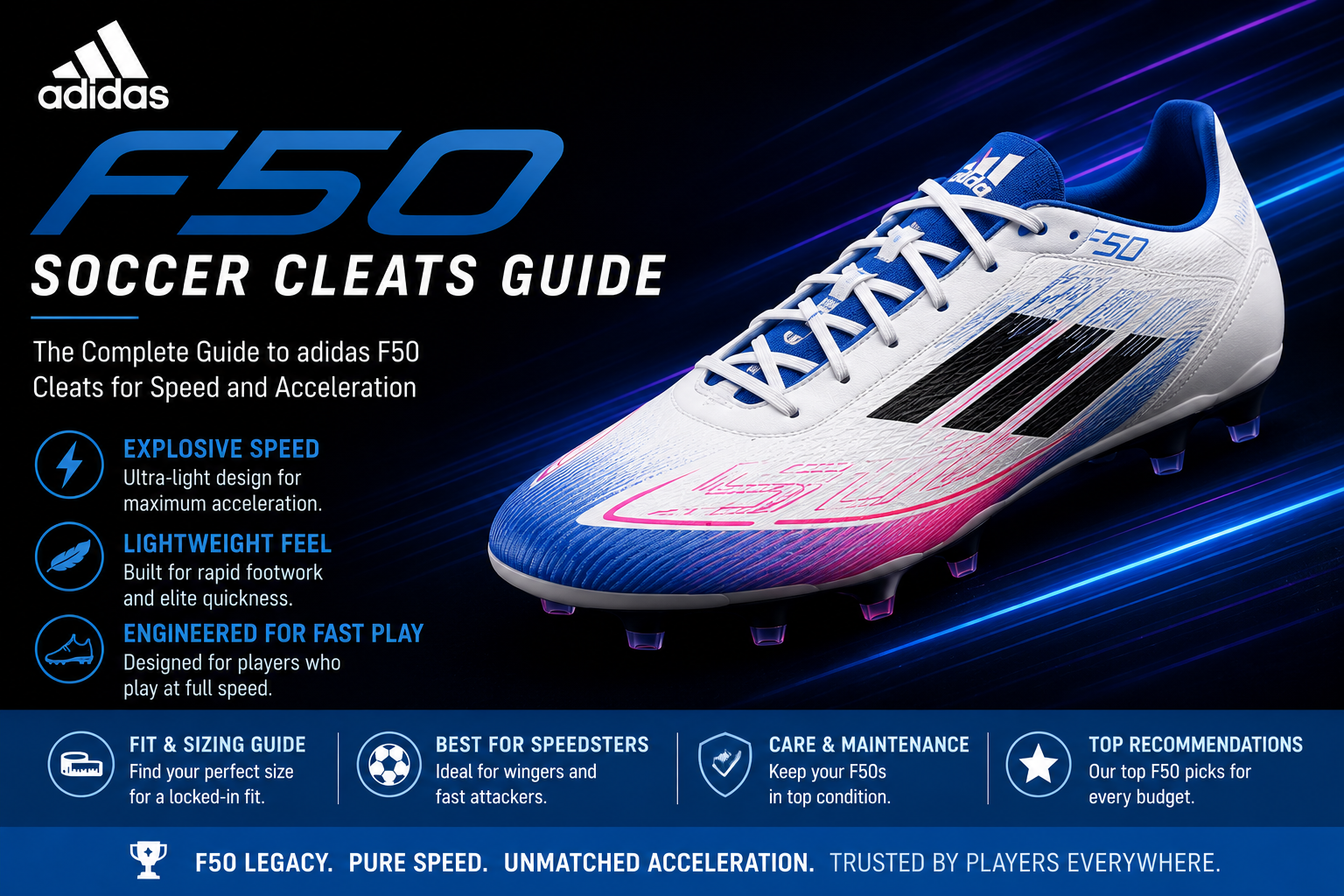
Adidas F50 is best for players who want a lightweight speed cleat with a snug fit. F50 League is usually the best value, Pro suits competitive club players, and Elite is for advanced players who prioritize the lightest and most responsive construction. Always choose the correct outsole and confirm the fit before moving up tiers.
What Are Adidas F50 Soccer Cleats?
Adidas F50 is the brand’s speed-focused soccer-cleat family. The line is built around a lightweight feel, quick acceleration, aggressive movement, and a close connection between the foot and the ball. Players who like to attack space, sprint repeatedly, and change direction quickly are the natural audience.
The F50 name also carries history. Many players remember F50 Adizero, Messi editions, numbered generations, and the later evolution of Adidas speed boots. That long identity matters because the modern F50 is not just a single product; it is a complete speed silo with multiple tiers, surface types, youth versions, and fit options.
This hub connects the full F50 topic cluster, including Adidas F50 Sizing Guide, Best Adidas F50 Cleats, Adidas F50 for Wingers, and F50 League vs Pro vs Elite.
Adidas F50 at a Glance
Adidas F50 Models Explained
| Model or Tier | Best For | Main Strength | Main Tradeoff |
|---|---|---|---|
| F50 Elite | Advanced competitive players | Lowest weight and premium materials | Highest price and less forgiving value |
| F50 Pro | Serious club players | Strong performance without full Elite cost | Still expensive compared with League |
| F50 League | Youth, club, and recreational players | Best balance of value and speed feel | Heavier and less refined than Elite |
| F50 Club | Beginners and budget buyers | Lowest entry price | Basic upper and soleplate |
| F50 Messi | Messi fans and agile attackers | Signature identity and creative-player appeal | May prioritize styling over value |
| F50 Adizero | Collectors and longtime F50 fans | Classic lightweight heritage | Older pairs may not be safe for regular play |
F50 Elite vs Pro vs League vs Club
Tier selection should be based on playing frequency, budget, durability needs, and how certain the player is about the fit. Elite is not automatically the smartest purchase. A player who trains frequently on abrasive artificial grass may get better value from Pro or League.
| Tier | Upper Feel | Soleplate | Weight | Best Buyer |
|---|---|---|---|---|
| Elite | Thinnest and most responsive | Most aggressive | Lightest | Advanced players |
| Pro | Performance-focused | Responsive | Light | Competitive club players |
| League | More structured and durable | Balanced | Moderate | Most youth and adult players |
| Club | Basic synthetic | Simple molded outsole | Heaviest | Beginners and backups |
Read the full comparison: Adidas F50 League vs Pro vs Elite.
Who Should Wear Adidas F50?
F50 is best for players who want the cleat to feel fast, close, and direct. Position matters less than playing style. A quick center back may like F50 more than a slow winger, while a technical midfielder may prefer Predator or Copa.
- Players who rely on acceleration.
- Wingers who attack defenders in space.
- Strikers making runs behind the back line.
- Fullbacks covering long distances.
- Attacking midfielders who want a light boot.
- Youth players who enjoy speed-cleat styling.
Who May Prefer Another Cleat?
F50 may not be ideal for players who want a wide, padded, or highly protective fit. Players with sensitive feet, very wide forefeet, or a preference for leather-like comfort may be happier in another Adidas silo.
For structure, grip, passing, and striking feel.
For comfort, softness, and a more traditional touch.
For speed, low weight, and streamlined movement.
When Nike Mercurial or Puma Ultra fits better.
How Adidas F50 Cleats Fit
F50 generally uses a snug speed-boot shape. The heel and midfoot should feel locked in, while the forefoot should hold the foot securely without painful pressure. The toes should not be crushed or forced to curl.
Because fit changes across generations and tiers, the exact model matters. Elite and Pro versions may feel thinner and more anatomical, while League and Club can feel more structured.
Use the Adidas F50 Sizing Guide and How to Fit Soccer Shoes before buying.
Adidas F50 Sizing Guide
| Fit Area | Correct Feel | Warning Sign |
|---|---|---|
| Heel | Secure with minimal lift | Sliding or rubbing |
| Midfoot | Snug and supported | Numbness or strong pressure |
| Forefoot | Close but comfortable | Sidewall pinching |
| Toes | Natural movement with little excess space | Crushed toes or large empty gap |
| Upper | Smooth without folds | Bunching from oversizing |
Are Adidas F50 Cleats Good for Wide Feet?
F50 is not the first recommendation for very wide feet because the line emphasizes a streamlined shape. Some slightly wide-footed players can wear F50 successfully, especially if the upper is flexible and the lacing allows adjustment.
Very wide players should compare the F50 with Best Soccer Cleats for Wide Feet and Best Kids Soccer Cleats for Wide Feet.
Are Adidas F50 Cleats Good for Narrow Feet?
Narrow-footed players are often a natural match for F50. The close heel and midfoot can reduce internal movement and improve confidence during quick cuts.
However, a narrow player should not size down excessively. Use laces and the correct shape rather than forcing a smaller length.
Laced vs Laceless Adidas F50
| Feature | Laced F50 | Laceless F50 |
|---|---|---|
| Adjustment | More customizable | Depends on exact foot shape |
| Lockdown | Easier to tune | Can feel clean and seamless |
| Best For | Most players | Players who already know laceless fits them |
| Risk | Pressure from overtightening | Insufficient lockdown if upper does not match foot |
Adidas F50 Surface Types
The outsole matters as much as the upper. A perfect-fitting F50 with the wrong stud pattern can feel uncomfortable, unstable, or overly aggressive.
| Surface | F50 Outsole | Best Use |
|---|---|---|
| Firm natural grass | FG | Dry to moderately firm grass |
| Artificial grass | AG | Modern synthetic fields |
| Mixed outdoor fields | MG or FG/MG | Youth schedules using grass and AG |
| Short hard turf | TF | Training centers and small-sided fields |
| Indoor court | IC | Futsal and flat indoor surfaces |
Surface comparison: FG vs AG Soccer Cleats.
F50 Firm Ground Cleats
FG F50 cleats are designed for natural grass with firm soil. They usually provide the most aggressive acceleration feel in the line.
Do not assume FG is appropriate for every outdoor field. Hard artificial turf and dry compact ground may create uncomfortable stud pressure.
F50 Artificial Grass Cleats
AG F50 versions are the safer choice for regular artificial-grass use because they distribute pressure more evenly and release more naturally from synthetic fibers.
Players training several times per week on AG should prioritize the correct outsole even if another color or tier is cheaper.
F50 Turf Shoes
TF F50 shoes use many small rubber lugs for short, hard turf. They are useful for training facilities, cages, and small-sided leagues where full studs feel harsh.
Turf models can also serve as practical training shoes for coaches and players who spend long periods on artificial surfaces.
F50 Indoor Shoes
Indoor F50 shoes use a flat non-marking outsole for futsal and court soccer. They should provide reliable grip without the studs used outdoors.
Indoor fit may feel different because the outsole and upper construction are adapted for court movement.
Adidas F50 for Wingers
Wingers are one of the strongest F50 position matches. The line supports repeated sprints, sharp cuts, and quick 1v1 movement.
- Low-bulk upper for fast touches.
- Speed-focused traction.
- Streamlined fit for quick direction changes.
- Light feel during repeated runs.
See Adidas F50 for Wingers and Best Soccer Cleats for Wingers.
Adidas F50 for Strikers
Strikers who attack space and separate from defenders can benefit from F50. The line is especially appealing for forwards who prioritize movement over heavy padding.
Power-focused strikers may prefer Predator, while speed-focused forwards may prefer F50.
Adidas F50 for Midfielders
Attacking midfielders and mobile box-to-box players can wear F50 successfully. The lightweight feel can reduce fatigue and support quick turns.
Midfielders who want more grip or structure may prefer Predator, while comfort-first players may prefer Copa.
Adidas F50 for Defenders
Fast fullbacks are an excellent match for F50 because they sprint repeatedly and attack wide spaces. Center backs can also wear F50 if they like a direct, lightweight boot.
Defenders who want more protection or a softer upper may prefer Copa or Predator.
Adidas F50 for Goalkeepers
Goalkeepers can wear F50 if the traction, fit, and surface match are correct. The light feel may help during quick set-position movements and distribution.
Goalkeepers should prioritize stability and comfort over the speed label.
Adidas F50 for Youth Players
Youth F50 cleats can be an excellent choice for fast-growing players who enjoy a speed-boot fit. League and Club tiers are usually the best value because kids may outgrow the cleats before premium materials matter.
- Buy the size that fits now.
- Use the correct outsole.
- Check width and toe pressure.
- Choose League or Pro for regular club play.
- Avoid Elite unless fit and budget are already established.
Related: Adidas F50 Youth Cleats.
Adidas F50 for Speed Players
F50 is built for players who think of speed as part of their identity. The cleat does not create pace, but the low-bulk fit and traction can feel responsive for explosive movement.
Read Adidas F50 for Speed Players and Best Soccer Cleats for Speed.
Adidas F50 vs Nike Mercurial
| Category | Adidas F50 | Nike Mercurial |
|---|---|---|
| Identity | Adidas speed silo | Nike speed silo |
| Fit | Snug and streamlined | Usually narrow and anatomical |
| Best For | Players who prefer Adidas feel | Players who prefer Nike fit and traction |
| Main Decision | Choose the one that fits your heel, midfoot, and forefoot best | |
Full comparison: Adidas F50 vs Nike Mercurial.
Adidas F50 vs Puma Ultra
F50 and Puma Ultra are both lightweight speed cleats. Ultra may feel different through the forefoot and heel, while F50 follows Adidas sizing and design language.
The best choice depends on foot shape, surface, tier, and price rather than branding alone.
Full comparison: Adidas F50 vs Puma Ultra.
Adidas F50 vs Adidas Predator
| Category | F50 | Predator |
|---|---|---|
| Main focus | Speed and lightweight feel | Control, grip, and striking |
| Upper feel | Thin and direct | More structured |
| Best positions | Wingers and strikers | Midfielders and control-focused attackers |
| Best buyer | Player prioritizing pace | Player prioritizing touch and structure |
See the Adidas Predator Guide.
Adidas F50 vs Adidas Copa
Copa prioritizes comfort, softness, and a more traditional touch, while F50 prioritizes speed and low weight. Wide-footed or comfort-first players may prefer Copa.
Players who want a direct, tight speed fit will usually prefer F50.
Modern F50 vs Old F50 Adizero
Older F50 Adizero models became iconic because of their extreme lightweight identity. Modern F50 models carry that speed concept forward with updated materials, traction, and tier structures.
Old pairs can be collectible, but aged glue and plastic may fail. They should be inspected carefully before use.
F50 Messi Editions
Messi-branded F50 versions appeal to creative attackers and fans of his playing style. They may use signature colorways, logos, or design details.
The fit and tier still matter more than the name. A Messi colorway does not change the need for correct sizing and surface selection.
Old F50 Models People Still Search
| Historic Search | Why Players Remember It |
|---|---|
| F50 Adizero | Iconic lightweight speed identity |
| F50 Messi | Signature Messi association |
| F50.6–F50.9 | Numbered generations from the classic era |
| F50 X Ghosted | Connection to Adidas speed-boot evolution |
| Vintage F50 leather and synthetic models | Different materials and nostalgic fit |
How F50 Uppers Affect Touch
Elite uppers usually feel thinner and more direct, while League and Club uppers are often thicker and more protective. Neither is automatically better. Some players prefer a thin barefoot sensation, while others want structure and durability.
How F50 Soleplates Affect Traction
Aggressive soleplates can improve confidence during acceleration, but traction must release safely during rotation. The correct outsole for the surface matters more than maximum stud aggression.
Players who feel stud pressure or difficulty turning should reassess surface compatibility.
How F50 Weight Affects Performance
Lower weight can make a boot feel quicker, but the difference is usually smaller than fit, traction, and comfort. A slightly heavier League model that fits correctly can perform better than an Elite model that causes slipping or pressure.
How Durable Are Adidas F50 Cleats?
Durability varies by tier and use. Elite models use lighter materials and may show wear faster, while League models often use thicker construction.
- Use the correct surface.
- Avoid walking on concrete.
- Clean infill after AG sessions.
- Air-dry away from heat.
- Rotate pairs when training frequently.
How Long Should F50 Cleats Last?
| Use Pattern | Possible Lifespan | Main Risk |
|---|---|---|
| One session per week | One season or longer | Growth or outsole wear |
| Two to three sessions | Several months to a season | Upper separation and stud wear |
| Four or more sessions | May wear faster | Heavy repetition and AG abrasion |
| Youth player | Often outgrown first | Rapid foot growth |
Breaking In Adidas F50 Cleats
F50 should feel secure from the beginning. A short break-in period may soften the upper, but pain is not normal.
- Wear them indoors briefly.
- Use them for a light training session.
- Check heel and forefoot pressure.
- Increase use gradually.
- Stop if numbness or sharp pain develops.
How to Clean Adidas F50 Cleats
- Remove loose dirt with a soft brush.
- Use mild soap and cool water.
- Do not soak the entire cleat.
- Remove insoles when necessary.
- Air-dry away from radiators and dryers.
- Keep studs free of mud and rubber infill.
When to Replace Adidas F50 Cleats
Replace F50 cleats when the outsole separates, studs crack, traction wears unevenly, the upper tears, or the fit becomes unsafe. Youth players may need replacement simply because the foot has grown.
Best F50 Tier by Player Type
| Player Type | Recommended Tier | Reason |
|---|---|---|
| Beginner | Club or League | Affordable and practical |
| Recreational youth | League | Best balance of value and durability |
| Competitive youth | League or Pro | Performance without unnecessary cost |
| Serious adult player | Pro or Elite | More responsive materials |
| Backup pair | League | Reliable value |
Common Adidas F50 Buying Mistakes
- Buying Elite before confirming fit.
- Choosing the wrong outsole.
- Buying too large for growth.
- Ignoring width.
- Choosing laceless only for appearance.
- Using FG repeatedly on artificial grass.
- Assuming lighter always means better.
- Buying old F50 pairs without checking material age.
- Ignoring return policies.
- Choosing color before comfort.
Adidas F50 Value Guide
F50 League is usually the best value for growing players and recreational use. Pro is a strong upgrade for serious club players. Elite makes the most sense when the player already knows the fit, plays frequently, and values the lightest possible construction.
Final Adidas F50 Checklist
| Question | Good Sign | Warning Sign |
|---|---|---|
| Does the heel stay locked? | Minimal lift | Sliding or blisters |
| Does the forefoot fit? | Snug and comfortable | Pinching or numbness |
| Is the outsole correct? | Matches the field | Stud pressure or unsafe grip |
| Is the tier appropriate? | Matches budget and frequency | Paying for features not needed |
| Does the player like the feel? | Confident and mobile | Constant adjustment |
How the Adidas F50 Speed Concept Works
The F50 concept is built around reducing unnecessary bulk and creating a secure platform for acceleration. The upper, heel structure, soleplate, and stud pattern all contribute to how fast the cleat feels. None of these elements can create speed by themselves, but they can reduce distractions and help a quick player feel connected to the ground.
A speed cleat should support three phases of movement: the first explosive steps, the transition into full sprinting, and the sudden deceleration required for cuts. F50 is designed to feel most natural for players who repeatedly move through those phases.
Acceleration, Top Speed, and Change of Direction
| Movement | What the Player Needs | How F50 Can Help |
|---|---|---|
| First steps | Secure forefoot and heel | Close fit and responsive traction |
| Full sprint | Low distraction and stable platform | Lightweight streamlined construction |
| Sharp cut | Lateral lockdown | Snug midfoot and stud engagement |
| Deceleration | Controlled release from the surface | Correct outsole for field conditions |
| Reacceleration | Confidence after direction change | Secure fit with minimal internal movement |
What a Good Speed Cleat Should Feel Like
A speed cleat should feel secure, direct, and predictable. It should not feel loose in the heel, painfully narrow in the forefoot, or unstable during cuts. Lightweight construction only matters when the boot remains comfortable enough for a full match.
- Secure heel with minimal lift.
- Close midfoot without pressure points.
- Enough toe room for natural movement.
- No sliding during acceleration.
- Stud pressure appropriate for the surface.
- Upper that flexes without bunching.
F50 Performance Priorities
Reduces the feeling of bulk during repeated sprints.
Keeps the foot stable during acceleration and cuts.
Supports quick movement when matched to the field.
Creates a thin, close interaction with the ball.
How F50 Fit Changes by Tier
Elite, Pro, League, and Club do not always feel identical even when the size label matches. Premium tiers often use thinner, more flexible uppers that wrap closely around the foot. Lower tiers may feel more structured and slightly roomier because the materials are thicker.
Players moving from League to Elite should not assume the same size will feel exactly the same. Trying both is ideal, especially for players near the edge of a width range.
How F50 Fit Changes After Break-In
The upper may soften and conform more naturally after several sessions, but the boot should never depend on a painful break-in. Materials can relax slightly; they do not transform a fundamentally narrow shape into a wide one.
Heel slippage often becomes worse rather than better if the cleat is too large, so buying extra length for comfort is usually a mistake.
F50 Toe Box and Forefoot Fit
The toe box should allow the toes to lie naturally without a large empty gap. Players should check both length and width because a boot can be long enough but still too narrow across the forefoot.
Pressure along the little toe, numbness, or strong sidewall bulging are signs that the shape is not ideal.
F50 Heel Lockdown
Heel lockdown is essential in a speed boot. Excess movement can cause blisters and reduce confidence during acceleration. The heel should remain seated when the player runs, jumps, and cuts.
- Check for lift while walking uphill.
- Perform several short sprints.
- Try lateral cuts.
- Use the intended match socks.
- Adjust laces before changing size.
F50 Midfoot Compression
The midfoot should feel secure, but compression should be even. Sharp pressure across the arch or top of the foot may indicate the wrong shape or overtightened laces.
Laceless versions require especially careful testing because there is less ability to fine-tune the pressure.
F50 Fit Troubleshooting
| Problem | Likely Cause | Possible Solution |
|---|---|---|
| Heel lift | Too large or wrong heel shape | Try lacing adjustment or smaller size |
| Forefoot pinching | Too narrow | Try another tier, model, or silo |
| Toe pressure | Too short | Increase length |
| Upper bunching | Too long or too wide | Try smaller size or different fit |
| Arch pressure | Midfoot shape mismatch | Loosen laces or try another model |
F50 Sizing for Growing Kids
Parents should avoid buying a full size larger for growth. Excess length causes sliding, poor touch, and unstable cutting. A small amount of growth room is reasonable, but the heel must remain secure.
Check fit every few months during rapid growth periods. Youth players often outgrow cleats before wearing them out.
F50 Sizing for Adults
Adults should prioritize precise length and width because their feet are no longer growing. Compare the F50 with other Adidas models in the same size, then adjust only if heel or forefoot fit requires it.
Players using orthotics or thicker insoles should test the complete setup before deciding.
F50 Sizing with Grip Socks
Grip socks can make the fit feel tighter because they reduce internal sliding and may be thicker than standard socks. Try the cleats with the same socks used in matches.
Do not change size solely to accommodate excessively thick socks. Use a normal performance sock and focus on the shoe’s actual fit.
F50 Sizing with Orthotics or Insoles
Custom insoles can raise the foot inside the boot and reduce volume. Remove the original insole only when the replacement is designed to substitute for it.
Players using medical orthotics should confirm comfort with a qualified professional when needed.
Adidas F50 Elite: Who Should Buy It?
Elite makes sense for advanced players who value the lightest upper, most aggressive soleplate, and closest touch. It is best for players who already know the F50 shape fits them.
Elite is less logical for rapidly growing kids, occasional players, or anyone using the cleats heavily on abrasive surfaces without rotation.
Adidas F50 Pro: Best Balance for Competitive Players
Pro is often the smartest performance tier because it preserves much of the speed identity while costing less than Elite. Competitive youth and adult club players may find it offers the best combination of responsiveness and durability.
Adidas F50 League: Best Value for Most Players
League is usually the easiest recommendation for families and recreational adults. The materials are more basic, but the boot still delivers the F50 shape and speed-inspired feel.
League may also last longer under frequent use because its upper and soleplate are often more substantial.
Adidas F50 Club: Best Entry-Level Option
Club is designed for beginners, casual players, and budget buyers. It offers the F50 look and a basic molded outsole without premium construction.
Club is useful as a first pair or backup, but frequent competitive players may notice the extra weight and simpler fit.
F50 Tier Decision Matrix
| Question | Best Tier |
|---|---|
| Is the player new to soccer? | Club or League |
| Is the player growing quickly? | League |
| Does the player train three or more times weekly? | League or Pro |
| Does the player want premium responsiveness? | Pro or Elite |
| Is the boot a backup pair? | League |
| Is budget the main concern? | Club |
F50 for Natural Grass
Firm-ground F50 models are most at home on maintained natural grass. The studs can provide a fast, aggressive feel when the soil has enough give.
Very hard or dry fields may create pressure under the forefoot. In those conditions, MG or a less aggressive outsole can be more comfortable.
F50 for Artificial Grass
Artificial-grass players should choose AG or approved MG outsoles whenever possible. The higher frequency of training on synthetic surfaces increases the importance of pressure distribution and stud release.
Dedicated AG versions are usually the best long-term choice for players who train and play almost entirely on artificial grass.
F50 for Mixed Grass and AG Schedules
Many youth players use one pair across natural and artificial fields. MG or FG/MG versions are the most practical compromise when approved for both surfaces.
A two-pair system becomes worthwhile for competitive players who use each surface frequently.
F50 for Wet Grass
Wet grass requires careful traction selection. Standard FG can work when the field remains firm, but very soft ground may require a different stud configuration.
Players should not assume the lightest F50 version is automatically the safest choice in slippery conditions.
F50 for Hard Ground
Hard ground can make aggressive studs uncomfortable. MG or turf shoes may feel better depending on the surface.
Persistent stud pressure is a sign that the outsole does not match the field.
Surface Selection Checklist
Use FG when the soil is firm but not rock hard.
Use AG or approved MG for regular play.
Use TF with many small rubber lugs.
Use IC with a flat non-marking outsole.
F50 Touch and Ball Control
F50 provides a direct touch because the upper is usually thin and close to the foot. This can appeal to players who want immediate feedback when dribbling and shooting.
Players who prefer cushioning or a softer padded touch may prefer Copa or certain Predator models.
F50 for Dribbling
The streamlined upper can feel natural during quick touches and tight changes of direction. Dribbling performance still depends mainly on technique, but a secure fit helps reduce internal movement.
F50 for Shooting
F50 does not use heavy striking elements, so the shooting feel is direct rather than padded. Players who prefer a clean connection may like it, while those who want grip or structure may prefer Predator.
F50 for Passing
The thin upper can provide precise feedback for short and long passing. The boot does not create passing accuracy, but the close fit can feel predictable.
F50 for First Touch
Players who enjoy a barefoot-style touch may appreciate F50. Those who want softer cushioning should compare Copa.
F50 Skill Profile
| Skill | F50 Feel | Best Player Preference |
|---|---|---|
| Dribbling | Direct and light | Quick-touch attackers |
| Shooting | Clean and unpadded | Players who like natural contact |
| Passing | Precise feedback | Mobile midfielders |
| First touch | Thin upper sensation | Players who dislike heavy padding |
F50 vs Nike Mercurial: Fit Differences
Both are narrow speed boots, but the heel, arch, and forefoot shapes can feel very different. A player who struggles in Mercurial may still fit F50 well, and the reverse is also true.
Try both in the same intended match socks and compare heel lockdown before deciding.
F50 vs Puma Ultra: Fit Differences
Puma Ultra may feel more flexible or different through the forefoot depending on the generation. F50 follows Adidas sizing and may feel more familiar to players already using Adidas.
F50 vs Predator: Playing-Style Decision
Choose F50 when speed, low weight, and a direct touch are priorities. Choose Predator when the player wants a more structured upper, grip, and control-oriented design.
F50 vs Copa: Comfort Decision
Choose Copa when softness, width, and comfort matter more than the lightest possible feel. Choose F50 when the player prefers a tighter, more aggressive speed profile.
F50 for Wide Players
Wingers and fullbacks benefit from the line because they accelerate into open space and make repeated runs along the touchline. The cleat’s low-bulk construction can feel natural during these actions.
F50 for Central Players
Central midfielders and center backs can wear F50 successfully if they value mobility. The line is not limited to attackers.
Position labels should never override fit and surface compatibility.
F50 for Players Returning from Injury
Players returning from injury should prioritize comfort, stability, and professional guidance where appropriate. A lightweight boot is not automatically safer.
Use the correct outsole and avoid changing to a radically different fit during rehabilitation without testing.
F50 for Players with Heel Blisters
Heel blisters usually indicate movement, friction, or a mismatch in heel shape. Better socks, lacing, and correct sizing may help, but persistent problems suggest another model may fit better.
F50 for Players with Toe Pressure
Toe pressure can result from insufficient length, low toe-box height, or a narrow forefoot. Do not expect painful pressure to disappear completely through break-in.
Comfort Problem Decision Guide
| Symptom | Likely Issue | Next Step |
|---|---|---|
| Heel blister | Movement or heel mismatch | Adjust lacing or change size/model |
| Numb toes | Too short or narrow | Increase room |
| Arch pain | Midfoot shape mismatch | Try different fit |
| Stud pressure | Wrong outsole | Change surface type |
| Top-foot pressure | Laces or volume issue | Loosen or change model |
How to Rotate F50 Cleats
Frequent players can extend durability by rotating two pairs. One pair can dry completely while the other is used. A second pair can also cover another surface.
A common system is AG for regular training and FG for natural-grass matches.
How to Store F50 Cleats
Store cleats in a cool, ventilated area after they are completely dry. Do not leave them sealed in a hot car or damp bag.
Loosen laces and remove excess dirt before storage.
How to Protect the F50 Soleplate
Avoid concrete and asphalt because hard surfaces wear studs and can stress the soleplate. Put cleats on near the field and use slides or trainers for walking.
How to Protect the F50 Upper
Use a soft brush and mild cleaning solution. Harsh chemicals and aggressive scrubbing can damage thin synthetic materials.
Buying Old or Used Adidas F50 Cleats
Used or vintage F50 pairs can offer value, but buyers should inspect soleplate separation, cracked studs, worn heel lining, and brittle uppers. Old glue can fail even when the cleat looks unused.
Collectible pairs may be better for display than match play.
How to Spot a Poor-Value F50 Purchase
- The outsole does not match the field.
- The player buys Elite only for status.
- The size is wrong but the color is discounted.
- The pair is old enough for material degradation.
- The return policy is unclear.
- The seller does not provide authentic product details.
F50 Buying Strategy for Parents
Parents should begin with fit, surface, and playing frequency. League is usually the most sensible tier for younger players. Pro becomes more reasonable as training volume and competitive level increase.
Keep the receipt and test the cleats indoors before using them outside.
Parent Decision Guide
Choose League for value.
Compare League and Pro.
Confirm fit before Elite.
Choose MG or separate pairs.
F50 Buying Strategy for Adult Players
Adults can justify Pro or Elite when they play frequently and know the fit. Recreational players may get better value from League.
Adults should compare long-term comfort rather than selecting solely by weight.
F50 Buying Strategy for Competitive Players
Competitive players should prioritize exact fit, the correct outsole, and a realistic rotation plan. Premium tiers perform best when the player can maintain them and avoid using one pair on every surface.
F50 Buying Strategy for Budget Players
Search for previous colorways, discounted League or Pro models, and youth-to-adult size overlaps when appropriate. Never sacrifice fit or surface compatibility for a discount.
F50 Buying Strategy for Collectors
Collectors may value rare colorways, Messi editions, and vintage Adizero models. Condition, authenticity, box, and material aging matter.
Collector value and playing safety are separate considerations.
Adidas F50 History in Context
The F50 name became associated with lightweight speed, major tournaments, and elite attacking players. Over time, Adidas changed materials, fit systems, and naming, but the speed identity remained.
Read the full History of Adidas F50 Cleats.
Why F50 Remains Popular
F50 combines nostalgia with a modern speed-boot category that remains easy to understand. Players know what the line is meant to do: feel light, fit close, and support attacking movement.
Latest F50 Review Considerations
When evaluating any new F50 generation, compare fit, upper feel, traction, weight, tier differences, and surface availability. Cosmetic updates matter less than how the boot performs over several sessions.
Complete F50 Buying Summary
| Buyer | Recommended Tier | Recommended Surface Strategy |
|---|---|---|
| Young beginner | Club or League | MG for mixed youth fields |
| Competitive youth | League or Pro | AG for synthetic, FG for grass |
| Adult recreational | League | Match main surface |
| Serious adult player | Pro or Elite | Use separate surface-specific pairs |
| Collector | Historic or signature editions | Inspect before wear |
Final Verdict: Is Adidas F50 Right for You?
Adidas F50 is one of the strongest choices for wingers, strikers, fullbacks, and any player who values speed and low weight. It is less ideal for very wide feet or players who want a padded, comfort-first boot.
For most players, F50 League or Pro offers the best balance. Elite is worth considering only when fit, surface, and budget are already clear.
Shop Adidas F50 CleatsRelated Adidas F50 Guides
Adidas F50 Soccer Cleats FAQ
Are Adidas F50 cleats good?
Yes. Adidas F50 cleats are designed for players who want a lightweight, speed-focused boot with a close fit and responsive feel.
Who should wear Adidas F50 cleats?
They suit wingers, strikers, attacking midfielders, fullbacks, and any player who values acceleration, quick cuts, and a light feel.
Do Adidas F50 cleats run true to size?
Most players should begin with their normal Adidas soccer-cleat size, then check heel lockdown, toe room, and width because F50 fits can feel snug.
Are Adidas F50 cleats good for wide feet?
They can work for slightly wide feet, but very wide-footed players may prefer a more forgiving cleat or should try F50 carefully before buying.
What is the difference between F50 Elite, Pro, League, and Club?
Elite uses the lightest and most premium materials, Pro balances performance and price, League offers value for youth and club players, and Club is the entry-level tier.
Are Adidas F50 cleats good for kids?
Yes. Youth F50 models can be excellent for kids, provided the fit is comfortable and the outsole matches the playing surface.
Are Adidas F50 cleats good for strikers?
Yes. F50 works well for strikers who rely on acceleration, runs behind defenders, and quick changes of direction.
Are Adidas F50 cleats good for wingers?
Yes. Wingers are one of the best matches for F50 because the line emphasizes speed, lightweight movement, and sharp cuts.
Are Adidas F50 cleats good for midfielders?
They can be, especially for attacking or box-to-box midfielders who prefer mobility over a heavily padded control boot.
Are Adidas F50 cleats good for defenders?
Fast fullbacks and aggressive center backs can wear F50, but players who want more protection or a softer upper may prefer another silo.
What surfaces are Adidas F50 cleats available for?
Depending on the release, F50 is available in FG, AG, FG/MG, turf, and indoor versions.
Can Adidas F50 FG cleats be used on artificial grass?
Only when the exact outsole is approved for that surface. Dedicated AG or MG versions are usually better for regular artificial-grass use.
Are Adidas F50 turf shoes good?
Yes. TF versions are useful for short, hard turf, training centers, and small-sided games.
Are Adidas F50 indoor shoes good for futsal?
They can be a good option for players who want a speed-inspired indoor shoe, provided the outsole is flat and court-appropriate.
What is Adidas F50 Messi?
F50 Messi refers to Messi-inspired versions or colorways within the F50 family, often emphasizing agility, creativity, and his signature identity.
What happened to Adidas F50 Adizero?
F50 Adizero became one of Adidas' most recognizable lightweight speed-boot identities and remains popular among collectors and longtime players.
Is Adidas F50 better than Nike Mercurial?
Neither is universally better. F50 suits players who prefer Adidas fit and feel, while Mercurial suits players who prefer Nike's speed-boot shape and traction.
Is Adidas F50 better than Puma Ultra?
Both are speed cleats. The better option depends on fit, width, outsole preference, upper feel, and price.
Is Adidas F50 better than Adidas Predator?
F50 is better for players prioritizing speed and low weight, while Predator is better for players who want more grip, structure, and control-oriented features.
How long do Adidas F50 cleats last?
Durability depends on tier, surface, fit, frequency, and care. League models may feel more durable, while Elite models prioritize weight and responsiveness.
Do Adidas F50 cleats need break-in time?
Some models soften after a few sessions, but they should not be painfully tight from the start.
Are laceless Adidas F50 cleats worth it?
They can be if the foot shape matches the upper, but laced models usually offer more adjustable lockdown.
What size should kids wear in Adidas F50?
Use current foot length and the Adidas size chart rather than age alone. Avoid buying excessively large for growth.
Are old Adidas F50 models still worth buying?
They can be collectible or enjoyable, but aging glue, soleplates, and materials make old pairs risky for regular match use.
What is the best Adidas F50 tier for most players?
F50 Pro or League usually offers the best balance of price, comfort, durability, and performance for most club and youth players.
What is the best Adidas F50 for competitive players?
Competitive players who know the fit works may prefer F50 Elite or Pro depending on budget and durability needs.
What is the best Adidas F50 for beginners?
F50 League or Club is usually the most practical starting point because it costs less and is easier to replace.
How should Adidas F50 cleats fit?
They should feel snug through the heel and midfoot, with no painful pressure and enough toe room to move naturally.
Can goalkeepers wear Adidas F50 cleats?
Yes. Goalkeepers who like a light boot can wear F50, though traction and stability matter more than position labels.
How do you clean Adidas F50 cleats?
Brush off dirt, wipe the upper with mild soap and water, remove insoles when needed, and air-dry away from direct heat.
As an Amazon Associate, we may earn from qualifying purchases at no extra cost to you.