Best Match Soccer Balls for Competitive Play
Match soccer balls are designed for better touch, cleaner flight, consistent bounce, and a more game-ready feel than basic training balls. This guide explains what makes a good match ball, who should use one, how match balls compare to training balls, and what to look for before buying.
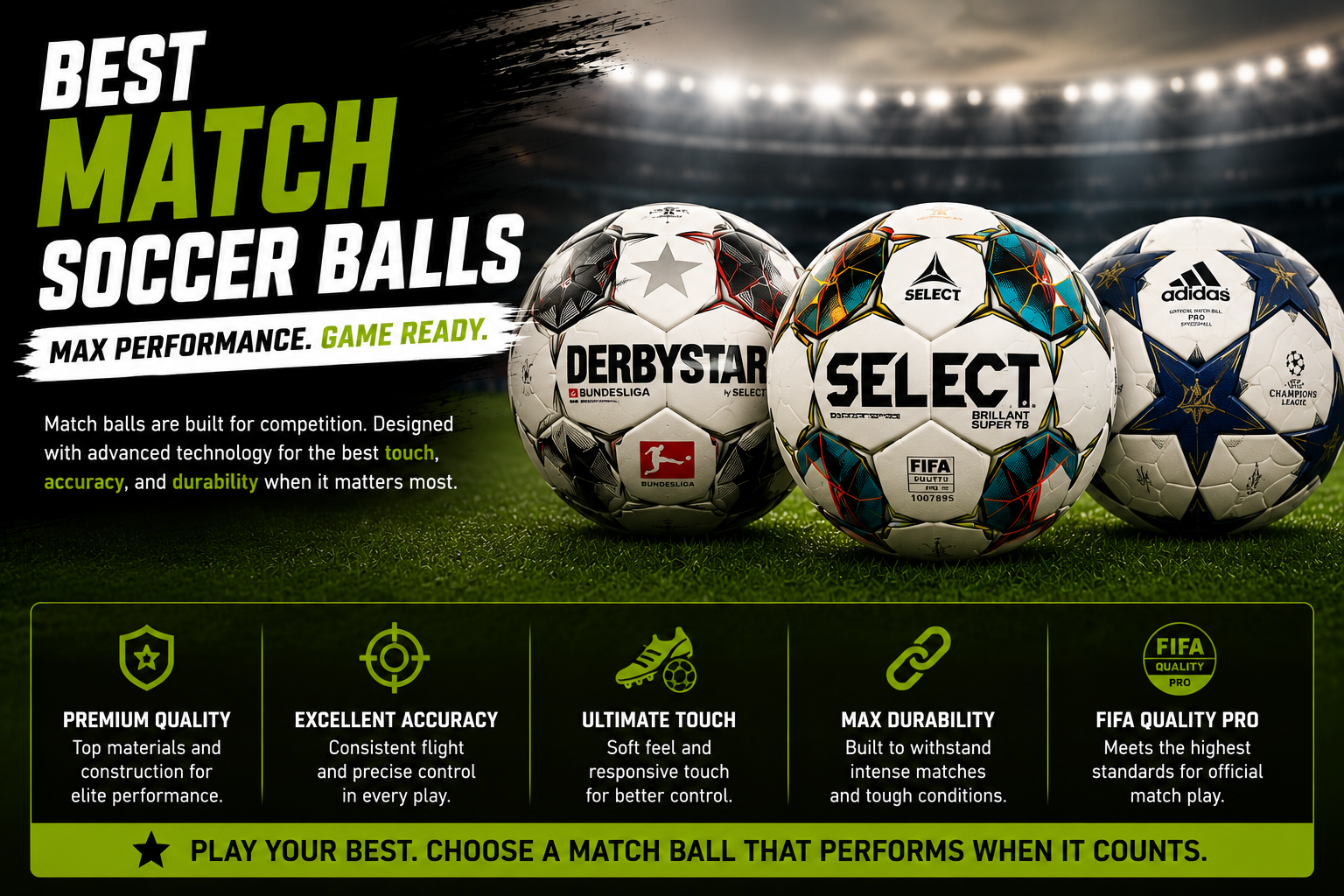
The best match soccer balls offer consistent flight, responsive touch, reliable shape retention, and the correct size for the player’s level. Match balls are best for games, serious training, club players, and competitive environments, while training balls are usually better for heavy everyday practice.
What Is a Match Soccer Ball?
A match soccer ball is designed for competitive play. Compared with most training balls, match balls usually focus more on touch, flight consistency, shape retention, and overall performance feel.
Match balls are commonly used in league games, tournaments, club matches, high-level training sessions, and competitive environments where ball quality matters. They are often more responsive than basic training balls, which can help with passing, shooting, crossing, first touch, and long balls.
For a broader overview of soccer ball types, visit the main Soccer Balls Hub.
Best Match Soccer Ball Types
Match soccer balls can vary by level, surface, player age, and performance needs.
Best Features to Look For in a Match Soccer Ball
A good match ball should feel consistent from the first touch to the final whistle. When comparing match balls, look beyond color and brand. Focus on how the ball performs during passing, shooting, receiving, and long-range play.
A match ball should travel predictably during passes, crosses, shots, and long balls.
The ball should feel controlled when receiving, dribbling, passing, and shooting.
A strong match ball should hold its round shape through regular game use.
Size 5 is standard for older players and adults, while youth leagues may use size 3 or size 4.
A quality bladder helps the ball stay properly inflated before and during matches.
Grass, turf, and indoor surfaces can affect how the ball feels and wears over time.
Match Soccer Ball Quick Picks
Use this quick guide to decide what type of match ball makes the most sense.
Choose a high-quality match ball with consistent flight, shape retention, and responsive touch.
Choose the correct size required by the league so young players can control the ball properly.
Choose a training-match style ball if you want better feel without saving it only for games.
Choose a durable match-style ball that balances performance feel with everyday practicality.
Best Match Soccer Balls for Competitive Players
Competitive players usually notice the difference between a basic training ball and a quality match ball. A good match ball should feel cleaner when striking, receiving, crossing, and passing under pressure.
For players in club soccer, school soccer, adult leagues, or tournaments, a match ball can be worth it because it gives a more realistic game feel. It can also help players train with the same level of touch and responsiveness they expect in matches.
Match Ball vs Training Ball
Match balls and training balls are both useful, but they are made for different priorities.
| Ball Type | Best For | Main Advantage | Main Tradeoff |
|---|---|---|---|
| Match Soccer Ball | Games, tournaments, serious players | Better touch, flight, and performance feel | Usually costs more and may not be ideal for rough daily use |
| Training Soccer Ball | Drills, practice, team sessions, everyday use | Durability and better value for repetition | May not feel as responsive as a match ball |
| Training-Match Ball | Players wanting better feel during practice | Good balance of performance and durability | May not match top official game-ball quality |
| Youth Match Ball | Youth leagues and competitive kids | Correct size and game-ready feel | Players may need a new size as they grow |
Most players benefit from owning both: a durable training ball for daily practice and a match ball for games, finishing sessions, or higher-quality touches.
Best Match Soccer Balls for Youth Players
Youth players need match balls that are the correct size for their age and league. A ball that is too large or heavy can make passing, dribbling, and shooting harder than necessary.
Young players should use match balls only when the size is appropriate. For regular practice, a durable training ball may still be better, but for games and competitive preparation, a youth match ball can help players get used to match-level feel.
For youth-focused options, read our guide to the Best Soccer Balls for Kids.
Match Soccer Ball Sizes Explained
Match balls must be the correct size for the age group or competition.
| Ball Size | Best For | Common Use | Buying Tip |
|---|---|---|---|
| Size 3 | Young kids | Early youth games and small-sided play | Best for smaller players learning control |
| Size 4 | Youth players | Youth matches, training, and development | Check league rules before buying |
| Size 5 | Older players and adults | Official full-size matches and adult play | Standard match size for most competitive older players |
| Futsal Ball | Indoor/futsal players | Hard court matches and futsal training | Lower bounce than regular outdoor balls |
Are Match Soccer Balls Worth It?
Match soccer balls can be worth it for competitive players because they usually provide better touch, flight, and game feel than basic training balls. Players who compete regularly may benefit from practicing with a ball that feels closer to what they will use in games.
For beginners, casual players, or families who mostly need a ball for backyard play, a durable training ball may be the better value. A match ball is most useful when performance feel matters.
Best Match Balls by Player Type
The right match ball depends on the player’s age, level, and how often the ball will be used.
- Beginners: Start with a durable training ball before spending more on a match ball.
- Youth players: Choose the correct size required by league rules.
- Club players: Consider a match ball for game preparation and serious sessions.
- Adults: Choose a size 5 match ball for leagues, pickup games, and competitive play.
- Coaches: Use match balls for finishing work or scrimmages, but training balls for repetition.
- Goalkeepers: Match balls can help with realistic shot handling and distribution practice.
How to Make a Match Soccer Ball Last Longer
Match balls usually cost more than training balls, so it makes sense to protect them. Avoid using a match ball constantly on rough pavement, sharp surfaces, or wet storage areas. Keep it properly inflated, store it indoors, and use a training ball for heavy repetition.
If the ball starts losing air quickly, becomes misshapen, or feels dead when kicked, it may be time to replace it or move it into casual practice use.
Common Mistakes When Buying Match Soccer Balls
- Buying a match ball when a training ball would be better for daily use.
- Choosing the wrong size for a youth player.
- Using an expensive match ball on rough pavement or poor surfaces.
- Ignoring league requirements for ball size or approval level.
- Letting the ball stay underinflated or overinflated.
- Buying based only on color or brand instead of touch, flight, and purpose.
Ready to Compare Match Soccer Balls?
The best match soccer balls give players better touch, flight, and game-ready feel. Choose the correct size, match the ball to the level of play, and use training balls for heavy daily repetition so your match ball lasts longer.
Shop Soccer Balls on AmazonRelated Soccer Ball Guides
Continue comparing soccer balls, sizes, training balls, and related equipment with these guides.
Match Soccer Balls FAQ
What is the best match soccer ball?
The best match soccer ball is properly sized, responsive, consistent in flight, and suitable for the player’s level of competition.
What is the difference between a match ball and a training ball?
A match ball focuses on touch, flight, and performance, while a training ball focuses more on durability and repeated practice use.
Are match soccer balls worth it?
Match soccer balls are worth it for competitive players who want better game feel, but most beginners and casual players are fine with a durable training ball.
What size match soccer ball should I buy?
Most older players and adults use size 5, while youth players may use size 3 or size 4 depending on age and league rules.
Can you use a match ball for practice?
Yes, but it is usually better to save match balls for games or serious sessions and use training balls for heavy daily repetition.
Do match soccer balls last as long as training balls?
Match balls can last a long time with proper care, but training balls are usually better suited for rough, repeated everyday use.
We may earn a commission from qualifying purchases at no extra cost to you.