
Best Whistles for Soccer Coaches
The best whistles for soccer coaches should be clear, reliable, easy to hear, comfortable to use, and durable enough for weekly practices, scrimmages, games, camps, and tournaments. A good soccer coach whistle helps control transitions, stop play safely, organize drills, and get players’ attention without yelling across the field.
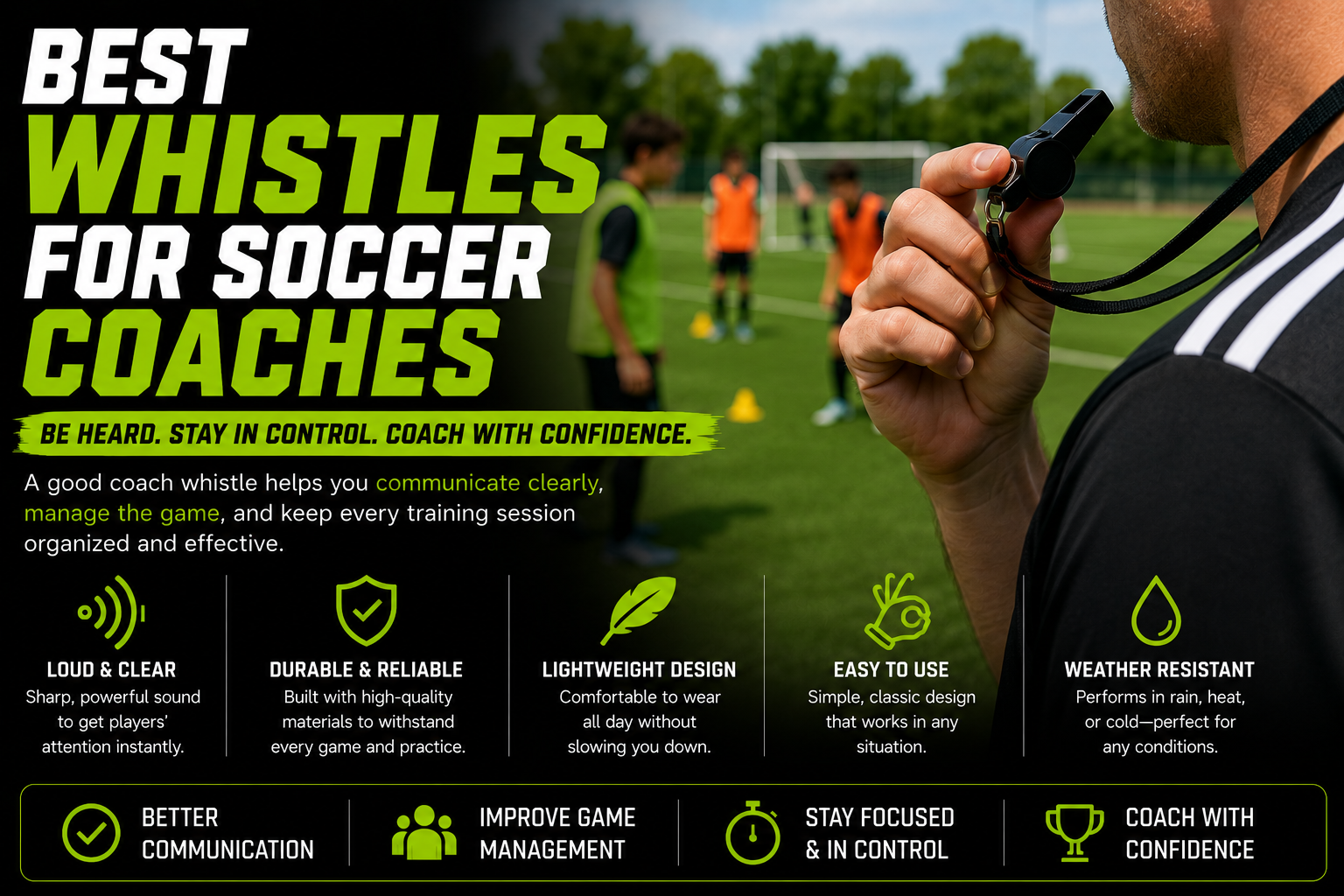
The best soccer whistle for most coaches is a loud, clear, pealess whistle with a comfortable mouth grip, durable build, and a lanyard or wrist strap. Youth coaches should choose a whistle that is easy to hear outdoors but not painfully harsh when used close to younger players.
Why Soccer Coach Whistles Matter
A whistle is one of the simplest pieces of soccer coaching equipment, but it can make practices much easier to control. Coaches use whistles to stop drills, restart play, rotate stations, signal transitions, manage scrimmages, and get attention when players are spread across the field.
Without a clear whistle, coaches often end up yelling more than they need to. A reliable whistle saves energy, improves practice flow, and helps players understand when to stop, listen, reset, or change activity.
For the full coaching category, visit the Coaching Equipment Hub. If you are building a full coach kit, compare this guide with Best Soccer Coaching Equipment, Best Soccer Coaching Boards, and Best Soccer Ball Bags.
Best Soccer Whistle Types
Best Features to Look For
The whistle should be easy for players to hear across the field without sounding muffled.
Outdoor practices need enough volume to cut through wind, noise, and active drills.
Coaches may use the whistle many times per practice, so comfort matters.
A coach whistle should handle bags, rain, drops, and weekly use.
A strap keeps the whistle close and prevents losing it during practice.
Coaches should keep an extra whistle in the ball bag or team bag.
What Soccer Whistles Help With
Stop and restart drills quickly without yelling.
Move players from warmups to drills, stations, scrimmages, and water breaks.
Stop play fast when a player is down, a ball enters the wrong area, or spacing breaks down.
Coach small-sided games, fouls, restarts, and rotations more clearly.
Soccer Coach Whistles Compared
| Whistle Type | Best For | Main Advantage | Buying Tip |
|---|---|---|---|
| Pealess Whistle | Most soccer coaches | Clear, consistent sound | Best all-around choice for practices |
| Classic Pea Whistle | Traditional coaching | Familiar whistle tone | May be less reliable when wet or dirty |
| Electronic Whistle | Hands-free or hygiene-focused use | No mouth contact needed | Check battery and sound strength |
| Plastic Whistle | Youth practices and light use | Lightweight and affordable | Keep a backup in your coach bag |
| Metal Whistle | Durability | Strong and long-lasting | Can feel cold or harsh for some users |
Best Pealess Whistles for Soccer Coaches
Pealess whistles are usually the best choice for soccer coaches because they produce a clean, consistent sound without relying on a small moving ball inside the whistle. That can make them more reliable in wet weather, dusty fields, or heavy weekly use.
They are also popular because the sound is sharp and easy to hear. For coaches running multiple groups, stations, or scrimmages, that clarity can make practice smoother.
- Great for regular team practices.
- Reliable in wet or dusty conditions.
- Clear sound for outdoor fields.
- Good choice for youth coaches and club coaches.
- Works well with a lanyard or wrist strap.
Best Whistles for Youth Soccer Coaches
Youth coaches need whistles that help control practice without overwhelming young players.
For younger teams, a whistle should be clear enough to stop play but not so aggressive that it feels harsh when players are nearby. Coaches should use short, consistent signals instead of blasting the whistle constantly.
- Use short whistle signals for stops and restarts.
- Teach players what each signal means.
- Avoid using the whistle too close to players’ ears.
- Keep a calm tone after the whistle so players listen.
- Use the whistle as a tool, not a punishment.
For more youth coach essentials, read Best Soccer Coaching Equipment and Best Training Bibs.
Best Electronic Whistles for Soccer
Electronic whistles can be useful for coaches who want to avoid putting a whistle in their mouth repeatedly. They can also be helpful when multiple coaches share equipment or when hygiene is a concern.
The main downside is that electronic whistles depend on batteries and may not always feel as natural as a traditional whistle. Coaches should test the volume before relying on one for a large outdoor field.
| Electronic Whistle Pros | Electronic Whistle Cons |
|---|---|
| No mouth contact needed | Requires battery power |
| Useful for shared coaching gear | May sound different than a traditional whistle |
| Can be easier for repeated use | Volume quality varies by model |
| Good for camps or multiple coaches | Needs testing before game or practice use |
Whistle Signals Coaches Can Use
A whistle works better when players know what the signal means.
| Signal | Meaning | Coach Use |
|---|---|---|
| One short whistle | Stop and listen | Pause drills or reset players |
| Two short whistles | Rotate or switch | Move groups between stations |
| One long whistle | End activity | Finish drill, water break, or scrimmage |
| Repeated short whistles | Urgent stop | Safety issue or immediate attention |
What to Keep With Your Soccer Whistle
- Lanyard or wrist strap.
- Backup whistle.
- Coach stopwatch or timer.
- Clipboard or coaching board.
- Ball bag or coach bag.
- Extra cones and pinnies.
- Small towel or sanitizer if sharing equipment.
- First aid basics for practices and games.
For related coach gear, read Best Soccer Stopwatches, Best Soccer Coaching Boards, and Best Soccer Ball Bags.
Other Coaching Gear to Pair With a Whistle
Helps time intervals, rotations, conditioning, and practice blocks.
Helps explain formations, drills, spacing, and set pieces.
Separate teams quickly during scrimmages and possession games.
Keeps balls, cones, pinnies, pumps, and whistles organized.
Common Soccer Whistle Mistakes
- Buying a whistle that is too quiet for outdoor fields.
- Using the whistle constantly instead of teaching clear signals.
- Forgetting a lanyard or wrist strap.
- Not keeping a backup whistle in the coach bag.
- Using a harsh whistle too close to young players.
- Sharing whistles without cleaning or using an electronic option.
- Relying on an electronic whistle without checking the battery.
- Not explaining whistle signals before practice starts.
Are Soccer Coach Whistles Worth It?
Soccer coach whistles are worth it because they are inexpensive, simple, and useful in almost every practice. A whistle helps control the field, stop play safely, manage transitions, and organize players faster.
The best whistle is not necessarily the loudest one. It should be clear, reliable, comfortable, easy to carry, and appropriate for the age group you coach.
Ready to Compare Soccer Coach Whistles?
Choose a pealess whistle for the best all-around reliability, a classic whistle for traditional coaching, an electronic whistle for no-mouth-contact use, or a whistle-and-lanyard set for easy practice organization. Prioritize clarity, comfort, volume, durability, and backup options.
Shop Soccer Coach WhistlesRelated Soccer Gear Guides
Soccer Coach Whistles FAQ
What is the best whistle for soccer coaches?
The best whistle for most soccer coaches is a clear, reliable pealess whistle with enough volume for outdoor fields and a lanyard for easy carrying.
Are pealess whistles better for soccer?
Pealess whistles are often better for soccer coaches because they produce a consistent sound and do not rely on a small moving ball inside the whistle.
How loud should a soccer coach whistle be?
A soccer coach whistle should be loud enough for players to hear across the field, but coaches should avoid using harsh blasts too close to young players.
Do soccer coaches need a whistle?
A whistle is not always required, but it is very useful for practice control, transitions, scrimmages, safety stops, and team organization.
Are electronic whistles good for soccer coaches?
Electronic whistles can be good for hygiene and repeated use, but coaches should test the volume and battery before relying on one outdoors.
Should youth soccer coaches use whistles?
Yes, youth soccer coaches can use whistles, but they should teach clear signals and avoid overusing the whistle during practice.
What should I keep with my whistle?
Coaches should keep a lanyard, backup whistle, stopwatch, coaching board, ball bag, cones, pinnies, and basic first aid supplies with their coaching gear.
How many whistles should a coach have?
Most coaches should have at least one main whistle and one backup whistle in their coach bag or ball bag.
We may earn a commission from qualifying purchases at no extra cost to you.