
Best Soccer Backpacks
The best soccer backpacks help players carry cleats, a soccer ball, shin guards, socks, water bottles, uniforms, snacks, and small training gear without needing a bulky duffel bag. This guide compares soccer backpacks for kids, teens, travel players, school soccer, tournaments, and everyday practice.
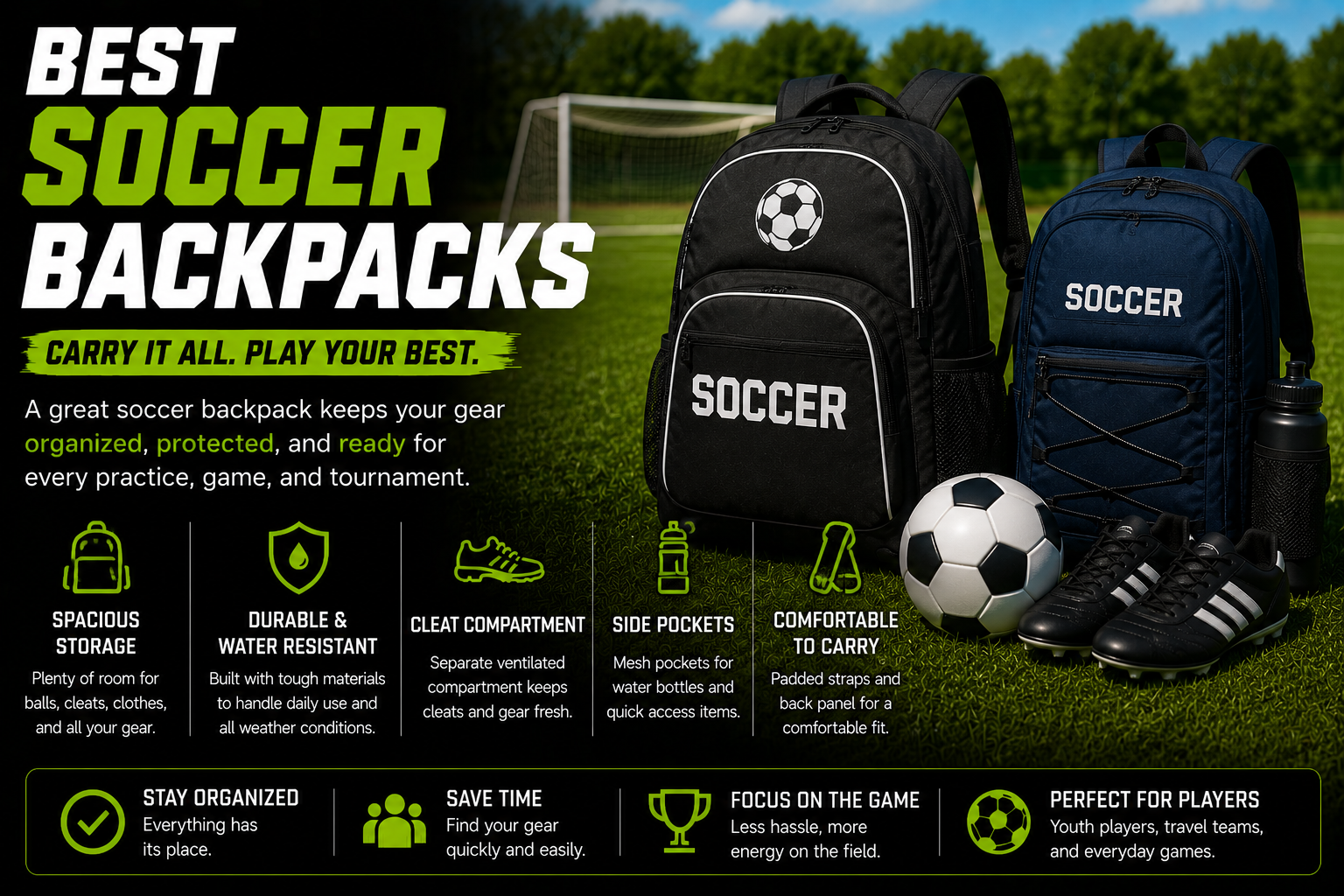
The best soccer backpack for most players has a separate cleat compartment, front ball pocket, side water bottle storage, padded straps, and enough room for shin guards, socks, uniform, and small gear. Younger kids need lightweight backpacks, while older players may need larger backpacks with more storage.
Best Soccer Backpacks at a Glance
Best Soccer Backpacks — Quick Comparison
| Backpack Type | Best For | Main Advantage | Buying Tip |
|---|---|---|---|
| Backpack with Ball Pocket | Most players | Easy way to carry one ball plus gear | Best all-around soccer backpack style |
| Backpack with Cleat Compartment | Players carrying dirty shoes | Keeps cleats away from clean gear | Look for ventilation or separate shoe storage |
| Lightweight Youth Backpack | Younger kids | Easy to carry and not too bulky | Best for U6–U10 players |
| Large Soccer Backpack | Teens and travel players | More space for clothes, snacks, and extras | Best for tournaments and school soccer |
| Hybrid Soccer Backpack | Players with lots of gear | Backpack feel with duffel-like storage | Good for older players who carry extra items |
Why Soccer Backpacks Are Better for Most Players
A soccer backpack is usually the easiest bag for youth players because it keeps both hands free. Players can carry cleats, shin guards, a soccer ball, water, and uniform while walking across fields, school campuses, or tournament complexes.
Compared with duffel bags, backpacks are easier for younger players to manage. Compared with drawstring bags, they offer better structure, more compartments, and more protection for gear.
For the full bag category, read Best Soccer Bags. You can also visit the Soccer Accessories Hub for bags, pumps, water bottles, and extra gear.
Soccer Backpack Features That Matter
Separate shoe storage keeps mud, grass, and odor away from clean gear.
A front ball pocket helps players carry one soccer ball without using their hands.
Side pockets make hydration easy for practice, games, and tournaments.
Comfortable straps matter when kids walk long distances to the field.
Best Soccer Backpack for Kids
Kids need soccer backpacks that are lightweight, simple, and not too large. A giant backpack may have more storage, but it can feel awkward for younger players to carry.
For most kids, the best soccer backpack has one main compartment, a small cleat section, a water bottle pocket, and enough space for shin guards and socks. A ball pocket is helpful if the player brings a ball to practice.
- Choose lightweight materials for younger players.
- Make sure the backpack is not too large for the child’s body.
- Look for easy zippers and simple compartments.
- Use a cleat pocket if the child changes shoes after practice.
- Choose padded straps for comfort.
Soccer Backpack Size Guide by Age
| Age Group | Best Backpack Size | What It Should Carry |
|---|---|---|
| U6–U8 | Small youth backpack | Shin guards, socks, water bottle, small gear, maybe cleats |
| U9–U12 | Standard soccer backpack | Cleats, ball, shin guards, socks, water, uniform |
| U13–U15 | Medium or large soccer backpack | Extra clothes, snacks, tape, warmups, and training gear |
| High School | Large soccer backpack | School items, soccer gear, extra shoes, recovery items |
| Travel Players | Large backpack or hybrid bag | Tournament gear, extra clothes, snacks, water, and accessories |
Best Soccer Backpack with Cleat Compartment
A cleat compartment is one of the most useful soccer backpack features. It keeps dirty cleats separate from clean uniforms, socks, snacks, and personal items.
This is especially important after rainy practices, muddy games, or turf sessions where rubber pellets and dirt get stuck to shoes. A ventilated shoe pocket is even better because it helps reduce odor and moisture buildup.
- Best for players who change shoes at the field.
- Keeps clean clothes away from dirty cleats.
- Helps organize practice and game-day gear.
- Ventilation is helpful for odor control.
- Works well for kids, teens, and travel players.
For cleat help, visit the Soccer Shoes Hub and Best Soccer Cleats for Kids.
Best Soccer Backpack with Ball Holder
A soccer backpack with a ball holder is a great option for players who bring their own ball to practice. The ball pocket keeps the ball outside the main compartment so it does not take up space inside the bag.
This is especially helpful for players who train before practice, warm up on their own, or bring a ball to school or camp. For younger kids, make sure the ball holder is easy to use and does not make the backpack too heavy.
- Best for players who bring their own ball.
- Keeps the ball outside the main storage area.
- Helpful for practices, camps, and solo training.
- Make sure the ball pocket holds the correct ball size.
- Check that the backpack still feels balanced when loaded.
For ball sizing and buying help, visit the Soccer Balls Hub and Best Soccer Balls for Kids.
What Should Fit Inside a Soccer Backpack?
| Item | Why It Matters | Related Guide |
|---|---|---|
| Cleats | Main game and practice footwear | Soccer Shoes Hub |
| Shin Guards | Required protection for most players | Shin Guards Hub |
| Soccer Socks | Hold shin guards and protect feet | Soccer Socks Hub |
| Water Bottle | Hydration for practices and games | Best Soccer Water Bottles |
| Soccer Ball | Useful for warmups and extra touches | Best Soccer Balls for Kids |
| Extra Clothes | Helpful for rain, cold weather, or tournaments | Soccer Apparel Hub |
Best Soccer Backpack for Teens and Travel Players
Older players usually need more space than younger kids. Teens may carry extra socks, slides, warmups, tape, recovery items, snacks, school items, and tournament gear.
For travel players, durability becomes more important. Look for strong zippers, reinforced stitching, padded straps, and compartments that keep wet or dirty items separated.
- Choose larger backpacks for older players.
- Look for durable zippers and strong fabric.
- Use separate compartments for dirty gear.
- Make sure water bottle pockets are deep enough.
- Consider a duffel if the player carries too much for a backpack.
If a backpack is not enough, compare Best Soccer Bags and Best Team Equipment Bags.
Soccer Backpack vs Soccer Duffel
| Bag Type | Best For | Why |
|---|---|---|
| Soccer Backpack | Most youth players | Easy to carry, balanced, and organized. |
| Soccer Duffel | Older players and travel | More room for clothes, towels, slides, and extra gear. |
| Drawstring Bag | Very light gear | Cheap and simple, but limited structure. |
| Team Equipment Bag | Coaches and teams | Better for cones, bibs, balls, pumps, and first aid gear. |
Best Soccer Backpack for School Soccer
School soccer players may need a backpack that works for both school and sports. The challenge is separating books, electronics, and clean clothes from cleats and sweaty gear.
If the player uses one backpack for school and soccer, choose a bag with separate compartments. A dedicated soccer backpack is better if the player carries dirty cleats or wet gear often.
- Use separate compartments for school and soccer gear.
- Do not pack dirty cleats with electronics or books.
- Choose a backpack with strong zippers.
- Keep a plastic bag or shoe pouch inside for wet gear.
- Air out the bag after every practice or game.
Common Soccer Backpack Mistakes
- Buying a backpack that is too large for a young child.
- Choosing a bag without enough space for cleats.
- Ignoring water bottle storage.
- Putting dirty cleats in the main compartment.
- Buying weak zippers that fail during the season.
- Leaving wet socks or gear inside the backpack.
- Choosing by color only instead of function.
- Buying a backpack that cannot hold the player’s ball size.
Final Verdict: What Is the Best Soccer Backpack?
The best soccer backpack for most players has a separate cleat compartment, ball holder, water bottle pocket, padded straps, and enough storage for shin guards, socks, uniform, and small accessories.
Younger kids should use a lightweight backpack that is easy to carry. Teens and travel players may need a larger backpack with more compartments. Coaches and teams usually need larger bags, but for individual players, a soccer backpack is usually the best everyday choice.
Shop Soccer BackpacksRelated Soccer Gear Guides
Best Soccer Backpacks FAQ
What is the best soccer backpack for players?
The best soccer backpack for most players has a cleat compartment, ball holder, water bottle pocket, padded straps, and room for shin guards, socks, and uniform.
Do soccer backpacks need a cleat compartment?
A cleat compartment is very useful because it keeps dirty shoes away from clean clothes, socks, snacks, and school items.
Are soccer backpacks better than duffel bags?
Soccer backpacks are better for most youth players because they are easier to carry. Duffel bags are better for older players who need more storage.
What size soccer backpack should kids use?
Younger kids should use a small or standard youth backpack. Older kids and teens may need a larger soccer backpack with more compartments.
Can a soccer backpack hold a ball?
Many soccer backpacks have a front ball pocket or mesh holder that can carry a size 3, size 4, or size 5 soccer ball.
What should players put in a soccer backpack?
Players should pack cleats, shin guards, soccer socks, water bottle, uniform, ball, tape, snacks, extra clothes, and small accessories.
Are soccer backpacks good for school soccer?
Yes, but players should choose a backpack with separate compartments so school items stay away from dirty cleats and sweaty gear.
What backpack features matter most for soccer?
The most important features are cleat storage, ball pocket, water bottle storage, padded straps, durable zippers, and enough room for gear.
We may earn a commission from qualifying purchases at no extra cost to you.