
What Age Do Kids Need Soccer Cleats?
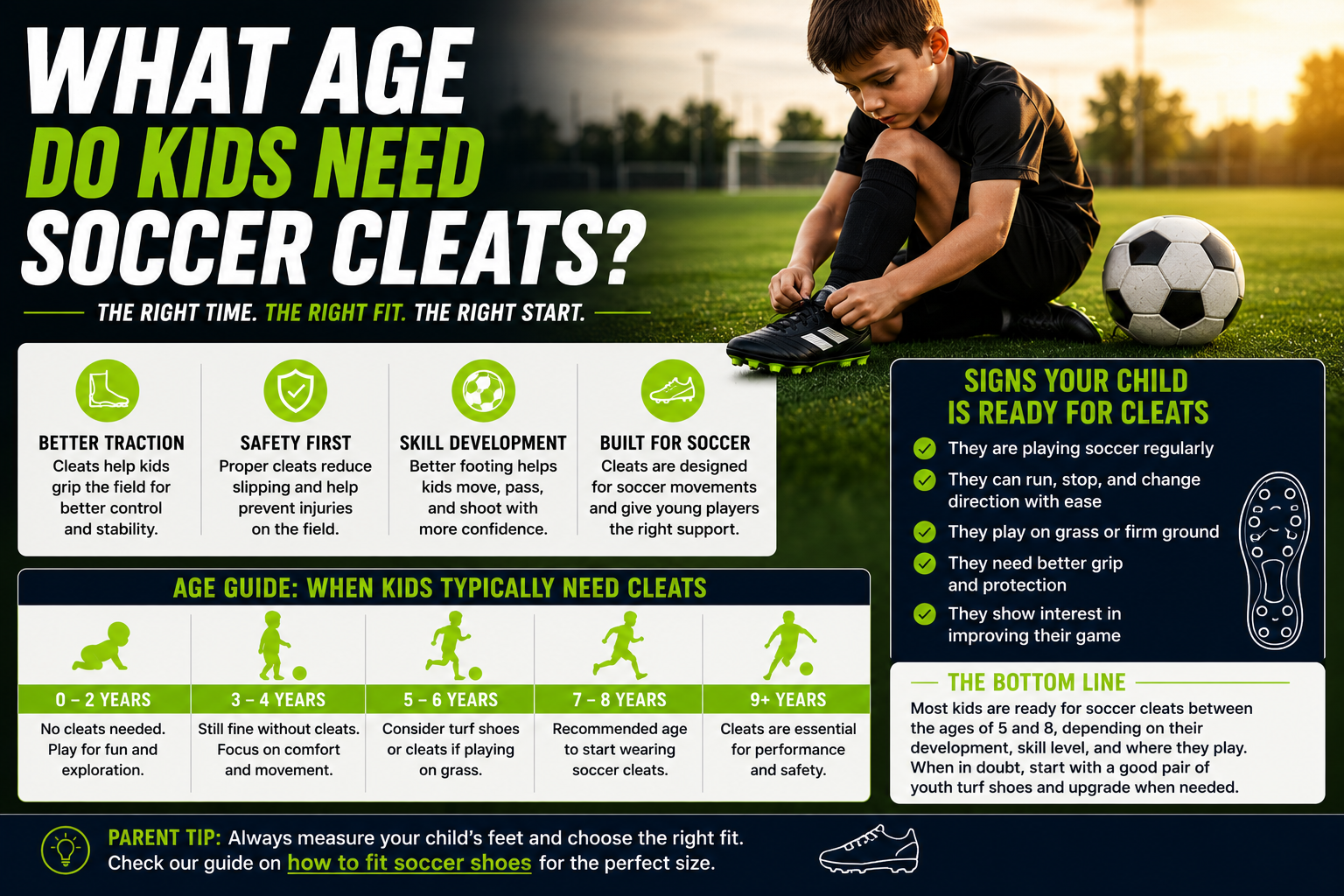
Most children do not need soccer cleats simply because they have started kicking a ball. They usually need them when organized play, faster movement, field conditions, or league rules make soccer-specific traction useful. For many families, that transition happens between ages five and eight, but age alone should never make the decision.
Affiliate disclosure: Soccer Gear Guide may earn a commission from qualifying purchases at no additional cost to you.
Soccer Cleats by Age: Practical Parent Chart
The chart below is a starting point, not a strict rule. Two children of the same age can need different footwear because one plays casual backyard soccer while the other practices twice a week on a firm grass field. Always combine age with playing surface, speed, coordination, and league instructions.
| Age | Do They Usually Need Cleats? | Best Starting Option | What Parents Should Watch |
|---|---|---|---|
| 2–3 years | Usually no | Lightweight athletic shoes with a flexible rubber outsole | Comfort, balance, easy movement, and no pressure points |
| 4 years | Often no, sometimes yes | Athletic shoes for casual classes; beginner cleats only when required or clearly useful | League rules, wet grass, repeated slipping, and whether the child can run naturally |
| 5–6 years | Sometimes | Simple youth FG/MG cleats for organized outdoor soccer; turf shoes for artificial turf | Traction, heel stability, easy fastening, and correct surface |
| 7–8 years | Usually yes for organized outdoor play | Youth soccer cleats matched to field surface | Fit, stud pattern, comfort through a full practice, and secure heel hold |
| 9–12 years | Yes in most leagues | Proper soccer cleats based on surface, foot shape, and weekly use | Growth spurts, width, outsole wear, and whether one pair must cover multiple surfaces |
| 13+ years | Yes for outdoor competitive play | Cleats chosen by surface, fit, comfort, playing frequency, and personal preference | Durability, stud pressure, fit consistency, and replacement timing |
When Do Kids Actually Need Soccer Cleats?
Children need soccer cleats when soccer-specific traction solves a real problem. That problem may be slipping on natural grass, losing stability while turning, playing in a league that requires molded cleats, or moving fast enough that regular running shoes no longer provide predictable grip.
Parents sometimes treat cleats as a milestone: the child joins a team, so the child must immediately own a pair. In reality, a four-year-old in a short introductory class on dry artificial turf may be more comfortable in turf shoes or athletic shoes than in firm-ground cleats. A six-year-old playing weekend games on damp grass may benefit from cleats right away.
The decision should answer four questions:
- What surface does the child play on most often?
- Does the league require or prohibit a particular type of footwear?
- Is the child slipping, struggling to stop, or feeling unstable in athletic shoes?
- Can the child wear cleats comfortably without changing natural movement?
If the answer points toward better traction and the field is appropriate for studs, cleats make sense. If the child is comfortable, stable, and playing casually on a flat surface, there may be no need to rush.
Do Toddlers Need Soccer Cleats?
Most toddlers do not need soccer cleats. At ages two and three, children are still developing basic balance, coordination, body control, and confidence running in different directions. The main goal is usually enjoyment and familiarity with the ball, not maximizing traction.
A toddler shoe should bend naturally through the forefoot, feel light, and allow the child to run without looking awkward or stiff. Some small cleats are designed to look like adult soccer boots, but appearance does not make them necessary. If the outsole feels rigid or the studs make the child walk on the outside of the feet, the shoe is working against the developmental goal.
For toddler classes on indoor floors, hard courts, short artificial turf, or dry playground-style surfaces, regular athletic shoes are often the simplest choice. They provide familiar traction and are easier to use beyond soccer.
Cleats may become reasonable for a toddler only when all of the following are true:
- The program specifically recommends them.
- The child plays on natural grass rather than a hard or indoor surface.
- The cleat is lightweight and flexible.
- The child runs naturally in the shoe.
- The studs do not create uncomfortable pressure under the foot.
Do 4-Year-Olds Need Soccer Cleats?
Most four-year-olds can participate in beginner soccer without cleats, especially in short recreational sessions. Comfortable athletic shoes are usually adequate when the surface is flat, dry, and forgiving.
However, four is also the age when some children begin organized outdoor leagues. If the league plays on grass and the child repeatedly slips while starting, stopping, or turning, a basic pair of molded youth cleats may improve confidence. The key word is basic. A four-year-old does not need a narrow speed boot, carbon-style plate, or premium upper.
Parents should also look at the league handbook. Some programs say “soccer cleats recommended,” while others allow sneakers. A recommendation means parents can judge based on the child and surface. A requirement should still be checked carefully to confirm which outsole types are permitted.
Parent Tip: Let a four-year-old walk, jog, stop, and squat in the cleats before removing tags. If the child suddenly takes short steps, avoids bending the foot, or says the bottoms feel hard, try a more flexible shoe.Do 5- and 6-Year-Olds Need Soccer Cleats?
Ages five and six are the most common transition period. Children begin moving faster, playing longer sessions, and participating in organized games. On natural grass, cleats can provide more consistent traction than running shoes, especially when the ground is damp.
This does not mean every five-year-old needs studs. Surface still matters. A child playing on short artificial turf should usually wear turf shoes or an appropriate multi-ground option rather than aggressive firm-ground studs. A child in an indoor league needs a flat indoor outsole.
At this age, the best first cleat should be:
- Easy to put on and secure.
- Flexible enough for natural running.
- Wide enough across the forefoot.
- Snug at the heel without squeezing the toes.
- Appropriate for the actual field surface.
- Affordable enough to replace after a growth spurt.
Parents should not expect a beginner cleat to transform performance. The real benefit is predictable footing. When the child can stop, turn, and accelerate without worrying about slipping, attention can stay on the ball and the game.
Do Kids Ages 7 and Older Need Cleats?
By ages seven and eight, most children playing organized outdoor soccer benefit from proper soccer cleats. Practices become more structured, games involve more direction changes, and players start using the foot more deliberately for passing, dribbling, and shooting.
From age nine onward, cleats are standard in most outdoor leagues, but the purchase becomes more individualized. One child may need a roomier forefoot. Another may need turf shoes because every practice is on artificial grass. A third may play on both surfaces and need a versatile multi-ground outsole.
Older children also begin to care more about brands, colors, and player-inspired models. Those preferences are understandable, but fit and surface compatibility should remain non-negotiable. A popular boot that squeezes the foot or uses the wrong outsole is not a good purchase.
The Playing Surface Matters More Than Age
The same child may need different shoes on different fields. Cleats are not a single category; the outsole is designed for a particular surface. Choosing the wrong one can reduce comfort, create too much or too little grip, and wear the shoe quickly.
| Playing Surface | Best Footwear | Typical Outsole | Parent Guidance |
|---|---|---|---|
| Natural grass, firm and dry | Firm-ground or multi-ground soccer cleats | Molded studs | Good standard choice for many outdoor youth leagues |
| Natural grass, mixed conditions | Multi-ground or youth firm-ground cleats | Moderate molded studs | Avoid overly aggressive adult-style stud patterns for beginners |
| Artificial grass with longer blades and infill | AG or suitable MG cleats | More numerous, shorter studs | Check field and league guidance because artificial fields vary |
| Short, carpet-like turf | Turf soccer shoes | Many small rubber nubs | Usually more comfortable and stable than long studs |
| Indoor court or gym floor | Indoor soccer shoes | Flat non-marking rubber | Studded cleats should not be used on hard indoor courts |
| Casual backyard or park play | Athletic shoes or surface-appropriate soccer shoes | Rubber traction | Choose based on comfort and ground conditions, not appearance |
Firm Ground (FG)
Firm-ground cleats are made for natural grass that is reasonably dry and stable. They are the traditional choice for outdoor soccer. Youth versions often use molded plastic studs that are safer and easier to manage than removable metal studs.
Parents should avoid assuming every shoe labeled FG is equally suitable for every child. Some modern speed boots use more aggressive blade-shaped studs. A younger beginner may feel more comfortable in a rounded or mixed stud pattern that distributes pressure more evenly.
Multi-Ground (MG)
Multi-ground cleats are intended to cover more than one outdoor surface. They can be a practical option for families whose child practices on artificial grass but plays games on natural grass. They are not perfect for every field, but versatility can be more useful than buying two pairs for a fast-growing child.
Look for a youth MG outsole with numerous moderate-length studs rather than a very aggressive pattern. More contact points can reduce pressure under the foot and provide a smoother transition between surfaces.
Artificial Grass (AG)
AG cleats are designed specifically for modern artificial grass. They generally use more studs that are shorter and shaped to release from the turf more predictably. Dedicated AG models are useful for children who play almost exclusively on artificial grass.
The difficulty is that many youth models are not offered in every outsole. When a true AG option is unavailable, a suitable MG cleat may be the next best choice. Parents should check the manufacturer’s outsole description and local field recommendations.
Turf Shoes
Turf shoes use many small rubber nubs. They are best for short artificial turf, older carpet-like fields, cages, and some training areas. They usually feel more stable than long studs on a shallow surface and can be an excellent first soccer-specific shoe.
Turf shoes are also useful for children who find stud pressure uncomfortable. The outsole spreads load across many small contact points. However, turf shoes may not provide enough grip on wet natural grass.
Indoor Shoes
Indoor soccer shoes use a flat rubber outsole and should be selected for gyms, futsal courts, and hard indoor surfaces. Outdoor cleats should never be worn on a hard court because the studs cannot sink into the surface, making the child unstable.
Indoor shoes should fit securely but still flex through the forefoot. Non-marking rubber is often required by facilities.
Can Kids Wear Running Shoes for Soccer?
Yes, young beginners can often wear running shoes for casual soccer, introductory classes, and some recreational programs. Running shoes are familiar, comfortable, and easy to use. They are especially reasonable for ages two through four.
Their limitations appear as the game becomes faster. Running shoes are designed mainly for forward motion. Many have a high cushioned midsole that can feel less stable during sharp lateral cuts. Their tread may also clog or slip on wet grass.
A child should move from running shoes to soccer footwear when:
- The child plays organized games regularly.
- The field is natural grass and traction is inconsistent.
- The child slips while changing direction.
- The shoe feels unstable during side-to-side movement.
- The league or coach recommends soccer-specific footwear.
Read our full guide: Can Kids Wear Running Shoes for Soccer?
Signs Your Child Is Ready for Soccer Cleats
A birthday does not create an automatic need for cleats. Movement and environment provide better clues. The following signs suggest that soccer-specific footwear may help.
Repeated Slipping The child loses footing while accelerating, stopping, turning, or chasing the ball on grass. Organized Weekly Play Practices and games are regular enough that dedicated soccer footwear becomes practical. Faster Direction Changes The child is moving beyond simple jogging and beginning to cut, pivot, and defend. League Recommendation The coach or league identifies cleats as the preferred footwear for the field.Another sign is confidence. Some children hesitate on damp grass because they do not trust their footing. A suitable cleat can help, but it must not create a new problem such as stud pressure, stiffness, or poor fit.
What Type of Cleats Should Kids Start With?
A first soccer cleat should be simple, comfortable, and forgiving. Young players do not need elite materials or the lightest possible construction. They need a shoe that stays secure, bends naturally, matches the field, and does not distract them.
| First-Cleat Feature | Why It Matters | What to Avoid |
|---|---|---|
| Flexible upper | Reduces pressure and adapts more comfortably to a growing foot | Very stiff materials that require painful break-in |
| Secure heel | Prevents sliding and helps the foot stay centered | Buying so large that the heel lifts with every step |
| Room for toes | Allows natural toe position without excess empty length | Squeezed toes or a shoe several sizes too large |
| Moderate stud pattern | Provides useful grip without harsh pressure | Overly aggressive studs for a young beginner |
| Simple closure | Makes it easier to achieve consistent tension | Complicated laceless systems that do not hold the child’s foot well |
| Reasonable price | Children may outgrow the shoe before wearing it out | Paying premium prices before fit and preferences are established |
Best First Soccer Cleat Styles for Kids
Beginner-friendly youth cleats usually come from the entry or academy level of major boot families. These models are often more durable and forgiving than elite versions. They may use thicker synthetic uppers and simpler soleplates, which can be a benefit for young players.
Comfort-Focused Cleats
Comfort-focused models usually have a softer upper, moderate fit, and less aggressive outsole. Copa-style and Tiempo-style youth cleats often appeal to families seeking a more traditional feel. The exact fit still varies by generation, so the child must try them on.
Beginner Speed Cleats
Entry-level Mercurial, F50, or Puma speed models can work for children who prefer a close fit and lightweight feel. However, speed cleats are often narrower through the midfoot and forefoot. They should not be chosen simply because a favorite professional wears the line.
Budget Cleats
Budget youth cleats can be excellent first pairs because they deliver the basic function without a large investment. A well-fitting $35–$50 cleat is better than an uncomfortable premium boot. Parents should prioritize fit, outsole, and return policy rather than tier name.
Helpful guides: Best Soccer Cleats for Kids and Best Soccer Cleats Under $50.
How Soccer Cleats Should Fit Growing Kids
Youth cleats should fit snugly, but “snug” does not mean painfully tight. The heel should stay in place, the midfoot should feel secure, and the toes should have a small amount of space without sliding forward.
Parents often buy a full size larger to make the shoe last. This can create heel lift, blisters, toe gripping, and reduced control. Excess length also allows the foot to slide during stops and cuts.
A practical target is roughly a thumb’s width or less of space at the front, depending on the child’s age, sock thickness, and the shape of the cleat. The shoe should not feel loose through the heel.
Fit Test for Parents
- Use soccer socks. The child should try on cleats with the same sock thickness used for games.
- Check both feet. One foot may be slightly larger, so fit the larger foot.
- Stand, do not only sit. The foot spreads under body weight.
- Check toe space. Toes should not hit the front, but there should not be a large empty gap.
- Check the heel. The heel should remain secure during walking and light jogging.
- Test movement. Have the child jog, stop, turn, and squat if the store allows.
- Ask specific questions. Instead of “Do they feel okay?” ask whether the sides pinch, toes touch, heel slips, or studs feel hard.
For more detail, see: How to Measure Kids Soccer Cleats, How to Fit Soccer Shoes, and Soccer Cleat Size Chart.
Should Kids’ Soccer Cleats Be a Size Bigger?
Cleats should not be bought a full size larger simply to allow growth. A small amount of growing room is sensible, but too much length makes the foot unstable inside the shoe.
A better strategy is to buy the correct shape and a modest amount of space, then monitor fit during the season. Children can grow quickly, especially between ages nine and twelve. Check the toes and heel every few weeks.
Signs the cleat is becoming too small include:
- Toes touching or curling at the front.
- Redness or pressure along the sides.
- Complaints after practice that were not present before.
- Difficulty putting the shoe on despite loosened laces.
- Toenail irritation or blisters.
Read the full explanation: Should Soccer Cleats Be a Size Bigger?
Wide Feet, Narrow Feet, and Foot Shape
Age does not determine foot shape. Some young children have broad forefeet, high-volume feet, narrow heels, or low-volume feet. Choosing a cleat by length alone can lead to a poor fit.
Kids with Wide Feet
Look for a roomier forefoot, softer upper, and laces that allow adjustment. Do not solve a width problem by buying an excessively long shoe. The foot may still be squeezed at the sides while sliding front to back.
Kids with Narrow Feet
A closer-fitting upper and secure lacing can help prevent movement. Check that the heel stays locked without having to overtighten the entire shoe.
High-Volume Feet
Children with a high instep may struggle with laceless boots or shallow openings. Traditional laces often provide more control over tension.
The correct shape should feel comfortable immediately. Parents should be cautious when told that a painful children’s cleat will “stretch out.” Some uppers soften slightly, but a poor basic shape usually remains poor.
Laces, Straps, or Laceless Cleats for Beginners?
| Closure Type | Advantages | Limitations | Best For |
|---|---|---|---|
| Traditional laces | Most adjustable and usually the easiest to fit securely | Young children may need help tying them | Most beginners and children with fit differences |
| Hook-and-loop strap | Fast and easy for very young players | Fewer performance options and less precise tension | Toddlers and early recreational programs |
| Laceless | Clean striking surface and easy appearance | Fit depends heavily on foot shape; harder to adjust | Older children whose feet match the boot well |
| Elastic or quick-lace system | Convenient and secure when properly designed | Replacement and adjustment may be less familiar | Children who struggle with traditional laces |
Traditional laces remain the safest default because they allow parents to change tension across the foot. Very young players may prefer straps for independence. Laceless cleats should only be selected when the heel and midfoot are already secure.
Are Expensive Cleats Better for Young Kids?
Expensive cleats are not automatically better for young children. Premium models may be lighter and use thinner materials, but those benefits are often small compared with fit, comfort, and surface compatibility.
Entry-level and academy-level youth cleats can actually be more practical. They may have thicker uppers, more durable construction, and a less aggressive soleplate. Since children outgrow footwear quickly, durability and value matter.
Premium cleats make more sense when:
- The child plays frequently and has a stable shoe size.
- The family already knows which boot shape fits well.
- The premium material solves a specific comfort or fit need.
- The purchase fits the family budget without pressure.
They do not make sense when the only reason is a professional player’s name, a limited colorway, or the belief that expensive boots create better technique.
How Much Should Parents Spend on First Soccer Cleats?
Many first youth cleats fall between roughly $30 and $70. Sales can bring quality beginner models below that range. The ideal budget depends on how often the child plays and how quickly the feet are growing.
| Budget Level | Typical Use | What Parents Can Expect |
|---|---|---|
| Under $40 | First season, recreational play, fast growth | Basic synthetic upper, molded outsole, practical durability |
| $40–$70 | Regular practices and games | Better comfort details, more brand/model choices, improved fit options |
| $70–$120 | Competitive youth player with known preferences | Lighter materials, more refined uppers, academy or pro-tier options |
| $120+ | Older competitive player or specific premium preference | Top-tier materials and marketing features, but not automatically better fit |
The smartest first purchase is often a reasonably priced cleat from a retailer with an easy return policy. Fit mistakes cost more than choosing a lower tier.
League Rules Parents Should Check
Youth soccer organizations can set footwear rules in addition to general laws of the game. Parents should read the league’s equipment page instead of relying on another team’s habits.
Check for:
- Whether cleats are required or only recommended.
- Whether metal studs are prohibited.
- Whether toe cleats are prohibited.
- Whether indoor facilities require non-marking soles.
- Whether certain fields require turf or AG footwear.
- Whether the referee performs a pregame equipment check.
Most young players use molded rubber or plastic studs. Metal studs are unnecessary for typical beginner soccer and are often restricted.
Safety: Can Cleats Cause Injuries?
Properly fitted, surface-appropriate cleats are normal soccer equipment. Problems are more likely when the outsole is wrong for the field, the shoe is too large or too small, or the child is not comfortable moving in it.
Too little grip can cause slipping. Too much grip can make the foot feel stuck during rotation. Hard studs on shallow turf can create pressure. Oversized shoes can lead to sliding and blisters.
Parents can reduce risk by:
- Matching the outsole to the surface.
- Choosing molded youth studs rather than aggressive adult patterns.
- Checking fit before every new season.
- Replacing cracked or heavily worn outsoles.
- Allowing the child to practice in new cleats before a tournament.
- Listening to repeated complaints instead of assuming discomfort is normal.
How to Break In Kids’ Soccer Cleats
Children’s cleats should not require a painful break-in. The goal is to help the upper flex and confirm there are no hidden pressure points.
- Wear them indoors briefly. Keep the outsole clean in case the shoes need to be returned.
- Use soccer socks. This gives a realistic fit test.
- Start with a short practice. Avoid making a tournament the first full use.
- Check the feet afterward. Look for redness, rubbing, blisters, or nail pressure.
- Adjust lacing. Loosen areas that feel compressed while preserving heel security.
- Stop if pain develops. Do not force a child to continue because the shoe is new.
Avoid soaking cleats in hot water, heating them, or using aggressive stretching methods. These can damage adhesives and shape without solving the real fit problem.
How Often Do Kids Need New Soccer Cleats?
Children often replace cleats because of growth before the outsole wears out. The replacement schedule can range from a few months during a growth spurt to a full season or longer for a child with stable foot size.
Replace or reevaluate cleats when:
- The toes reach the front.
- The upper separates from the sole.
- Studs become uneven, cracked, or worn smooth.
- The heel lining tears and causes rubbing.
- The child develops new discomfort.
- The primary playing surface changes.
Do not judge only by exterior appearance. A shoe can look clean but be too small.
Can Siblings Share or Hand Down Soccer Cleats?
Hand-me-down cleats can save money when they remain structurally sound and fit the next child correctly. The outsole should be even, the upper should not be permanently distorted, and the heel lining should be intact.
The second child’s foot shape still matters. A cleat molded to a narrow foot may not suit a wider sibling. Replace the insole when practical and clean the interior thoroughly.
Do not pass down cleats with cracked studs, separated soles, strong odor that cannot be cleaned, or heavy internal wear.
What Should Kids Wear With Soccer Cleats?
Cleats are only one part of the setup. Children should wear soccer socks that fit smoothly, shin guards required by the league, and no extra layers that bunch inside the shoe.
Thick socks do not fix an oversized cleat. They can create heat and friction. Use the actual match socks when fitting the shoe.
For shin guard guidance, see our Soccer Shin Guards Hub.
Common Mistakes Parents Make
| Mistake | Why It Causes Problems | Better Choice |
|---|---|---|
| Buying cleats only because the child joined a team | The surface or program may not require studs | Check the field and league rules first |
| Buying a full size larger for growth | Creates heel slip, blisters, and unstable movement | Allow modest growing room while keeping the heel secure |
| Using firm-ground cleats on short turf | Studs may feel unstable or create pressure | Use turf, AG, or suitable MG footwear |
| Choosing a professional player’s boot without checking fit | Popular speed boots can be narrow or stiff | Fit the child’s foot shape first |
| Assuming pain is part of break-in | Children may develop blisters or avoid natural movement | Choose a cleat that feels comfortable from the start |
| Buying premium cleats for a first short season | The child may outgrow them quickly | Begin with a durable entry or academy model |
| Trying on cleats without soccer socks | The game-day fit may be different | Use the actual sock thickness during fitting |
| Ignoring the child’s feedback | Young children may change their stride to avoid pressure | Ask specific questions about toes, sides, heel, and studs |
First Soccer Cleat Buying Checklist
- Confirm the main playing surface.
- Read the league’s footwear rules.
- Measure both feet near the time of purchase.
- Use soccer socks during fitting.
- Check width, not only length.
- Make sure the heel stays secure.
- Choose a flexible, beginner-friendly upper.
- Avoid an overly aggressive stud pattern.
- Test walking, jogging, stopping, and turning.
- Buy from a retailer with a practical return policy.
- Let the child use the cleats in practice before an important game.
- Recheck fit during the season.
Final Recommendation
Most kids begin needing soccer cleats between ages five and eight, but there is no universal starting age. A child needs cleats when organized outdoor play, field conditions, movement speed, or league rules make soccer-specific traction useful.
Children ages two through four can usually start in comfortable athletic shoes. Five- and six-year-olds may benefit from beginner cleats on grass. By ages seven and eight, most regular outdoor players should use surface-appropriate soccer footwear.
The best first pair is not the most expensive or the one worn by a famous player. It is the pair that fits the child’s foot, matches the field, feels comfortable immediately, and allows natural movement.
Related Soccer Guides
- Best Soccer Cleats for Kids
- Soccer Cleat Size Chart
- How to Measure Kids Soccer Cleats
- How to Fit Soccer Shoes
- Should Soccer Cleats Be a Size Bigger?
- Best Soccer Cleats Under $50
- Can Kids Wear Running Shoes for Soccer?
- Best Youth Soccer Cleats for Turf
- Best Kids Soccer Cleats for Wide Feet
- Youth Soccer Cleats Guide
FAQ – What Age Do Kids Need Soccer Cleats?
At what age should a child start wearing soccer cleats?
Most children begin benefiting from soccer cleats between ages five and eight when they start playing organized outdoor soccer regularly. Surface and league rules matter more than age alone.
Do 3-year-olds need soccer cleats?
Usually not. Most three-year-olds are better served by lightweight athletic shoes that support natural balance and movement during introductory soccer activities.
Do 4-year-olds need soccer cleats?
Most four-year-olds can play in athletic shoes unless the league recommends cleats, the games are on natural grass, or the child repeatedly slips.
Do 5-year-olds need soccer cleats?
Many five-year-olds playing organized soccer on grass benefit from beginner cleats. Children playing indoors or on short turf need a different outsole.
Can kids play soccer without cleats?
Yes. Very young beginners and casual players can often use athletic shoes depending on the surface and league rules. Cleats become more useful as speed and direction changes increase.
Can kids wear running shoes for soccer?
Running shoes can work for introductory play, but they may provide less lateral stability and less grip on wet grass than soccer-specific footwear.
What are the best first soccer cleats for kids?
The best first cleats are flexible, comfortable, surface-appropriate, securely fitted at the heel, and reasonably priced. Entry-level or academy youth models are usually practical choices.
Should I buy soccer cleats a size bigger for growth?
Do not buy a full size larger solely for growth. A small amount of toe room is reasonable, but excessive length can cause heel slip, blisters, and unstable movement.
Are turf shoes considered soccer cleats?
Turf shoes are soccer-specific footwear, but they use many small rubber nubs rather than traditional studs. They are best for short artificial turf and training surfaces.
Can kids wear firm-ground cleats on artificial turf?
Some multi-ground models can work across surfaces, but aggressive firm-ground studs may be uncomfortable or unsuitable on artificial turf. Check the outsole label and field rules.
Are expensive cleats worth it for young kids?
Usually not for a first pair. Young children often outgrow cleats quickly, and fit matters more than premium materials. A comfortable lower-tier model is often the better value.
How long should kids’ soccer cleats last?
Some last a full season or longer, but growth often determines replacement timing. Recheck fit regularly and replace cleats when toes reach the front, studs wear unevenly, or the shoe causes discomfort.
Can siblings share soccer cleats?
Yes, if the cleats remain structurally sound and fit the next child correctly. Check stud wear, heel lining, outsole separation, and whether the shoe shape matches the second child’s foot.
Do soccer cleats help kids play better?
Cleats can improve traction and confidence on the correct surface, but they do not replace practice, coordination, or technique. Fit and comfort remain more important than price.
What if my child says the studs hurt?
Try a softer insole, a less aggressive stud pattern, a turf shoe, or a different model. Persistent stud pressure is not something a young child should be expected to tolerate.
Should kids wear cleats to every practice?
They should wear the footwear appropriate for the practice surface. If games are on grass but practice is on turf, the child may need different shoes or a versatile multi-ground pair.
Are laceless cleats good for young kids?
They can be, but only when the child’s foot is held securely. Traditional laces are easier to adjust and are usually the safest first choice.
How do I know if soccer cleats are too small?
Signs include toes touching the front, redness along the sides, nail pressure, difficulty putting the shoe on, and pain that appears during or after play.