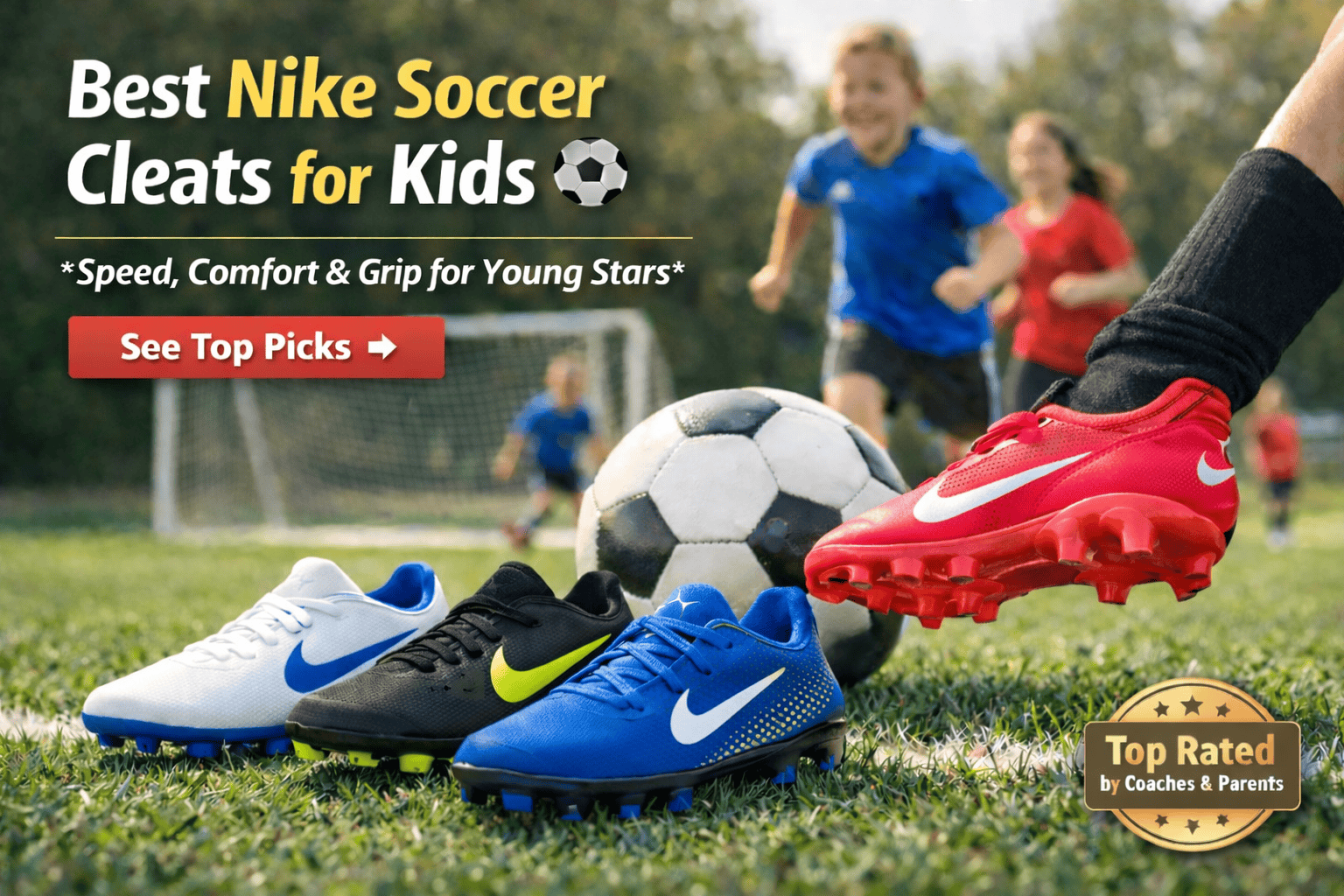
Best Nike Soccer Cleats for Kids
Looking for the best Nike soccer cleats for kids? This guide compares top Nike youth soccer shoes based on fit, comfort, speed, control, durability, surface type, and value so parents can choose the right pair with confidence.
Affiliate disclosure: We may earn a commission from qualifying purchases, at no additional cost to you.
Quick answer
Nike Jr. Mercurial Vapor Academy is the strongest all-around Nike direction for many speed-focused youth players. Choose Phantom for touch and control, Legend for a more traditional comfort profile, and a TF outsole for artificial turf.
At a glance
Best Nike Soccer Cleats for Kids compared
Use the purpose, fit, surface, and budget columns to narrow the shortlist before checking current sizes and availability.
| Pick | Best for | Fit or use | Surface | Shop |
|---|---|---|---|---|
| 1Nike Jr. Mercurial Vapor 16 Academy | Best overall | Snug athletic fit | FG / MG | See options |
| 2Nike Jr. Mercurial Superfly 10 Club | Best value speed | Close and narrow-leaning | FG / MG | See options |
| 3Nike Phantom GX II Academy MG | Best for control | Structured midfoot | MG | See options |
| 4Nike Jr. Legend 10 Club | Best for comfort | Comfort-focused | FG / MG | See options |
| 5Nike Jr. Phantom Academy TF | Best for turf | Secure turf fit | TF | See options |
Our shortlist
The strongest options by need
Each choice serves a different player or use case. Confirm the exact product generation, size, and surface label before checkout.
Nike Jr. Mercurial Vapor 16 Academy
A responsive youth speed boot with a more performance-oriented Academy build.
Nike Jr. Mercurial Superfly 10 Club
A budget-friendlier Mercurial shape for quick players who like a collar.
Nike Phantom GX II Academy MG
A control-first Nike option for passing, receiving, and multidirectional play.
Nike Jr. Legend 10 Club
A calmer, less aggressive direction for players who prioritize an accommodating feel.
Nike Jr. Phantom Academy TF
Short rubber turf lugs for hard artificial surfaces where FG studs are unsuitable.
Buying advice
How to choose correctly
A famous logo cannot compensate for the wrong fit, size, surface, or intended use.
Identify the player’s age, level, field or court, practice frequency, and the problem the equipment must solve.
Follow the current manufacturer chart, measure when relevant, and avoid buying excessive room for growth.
Stable, comfortable equipment used correctly is more valuable than premium features the player cannot benefit from.
Choose durability and function appropriate to the player’s stage rather than paying automatically for the highest tier.
How we evaluate
A parent-first selection method
We separate the strongest options by need and state the limitations instead of presenting one universal winner.
- Age, playing level, and intended use
- Fit, comfort, and safe equipment selection
- Surface or environment compatibility
- Durability relative to price
- Clear reasons to choose or skip each option
Questions answered
Best Nike Soccer Cleats for Kids FAQ
What are the best Nike soccer cleats for kids?
The best option matches the child’s foot shape, surface, comfort needs, and budget. The top-ranked direction in this guide is a starting point, not a substitute for fit.
How should kids’ soccer cleats fit?
They should feel snug and secure without toe pressure, painful width pressure, or heel lift. Avoid excessive growth room.
Can kids wear soccer cleats on artificial turf?
Use a turf-specific TF outsole on hard artificial turf, or a manufacturer-approved MG outsole where the facility permits it. Long FG studs are not the default turf choice.
Are expensive soccer cleats worth it for kids?
Often a Club or Academy tier offers enough comfort and traction. Premium models make more sense for competitive players with stable sizing and clear preferences.
Do Nike soccer cleats run narrow?
Fit varies by model family and generation. Measure both feet and use model-specific guidance instead of assuming every shoe from one brand fits the same.
How much growth room should kids have?
Leave only modest functional toe room. Too much length can cause sliding, blisters, and weaker ball control.
How often should kids replace soccer cleats?
Replace them when they are outgrown, the outsole loses traction, the upper separates, or the fit no longer remains secure and comfortable.
Choose for the player—not the logo
Confirm the exact model, size, intended use, and current availability before ordering.
Check current optionsExplore this topic