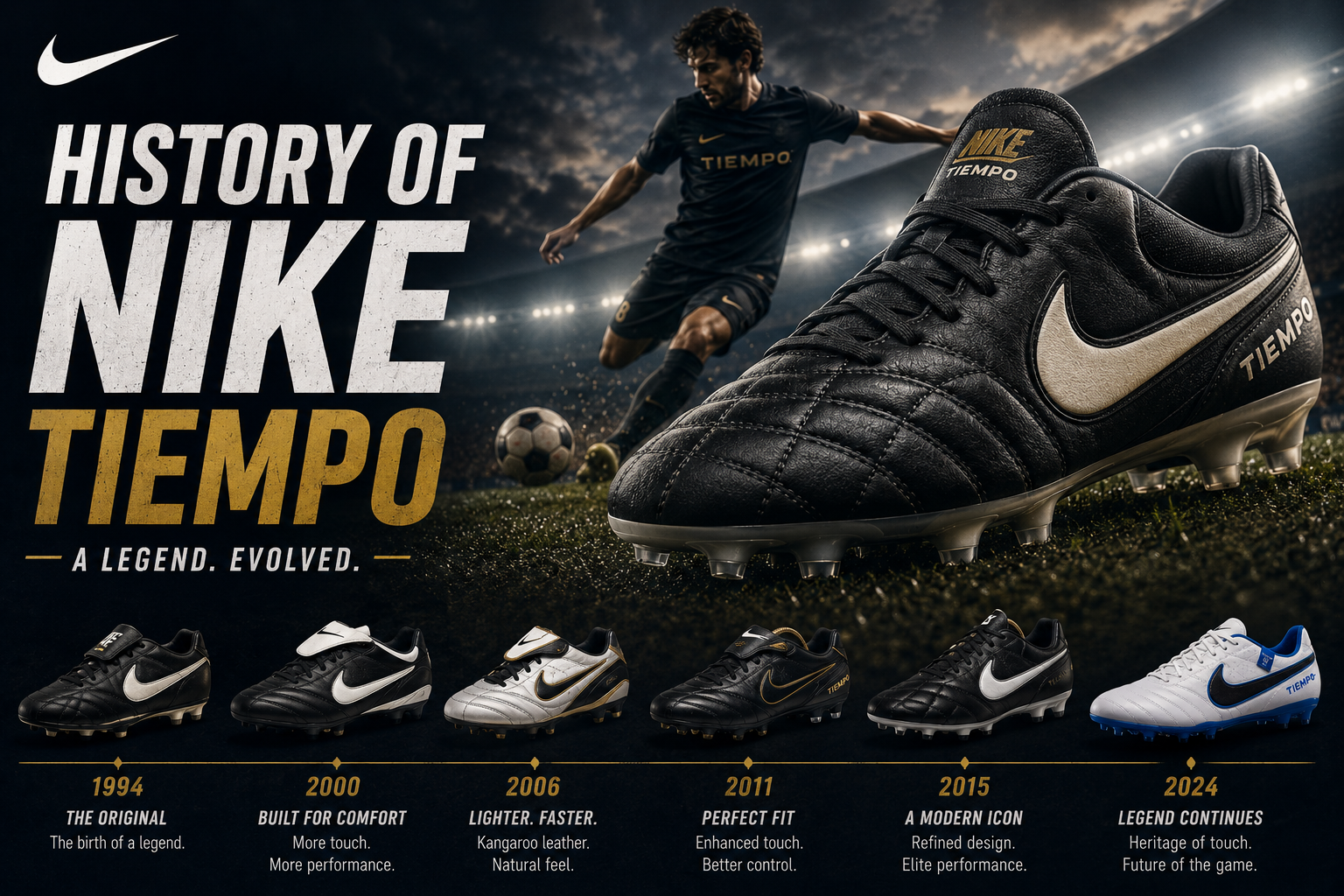
History of Nike Tiempo Cleats: Evolution of an Icon
The history of Nike Tiempo cleats stretches from a traditional all-leather soccer boot introduced in the 1980s to one of Nike’s longest-running and most recognizable cleat families. Tiempo became globally famous at the 1994 World Cup, evolved through ten Tiempo Legend generations, and repeatedly adapted its materials, fit, soleplates, and playing identity while preserving its reputation for comfort and touch.
Nike first introduced the Tiempo name in 1984, but the cleat became a global icon after the Nike Tiempo Premier appeared at the 1994 World Cup. Nike later reinvented the line as the Air Tiempo Legend in 2005 and continued developing it through Tiempo Legend II, III, IV, V, VI, VII, VIII, IX, and X. Across every era, Tiempo remained connected to comfort, touch, traditional styling, and players who valued control over an ultra-thin speed-boot feel.
Nike Tiempo History at a Glance
Nike Tiempo Cleats Timeline
| Year | Nike Tiempo Model or Era | Why It Mattered |
|---|---|---|
| 1984 | Nike Tiempo D | The earliest recognized Tiempo model established the traditional black leather foundation. |
| 1994 | Nike Tiempo Premier | The boot gained global attention at the World Cup and became part of Nike soccer history. |
| 1998 | Tiempo Premier M | A refined version carried the classic Tiempo identity into the next World Cup era. |
| 2005 | Nike Air Tiempo Legend | The Tiempo line was radically modernized with a sleeker shape and new performance technology. |
| 2006 | Tiempo Legend II | Nike refined the heel, stitching, stability, and overall fit. |
| 2006–2008 | Ronaldinho 10R and Super Ligera Era | Signature and lightweight variations expanded Tiempo beyond a single traditional model. |
| 2009 | Tiempo Legend III | The line improved leather quality, comfort, and touch while settling into a control-focused role. |
| 2011 | Tiempo Legend IV | A major redesign introduced Flywire, a carbon-fiber plate, and a lighter construction. |
| 2013 | Tiempo Legend V | Nike added weather-management technologies and further reduced weight. |
| 2015 | Tiempo Legend VI | An internal support cage reduced external stitching while maintaining a soft touch. |
| 2017 | Tiempo Legend VII | Flyknit entered the Tiempo line and the boot became significantly lighter. |
| 2019 | Tiempo Legend VIII | Nike introduced an internal Flyknit Fit Tunnel and a more structured midfoot fit. |
| 2021 | Tiempo Legend IX | The boot became lighter and added raised touch zones backed by soft foam pods. |
| 2023 | Tiempo Legend X | Nike replaced the traditional premium leather upper with engineered FlyTouch Plus material. |
| Modern Era | Tiempo Maestro and Tiempo Ligera | The Tiempo family continued evolving through control-focused and heritage-inspired models. |
Where Did Nike Tiempo Begin?
The Tiempo story began before the model became famous at the 1994 World Cup. Nike introduced the Tiempo name in 1984 through the Tiempo D, a traditional soccer boot built around the shape, leather construction, and understated appearance players associated with elite footwear at the time.
The original Tiempo was not created as an ultra-light speed cleat or a highly specialized control boot. It represented the classic idea of a soccer shoe: black leather, a traditional silhouette, straightforward construction, and a focus on dependable performance.
- The Tiempo name first appeared in 1984.
- The early design followed the traditional leather-cleat formula.
- Comfort, feel, and simplicity formed the foundation of the line.
- The earliest Tiempo models were less internationally famous than the later Tiempo Premier.
- Nike refined the concept for roughly a decade before its major 1994 breakthrough.
The Tiempo Identity Through the Decades
A traditional leather soccer boot built around simplicity and classic construction.
A globally visible match boot associated with the World Cup and elite international players.
A modernized playmaker boot connected to Ronaldinho, Pirlo, and creative soccer.
A lighter comfort-and-control line worn by defenders, midfielders, and technical players.
The 1994 Nike Tiempo Premier Breakthrough
The defining early moment in Nike Tiempo history came at the 1994 World Cup in the United States. Nike used the tournament to present the Tiempo Premier to a global audience at a time when the company was expanding its commitment to soccer.
The Tiempo Premier retained a traditional black leather appearance but added a large white Nike Swoosh that made the boot instantly recognizable on television. Players including Romário and Paolo Maldini wore Tiempo during the tournament, giving the model visibility at the highest level of international soccer.
The 1994 final between Brazil and Italy became especially important to Tiempo history. Multiple players on the field wore the Tiempo Premier, and Brazil’s victory connected the boot with one of the sport’s most watched and memorable stages.
- The Tiempo Premier became globally visible during the 1994 World Cup.
- Its black leather upper and white Swoosh created an immediately recognizable look.
- Romário helped connect Tiempo with Brazil’s attacking flair and tournament victory.
- Paolo Maldini gave the same boot credibility among elite defenders.
- The tournament helped establish Nike as a major force in soccer footwear.
Why the 1994 Tiempo Premier Became Iconic
The Tiempo Premier became iconic because it represented both tradition and change. Its shape and leather construction looked familiar to players, but the oversized Nike branding signaled a new competitor entering global soccer with confidence.
The boot also crossed positional boundaries. Romário represented attacking movement, finishing, and creativity. Maldini represented defending, composure, and technical quality. Their association demonstrated early that Tiempo was not limited to one position.
| Tiempo Premier Element | Historical Importance |
|---|---|
| Black leather construction | Preserved the traditional appearance players expected from premium soccer boots. |
| Large white Swoosh | Made Nike branding highly visible during televised matches. |
| World Cup exposure | Introduced the boot to a massive international audience. |
| Elite player adoption | Connected Tiempo with both attacking and defensive excellence. |
| Brazil’s championship | Placed the boot inside one of the tournament’s defining stories. |
Nike Tiempo Premier in the Late 1990s
Nike did not immediately abandon the successful Tiempo Premier formula. The company made relatively modest changes through the remainder of the 1990s because the original design already had a strong reputation.
The Tiempo Premier M carried the concept into the 1998 World Cup era. By then, Nike had also introduced the Mercurial, creating a clear contrast between the classic Tiempo and the new generation of lightweight speed boots.
That contrast helped define Tiempo’s long-term identity. Mercurial represented speed and bold innovation, while Tiempo represented touch, comfort, stability, and tradition.
Tiempo vs Mercurial: Two Different Nike Histories
| Nike Cleat Line | Original Identity | Long-Term Role |
|---|---|---|
| Nike Tiempo | Traditional leather, touch, comfort, and stability | Nike’s classic comfort-and-control cleat family |
| Nike Mercurial | Lightweight speed, acceleration, and bold design | Nike’s primary speed-cleat family |
The existence of Mercurial did not make Tiempo obsolete. Instead, it gave Tiempo a clearer reason to exist. Players could choose a classic, stable boot or a tighter, lighter speed model based on their preferences.
The Early 2000s: Tiempo Adapts Without Losing Its Identity
During the early 2000s, the Tiempo design changed gradually. Much of the development focused on the soleplate and reducing unnecessary weight while preserving the premium leather upper.
At one point, Tiempo used a soleplate connected to Nike’s faster Mercurial family. This helped make the boot lighter without forcing Nike to remove the traditional materials and comfort that Tiempo players expected.
This period established a pattern that would define Tiempo for decades: Nike repeatedly modernized the boot underneath and inside while trying to preserve its recognizable touch and comfort.
The Nike Tiempo Legend Era Begins
Nike radically reinvented Tiempo in 2005 with the Nike Air Tiempo Legend. The new model looked sleeker and more modern than the older Tiempo Premier while still maintaining the line’s connection to premium touch.
The Air Tiempo Legend included a ventilated mesh tongue and cushioning technology in the heel. It also became closely connected to Ronaldinho, who was one of the most creative and recognizable players in the world.
This changed how many fans viewed Tiempo. It was no longer simply an old-fashioned leather boot for traditional players. It became a stylish playmaker cleat associated with imagination, technique, passing, dribbling, and flair.
Why the Air Tiempo Legend Changed the Line
The boot became sleeker and more visually aligned with mid-2000s soccer footwear.
Ventilation and heel cushioning moved Tiempo beyond its simple traditional construction.
Ronaldinho helped present Tiempo as a boot for creative and technical players.
The new name established the generation system that would continue for years.
Nike Tiempo Legend I: The Ronaldinho Era
The first Air Tiempo Legend became strongly associated with Ronaldinho. His style made the boot feel different from the defensive image many modern players now connect with Tiempo.
Ronaldinho used touch, disguise, imagination, and improvisation rather than relying only on straight-line speed. Tiempo’s softer and more traditional upper matched that playing identity.
- The Air Tiempo Legend arrived in 2005.
- Ronaldinho became the defining face of the model.
- The boot was marketed around creative number 10 play.
- The design included a fold-over tongue and premium traditional styling.
- The model helped Tiempo transition into the modern cleat market.
Nike Tiempo Legend II
Nike followed the original Air Tiempo Legend with the Tiempo Legend II. Rather than completely changing the concept, Nike refined the heel counter, stitching pattern, stability, and touch.
The second generation continued Tiempo’s playmaker identity while expanding the number of available colorways. Tiempo was no longer restricted to conservative black-and-white releases and began appearing in brighter combinations.
This generation demonstrated that Nike could update Tiempo more frequently without removing the traditional elements that made the model recognizable.
The Ronaldinho 10R Tiempo Signature Line
Ronaldinho’s influence became even more visible through the Nike Tiempo Ronaldinho 10R signature line. Rather than simply placing his name on a standard release, Nike worked with him to create features connected to his preferences.
One of the most memorable ideas was a larger striking and passing area on the instep. Nike used an offset-style lacing arrangement and a fold-over tongue to create a cleaner area for ball contact.
The 10R line represented an important moment because it showed that Tiempo could support individual player expression while remaining connected to its classic heritage.
Ronaldinho’s Tiempo models helped transform the boot from a traditional leather cleat into a symbol of creativity, technique, and soccer culture.
Nike Tiempo Super Ligera
The Tiempo Super Ligera explored a lighter interpretation of the Tiempo formula. It combined a soft premium upper with a lighter outsole and removed some of the bulk associated with older Tiempo designs.
The Super Ligera was also notable because it moved away from the traditional fold-over Tiempo tongue. At the time, removing that visual feature was a significant change because the tongue had become closely connected to Tiempo’s appearance.
Although it never became as historically famous as the main Legend line, the Super Ligera showed Nike’s continuing interest in reducing weight without abandoning touch and comfort.
Nike Tiempo Legend III
The Tiempo Legend III arrived in 2009 and focused on improving the existing formula rather than completely reinventing it. Nike emphasized premium leather quality, cushioning, comfort, and touch.
Around the same time, Nike introduced the CTR360 as a dedicated control and playmaker boot. That new model affected Tiempo’s place in Nike’s lineup. Tiempo gradually shifted away from being marketed mainly as the number 10 boot and became more closely identified with comfort, dependable control, and traditional quality.
- Legend III improved leather quality and comfort.
- The design retained a traditional Tiempo appearance.
- CTR360 took over part of Nike’s dedicated playmaker identity.
- Tiempo moved toward the comfort-and-control position it holds today.
- The model remained popular with technical players who preferred leather.
How Tiempo’s Playing Identity Changed
| Tiempo Era | Primary Image | Typical Players Associated With It |
|---|---|---|
| 1990s Tiempo Premier | Traditional all-around match boot | Forwards, defenders, and elite international players |
| Mid-2000s Air Legend | Creative number 10 and playmaker boot | Ronaldinho, Andrea Pirlo, Francesco Totti |
| 2010s Legend Era | Premium comfort and control boot | Midfielders, defenders, and technical players |
| Modern Tiempo | Lighter comfort-focused all-position cleat | Defenders, midfielders, youth players, and control players |
Nike Tiempo Legend III Elite and the First Synthetic Tiempo
Nike’s 2010 Elite collection brought major technology changes across several cleat families. The Tiempo Legend III Elite used a carbon-fiber plate and introduced synthetic material into the Tiempo story.
This was historically important because Tiempo had been closely defined by natural leather. The synthetic construction demonstrated that Nike was willing to experiment with new materials when they could reduce weight or improve consistency.
The move did not immediately end leather Tiempo models, but it foreshadowed the larger material transition that would eventually arrive with Tiempo Legend X.
Nike Tiempo Legend IV
The Tiempo Legend IV arrived in 2011 and became one of the most highly regarded models in the line’s history. Nike combined traditional touch with more visible performance technology.
The boot included Flywire support, a carbon-fiber plate, a revised stud configuration, and a lighter construction. These upgrades made Legend IV feel more modern and responsive without completely abandoning Tiempo’s premium identity.
Many Tiempo collectors and longtime players still consider Legend IV one of the line’s landmark generations because it successfully balanced heritage and innovation.
- Introduced a major structural redesign.
- Used Flywire to support the upper.
- Included a lightweight carbon-fiber plate.
- Reduced weight compared with the previous model.
- Became one of the most remembered Tiempo Legend generations.
Nike Tiempo Legend V
Nike released Tiempo Legend V near the end of 2013. The new model became lighter and introduced technologies intended to improve performance in wet conditions.
Natural leather can absorb water and become heavier, so Nike added systems designed to reduce moisture uptake and maintain a more consistent feel. This reflected one of the continuing challenges in Tiempo development: preserving traditional touch while solving the limitations of natural materials.
Legend V also became the foundation for several memorable limited editions connected to Tiempo history and famous players.
Important Tiempo Legend V Special Editions
A 20th-anniversary model honoring the Tiempo Premier’s 1994 breakthrough.
A special edition that restored the traditional fold-over tongue preferred by Francesco Totti.
A Ronaldinho-inspired release celebrating the famous crossbar video and his Tiempo legacy.
These models showed the growing collector demand for classic Tiempo stories and designs.
The Return of the Nike Premier Line
During the Tiempo Legend V era, Nike also introduced a modern Nike Premier line inspired by the original Tiempo Premier. The goal was to provide a simpler, traditional leather option at a more accessible price.
The Nike Premier did not replace Tiempo Legend. Instead, it served players who preferred an old-school appearance, straightforward construction, and less expensive premium-leather feel.
This separation allowed Tiempo Legend to continue becoming more technical while Nike Premier preserved more of the original no-nonsense design philosophy.
Nike Tiempo Legend VI
Tiempo Legend VI arrived in 2015 and modernized the leather upper without covering it in extensive visible stitching. Nike used an internal support structure that helped shape the material and create cushioning beneath the surface.
The result was a cleaner appearance with fewer external seams. Legend VI preserved the soft Tiempo experience while showing how internal engineering could replace traditional quilting.
The understated design made Legend VI popular with players who wanted a premium boot that still looked refined and traditional.
Andrea Pirlo and Francesco Totti Tiempo Editions
Nike used Tiempo Legend VI to honor two players whose style matched the boot’s heritage: Andrea Pirlo and Francesco Totti.
Pirlo’s limited-edition Tiempo used a wine-inspired color and presentation connected to his elegance and interest in winemaking. The design emphasized patience, refinement, and maturity rather than speed or aggressive styling.
The Totti edition celebrated his long career with Roma and restored an extended fold-over tongue. These releases reinforced Tiempo’s connection with players who valued touch, loyalty, creativity, and classic soccer culture.
Nike Tiempo Legend VII
Nike introduced Tiempo Legend VII in 2017. This generation brought Flyknit into the Tiempo line for the first time and significantly reduced the weight compared with Legend VI.
The Flyknit integration improved fit around the foot while the premium forefoot maintained the touch players expected. Nike also introduced the Hyperstability plate, designed to support multi-directional movement while reducing weight.
Legend VII marked another important image shift. Tiempo became increasingly associated with elite defenders such as Sergio Ramos and Gerard Piqué rather than only traditional playmakers.
- First Tiempo Legend with integrated Flyknit.
- Significantly lighter than Legend VI.
- Introduced the Hyperstability soleplate.
- Combined premium touch with a modern knitted structure.
- Strengthened Tiempo’s association with defenders.
Sergio Ramos and the Defender Era
Sergio Ramos became one of the defining Tiempo players of the late 2010s. His playing style combined defensive aggression, technical confidence, leadership, passing, and goal scoring.
Nike created a special Tiempo Legend VII inspired by Ramos, demonstrating how far Tiempo’s identity had shifted since the Ronaldinho era. The line still represented touch and confidence, but defenders had become some of its most visible ambassadors.
Tiempo moved from an all-position World Cup boot to a playmaker icon and later became one of the cleats most strongly associated with technically skilled defenders.
Nike Tiempo Legend VIII
Tiempo Legend VIII launched in 2019. Nike retained important elements from Legend VII but focused much of the redesign on the internal fit.
The model introduced a Flyknit Fit Tunnel intended to create a more supportive and secure feeling around the midfoot. The exterior used a distinctive textured pattern that gave the generation an immediately recognizable appearance.
Legend VIII was more evolutionary than revolutionary. It refined lockdown and fit while keeping the premium Tiempo identity intact.
Nike Tiempo Legend IX
Nike released Tiempo Legend IX in 2021 and made weight reduction a major part of the update. The boot became lighter and more streamlined than the previous generation.
Nike replaced the diamond-style exterior of Legend VIII with raised touch zones backed by soft foam pods. These areas were positioned where the foot frequently contacts the ball during passing, dribbling, and shooting.
Legend IX showed that Tiempo could offer comfort and cushioning without remaining heavy or bulky. It became a more athletic interpretation of the classic Tiempo formula.
| Legend IX Change | Performance Purpose |
|---|---|
| Lighter construction | Made Tiempo feel more mobile and suitable for more positions. |
| Raised touch zones | Added texture in key ball-contact areas. |
| Soft internal pods | Maintained cushioning and comfort during ball contact. |
| Streamlined shape | Reduced the bulky feeling associated with older traditional boots. |
Nike Tiempo Legend X and the End of the Traditional Leather Era
Tiempo Legend X represented one of the biggest material changes in the line’s history. Nike moved away from the natural leather that had defined premium Tiempo models and introduced FlyTouch Plus engineered material.
The goal was to recreate many of leather’s desirable characteristics while reducing water absorption, weight, inconsistency, and dependence on animal leather.
This transition divided some longtime Tiempo fans. Traditionalists preferred the natural softness and break-in characteristics of earlier generations. Other players appreciated the lighter weight, consistency, and easier maintenance of the engineered upper.
- Legend X replaced the traditional premium natural-leather construction.
- FlyTouch Plus was engineered to create a soft and adaptable feel.
- The material absorbed less water than traditional leather.
- The boot became lighter and more consistent across different conditions.
- The change marked the end of a major historical chapter for Tiempo Legend.
Leather Tiempo vs Synthetic Tiempo
| Category | Traditional Leather Tiempo | Engineered Modern Tiempo |
|---|---|---|
| Initial Feel | Soft, padded, and traditionally premium | More consistent and structured from the beginning |
| Break-In | Gradually molds and softens | Requires less dramatic adaptation |
| Water Absorption | Can absorb moisture and gain weight | Designed to remain more consistent in wet conditions |
| Maintenance | Requires more careful cleaning and drying | Generally easier to maintain |
| Heritage | Strong connection to classic Tiempo history | Represents the modern performance direction |
| Consistency | Natural material can vary | Engineered material offers greater uniformity |
The Tiempo Maestro and Tiempo Ligera Era
After ten Tiempo Legend generations, Nike continued developing the Tiempo family through models including Tiempo Maestro and Tiempo Ligera.
Tiempo Maestro represents a control-focused continuation of the Tiempo name, while Tiempo Ligera places greater emphasis on lightweight simplicity and traditional feel.
This modern structure shows how the Tiempo family has expanded beyond one single model. Nike can now explore different interpretations of the same heritage: one more technical and control-oriented, another more traditional and streamlined.
| Modern Tiempo Model | Main Identity | Connection to Tiempo History |
|---|---|---|
| Tiempo Maestro | Control, touch, and modern technical performance | Continues Tiempo’s history as a boot for composed and creative players. |
| Tiempo Ligera | Lightweight traditional feel and simplicity | Reconnects with the clean and familiar qualities of older Tiempo models. |
| Tiempo Legend X | Engineered comfort and modern leather-like touch | Represents the final Legend generation and major synthetic transition. |
Most Important Nike Tiempo Generations
The 1994 World Cup model that transformed Tiempo into a global soccer icon.
The 2005 reinvention that modernized Tiempo and connected it with Ronaldinho.
A celebrated balance of traditional touch, reduced weight, and modern technology.
The generation that ended the premium natural-leather era and introduced FlyTouch Plus.
Every Nike Tiempo Legend Generation Compared
| Generation | Main Historical Contribution | Tiempo Identity |
|---|---|---|
| Air Tiempo Legend | Modernized the original Tiempo and created the Legend line | Playmaker comfort and premium touch |
| Tiempo Legend II | Refined heel support, stitching, stability, and color options | Creative technical boot |
| Tiempo Legend III | Improved leather quality and established a comfort-control role | Premium traditional control |
| Tiempo Legend IV | Added Flywire, carbon fiber, and major weight reduction | Heritage combined with innovation |
| Tiempo Legend V | Introduced weather-management technology and special editions | Premium all-condition comfort |
| Tiempo Legend VI | Used an internal cage to shape the upper with less stitching | Clean and refined touch |
| Tiempo Legend VII | Introduced Flyknit and the Hyperstability plate | Lighter modern defender boot |
| Tiempo Legend VIII | Improved internal midfoot fit through the Flyknit Fit Tunnel | Supportive premium comfort |
| Tiempo Legend IX | Reduced weight and added foam-backed touch zones | Lighter comfort and control |
| Tiempo Legend X | Replaced premium natural leather with engineered FlyTouch Plus | Modern synthetic Tiempo performance |
Famous Players Who Wore Nike Tiempo
Part of Tiempo’s longevity comes from the range of players associated with it. The boot has appeared on forwards, playmakers, central midfielders, defenders, and leaders across different eras.
| Player | Tiempo Era or Connection | Playing Identity |
|---|---|---|
| Romário | 1994 Tiempo Premier | Movement, finishing, and Brazil’s championship run |
| Paolo Maldini | 1994 Tiempo Premier | Defensive elegance, technique, and composure |
| Ronaldinho | Air Tiempo Legend and 10R line | Creativity, flair, touch, and imagination |
| Andrea Pirlo | Tiempo Legend and signature editions | Passing, control, vision, and elegance |
| Francesco Totti | Customized and limited-edition Tiempo models | Loyalty, playmaking, finishing, and classic style |
| Sergio Ramos | Tiempo Legend VII era and signature model | Leadership, defending, technical confidence, and aggression |
| Gerard Piqué | Modern Tiempo defender era | Ball-playing defending and composure |
Why Tiempo Became Popular With Defenders
Tiempo was not originally a defender-only boot. Its early history included forwards and playmakers, but several qualities naturally appealed to defenders as the market became more specialized.
Defenders often wanted stability, comfort, protection from a less minimal upper, dependable touch, and a secure platform for passing. Tiempo provided those qualities while other Nike lines became increasingly focused on speed or aggressive control.
- Comfort for long matches and physical play.
- Stable platform for tackles and changes of direction.
- Reliable touch for clearances and passing from the back.
- More forgiving fit than many speed boots.
- Premium appearance associated with leadership and composure.
- High-profile adoption by Sergio Ramos, Gerard Piqué, and other defenders.
Read our full Nike Tiempo for defenders guide.
Why Midfielders Continued Wearing Tiempo
Even after Tiempo became strongly associated with defenders, it remained a natural option for central and defensive midfielders. The clean upper, comfortable fit, and stable platform worked well for players who received and distributed the ball frequently.
Tiempo did not offer the same aggressive control identity as Phantom, but many midfielders preferred its simpler and more predictable feel.
Explore our Nike Tiempo for midfielders guide.
How Nike Tiempo Technology Evolved
| Technology or Design Change | Tiempo Era | Purpose |
|---|---|---|
| Premium leather construction | Tiempo D through early Legend generations | Soft touch, comfort, and traditional feel |
| Heel cushioning | Air Tiempo Legend | Improved underfoot comfort and support |
| Carbon-fiber plate | Legend III Elite and Legend IV era | Reduced weight and increased responsiveness |
| Flywire support | Tiempo Legend IV | Improved structure and lockdown |
| All Conditions Control | Tiempo Legend V era | More consistent touch in different weather conditions |
| Internal support cage | Tiempo Legend VI | Shaped the upper while reducing external stitching |
| Flyknit integration | Tiempo Legend VII | Improved fit and reduced weight |
| Flyknit Fit Tunnel | Tiempo Legend VIII | Created more supportive midfoot lockdown |
| Foam-backed touch zones | Tiempo Legend IX | Added cushioning and texture in ball-contact areas |
| FlyTouch Plus | Tiempo Legend X | Created a lighter, engineered alternative to natural leather |
How the Weight of Nike Tiempo Changed
Older Tiempo models were often viewed as heavier than speed boots because they used substantial leather uppers, padded tongues, and traditional construction.
Over time, Nike reduced weight through lighter soleplates, internal support systems, Flyknit, streamlined uppers, and engineered synthetic materials. By the Legend IX and Legend X eras, Tiempo felt much closer to a modern performance cleat than a bulky traditional boot.
Weight reduction expanded Tiempo’s appeal beyond players who wanted only comfort. Fullbacks, mobile midfielders, and technical attackers could wear the line without feeling that they had selected an old-fashioned or excessively heavy model.
How Nike Tiempo Fit Evolved
Tiempo’s fit also changed significantly. Early leather models were expected to soften and adapt over time. Later generations introduced more internal structure, knitted components, engineered support, and synthetic materials.
| Tiempo Era | Fit Character |
|---|---|
| Early leather Tiempo | Traditional shape with natural molding during break-in |
| Air Legend era | Sleeker but still padded and leather-focused |
| Legend IV–VI | More structured support combined with soft forefoot materials |
| Legend VII–VIII | Flyknit and internal systems created more precise midfoot lockdown |
| Legend IX | Lighter, streamlined, and cushioned through touch zones |
| Legend X and newer Tiempo | More consistent engineered fit with less natural stretching |
For current fit advice, read our Nike Tiempo for wide feet guide and soccer cleat fit guide.
What Never Changed About Nike Tiempo?
Every generation attempted to preserve a more forgiving and wearable feel.
Tiempo consistently emphasized clean and dependable contact with the ball.
The line repeatedly crossed positions, eras, and different playing styles.
Even modern versions reference the classic appearance and reputation of earlier Tiempo boots.
Best Nike Tiempo Models in History
The best historical Tiempo depends on whether the player values cultural importance, performance innovation, nostalgia, or modern usability.
| Tiempo Model | Why It Stands Out | Best Historical Category |
|---|---|---|
| Tiempo Premier | The World Cup model that established Tiempo as a global icon | Most historically important |
| Air Tiempo Legend | Modernized Tiempo and became closely associated with Ronaldinho | Best cultural reinvention |
| Tiempo Ronaldinho 10R | One of Nike’s most memorable player-driven signature concepts | Best signature Tiempo |
| Tiempo Legend IV | Successfully combined classic touch with modern technology and lower weight | Best-loved Legend generation |
| Tiempo Legend VI | Clean design, premium feel, and limited editions connected to iconic players | Best refined leather design |
| Tiempo Legend VII | Integrated Flyknit and helped establish the modern defender era | Best major structural update |
| Tiempo Legend IX | Created one of the lightest and most athletic Tiempo experiences | Best lightweight leather-era Tiempo |
| Tiempo Legend X | Introduced the largest material shift in the line’s modern history | Most important modern transition |
Why Old Nike Tiempo Cleats Remain Popular
Older Tiempo models remain popular among collectors and players because each generation represents a different period in soccer design. Some buyers prefer the natural leather feel, fold-over tongues, stitching patterns, or signature-player connections that newer models no longer offer.
Nostalgia also plays a major role. Players remember Ronaldinho in the Air Legend, Pirlo controlling matches in Tiempo, Totti wearing customized tongues, and Ramos leading the later defender era.
- Natural leather feel that differs from modern engineered uppers.
- Classic fold-over tongues and stitched forefoot designs.
- Player associations with Ronaldinho, Pirlo, Totti, Ramos, and Maldini.
- Limited-edition releases with collectible value.
- Distinct generation-specific shapes and soleplates.
- Nostalgia for previous World Cups, clubs, and soccer eras.
Should You Play in Old Nike Tiempo Cleats?
Older Tiempo cleats can still be wearable if they have been stored correctly and remain structurally sound. However, age can weaken adhesives, separate soleplates, dry materials, and reduce stud safety.
Collectors should inspect used or old-stock Tiempo boots carefully before playing in them. A model can look clean while hidden adhesives or internal components have deteriorated.
- Do not play in boots with sole separation.
- Avoid cracked plates, damaged studs, or hardened uppers.
- Check heel lining and internal padding for deterioration.
- Do not assume unused old stock is automatically match-ready.
- Keep rare limited editions for collecting if replacement would be difficult.
How to Choose a Nike Tiempo Today
Compare current Tiempo models based on comfort, heritage, control, and playing style.
Academy for value, Pro for balance, and premium models for advanced players.
Confirm toe room, forefoot pressure, midfoot security, and heel lockdown.
Select FG, AG, MG, TF, or IC based on where you actually play.
Nike Tiempo History: Final Era Summary
| Historical Period | Tiempo’s Role |
|---|---|
| 1984–1993 | A traditional Nike leather boot developing before its global breakthrough |
| 1994–2004 | A recognizable World Cup boot that established Nike’s classic soccer identity |
| 2005–2010 | A modern playmaker boot strongly associated with Ronaldinho and creative soccer |
| 2011–2016 | A premium heritage boot using modern materials, support systems, and special editions |
| 2017–2022 | A lighter, more technical comfort boot increasingly associated with defenders |
| 2023 and Beyond | An engineered modern Tiempo family moving beyond traditional premium leather |
Final Verdict: Why Nike Tiempo Became a Soccer Icon
Nike Tiempo became an icon because it continued evolving without abandoning the qualities that made players trust it. The materials, weight, soleplates, fit systems, and player associations changed repeatedly, but comfort and dependable touch remained central to the line.
The Tiempo D established the traditional foundation in 1984. The Tiempo Premier turned the boot into a global symbol at the 1994 World Cup. The Air Tiempo Legend connected it with Ronaldinho and creative play. Later Legend generations introduced lighter plates, Flywire, Flyknit, internal support systems, touch zones, and eventually engineered leather alternatives.
Few soccer cleat families have crossed as many positions and eras. Tiempo has been worn by World Cup-winning forwards, elegant defenders, creative number 10s, deep-lying playmakers, aggressive captains, midfield controllers, and youth players seeking comfort.
That ability to adapt while remaining recognizable is why Nike Tiempo has lasted for decades—and why old and new Tiempo models continue to attract players, collectors, and soccer fans.
Explore Nike Tiempo CleatsRelated Nike Tiempo Guides
History of Nike Tiempo Cleats FAQ
When were Nike Tiempo cleats first released?
The Nike Tiempo name first appeared in 1984 with the Tiempo D, although the line became globally famous after the Tiempo Premier appeared at the 1994 World Cup.
What was the first Nike Tiempo cleat?
The Tiempo D from 1984 is recognized as the earliest Nike Tiempo model and established the line’s traditional leather identity.
Why is the 1994 Nike Tiempo Premier important?
The Tiempo Premier gained worldwide exposure at the 1994 World Cup and was worn by major players including Romário and Paolo Maldini.
Who wore Nike Tiempo at the 1994 World Cup?
Romário and Paolo Maldini were among the most famous players associated with the Tiempo Premier during the 1994 tournament.
When did the Nike Tiempo Legend line begin?
The modern Tiempo Legend era began in 2005 with the Nike Air Tiempo Legend.
Who made Nike Tiempo Legend famous?
Ronaldinho became the defining early face of the Tiempo Legend line and helped connect it with creativity, flair, and number 10 play.
How many Nike Tiempo Legend generations were released?
Nike produced ten main Tiempo Legend generations, beginning with the Air Tiempo Legend and continuing through Tiempo Legend X.
Which Nike Tiempo generation is considered the best?
Tiempo Legend IV is frequently remembered as one of the best-balanced generations, although collectors and players also value the Premier, Air Legend, Legend VI, Legend VII, and Legend IX.
When did Nike Tiempo first use synthetic material?
The Tiempo Legend III Elite introduced synthetic material into the Tiempo story during Nike’s 2010 Elite collection.
When did Nike Tiempo stop using leather?
The premium Tiempo Legend line moved away from traditional natural leather with Tiempo Legend X, which used engineered FlyTouch Plus material.
What was the Ronaldinho Tiempo 10R?
The Ronaldinho 10R was a player-influenced Tiempo signature line featuring design elements intended to create a larger and cleaner ball-contact area.
Why did defenders start wearing Nike Tiempo?
Defenders valued Tiempo’s comfort, stability, reliable touch, and less restrictive fit, while players such as Sergio Ramos and Gerard Piqué increased its visibility among defensive positions.
Did midfielders wear Nike Tiempo?
Yes. Andrea Pirlo, Francesco Totti, and many central midfielders wore Tiempo because of its comfort, passing feel, and clean touch.
What replaced Nike Tiempo Legend?
After ten Tiempo Legend generations, Nike expanded the modern Tiempo family through newer models including Tiempo Maestro and Tiempo Ligera.
What is the difference between Tiempo Legend and Tiempo Premier?
Tiempo Premier established the classic World Cup-era design, while Tiempo Legend became the more modern and technology-driven continuation beginning in 2005.
Why are old Nike Tiempo cleats collectible?
Older Tiempo models are collectible because of their leather construction, classic designs, famous player associations, limited editions, and connection to major soccer eras.
Can you still play in old Nike Tiempo cleats?
Old Tiempo cleats may be playable if structurally sound, but aging adhesives, sole separation, hardened materials, and damaged studs can make older boots unsafe.
Are modern Nike Tiempo cleats still comfortable?
Yes. Modern Tiempo models continue emphasizing comfort and touch, although engineered uppers feel different from the natural leather used in older generations.
What made Nike Tiempo last so long?
Tiempo survived because Nike repeatedly updated its weight, materials, fit, traction, and technology while preserving its core reputation for comfort and dependable touch.
Is Nike Tiempo the oldest Nike soccer cleat line?
Tiempo is Nike’s longest-running major soccer-cleat family still connected to a continuous modern product identity.
As an Amazon Associate, we may earn from qualifying purchases at no extra cost to you.