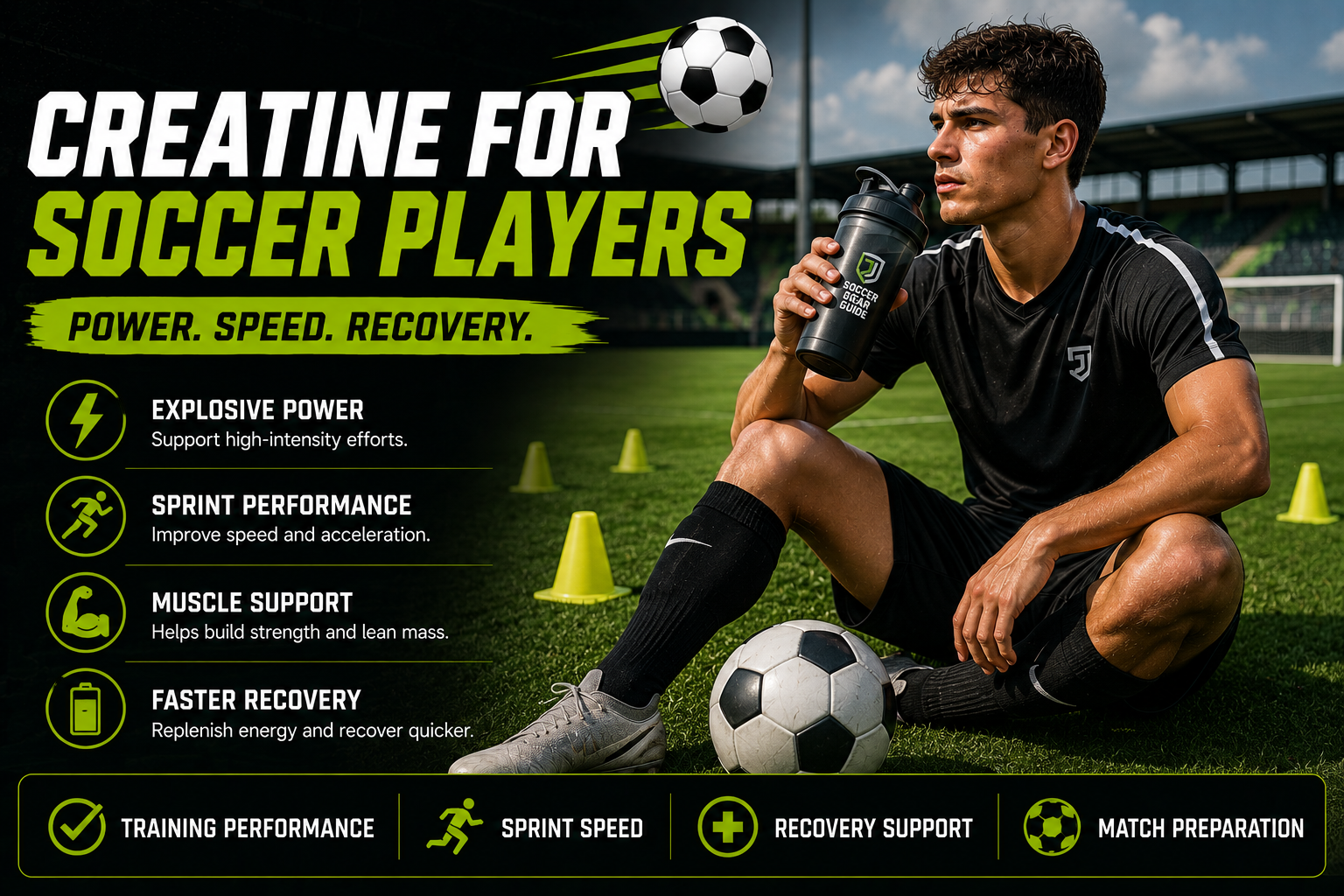
Creatine for Soccer Players (Benefits, Safety & Performance Guide)
Soccer Supplement Guide

Creatine for Soccer Players

Creatine can be useful for soccer players because the sport includes repeated sprints, accelerations, jumps, tackles, changes of direction, and strength work. It is not a magic endurance supplement, but it may support short bursts of power, training quality, strength development, and recovery when used correctly with good nutrition, hydration, and sleep.

Creatine for soccer players benefits safety and performance guide
Quick Answer:
Creatine can help some soccer players with repeated sprint power, strength training, muscle recovery, and high-intensity performance. It should be used only after the player already has solid meals, protein, carbs, hydration, and sleep. Youth players should not use creatine without parent approval and guidance from a qualified professional.

Creatine for Soccer Players at a Glance

Best ForStrength training, repeated sprints, explosive actions, and recovery support.
Not MagicCreatine does not replace carbs, protein, hydration, sleep, or training.
Simple FormCreatine monohydrate is usually the basic option most athletes look for.
Youth CautionYoung athletes need parent and professional guidance before supplements.

Creatine for Soccer Players Quick Comparison

Question Simple Answer Best Related Guide
Can creatine help soccer players? It may help with repeated high-intensity efforts, strength, power, and training quality. Soccer Nutrition Guide
Is creatine good before games? Creatine is usually a daily consistency supplement, not a last-minute game-day boost. Game Day Meal Plan
Should youth players take creatine? Youth players should only consider it with parent approval and qualified guidance. Youth Soccer Nutrition
Does creatine replace protein? No. Protein supports repair, while creatine supports high-intensity energy systems. Protein Guide
Do soccer players need hydration with creatine? Yes. Hydration should always be part of any supplement plan. Hydration Guide

What Is Creatine?

Creatine is a compound naturally found in the body and in foods like meat and fish. In sports nutrition, creatine is commonly used to support short, intense bursts of activity. That matters for soccer because players do not just jog. They sprint, press, jump, shoot, shield, tackle, and accelerate repeatedly.

Creatine is not the first thing a soccer player should fix. Before supplements, players should already have a strong foundation: enough food, enough carbohydrates, enough protein, enough fluids, and enough sleep.

Start with the basics first: Soccer Player Nutrition Guide, How Much Protein Do Soccer Players Need?, and Recovery Nutrition for Soccer Players.

Creatine Priorities for Soccer

Power

Creatine may support repeated high-intensity actions like sprints, jumps, and accelerations.

Strength

It can support gym work when paired with consistent training and enough food.

Recovery

It may help training consistency, but it does not replace recovery meals or sleep.

Safety First

Players with medical concerns or youth athletes should get qualified guidance first.

Benefits of Creatine for Soccer Players

Creatine is most relevant for the explosive parts of soccer. It is not mainly about running longer. It is more about repeated powerful efforts and supporting the training that builds stronger, faster players.

  • May support repeated sprint ability.
  • May help with short bursts of power and acceleration.
  • Can support strength training adaptation.
  • May help players maintain quality during intense training blocks.
  • Can support muscle recovery when paired with proper nutrition.
  • May help players who also lift weights or do speed training.
  • Works best with consistent use, not random game-day use.

Creatine Benefits by Soccer Situation

Soccer Situation How Creatine May Help Still Needed
Strength Training May support power and muscle training quality Protein, carbs, sleep, progressive workouts
Repeated Sprints May support short high-intensity efforts Speed training, conditioning, recovery
Explosive Actions May support jumps, tackles, and accelerations Technique, strength, mobility, warmups
Heavy Training Weeks May support consistency during demanding blocks Meals, hydration, recovery nutrition
Game Day Not a last-minute energy drink Pre-game carbs, fluids, post-game recovery

Is Creatine Safe for Soccer Players?

For many healthy adult athletes, creatine monohydrate is commonly considered one of the better-studied sports supplements. However, “safe for many adults” does not mean every soccer player should take it without thinking.

Players should be careful if they have kidney issues, medical conditions, take medication, are under 18, or have not built basic nutrition habits yet. Youth soccer players should only consider creatine with parent approval and guidance from a doctor, sports dietitian, or qualified professional.

  • Use simple products from reputable brands.
  • Avoid stimulant-heavy blends marketed as “performance boosters.”
  • Do not combine creatine with extreme supplement stacks.
  • Keep hydration consistent.
  • Stop using it if side effects or concerns appear.
  • Ask a qualified professional if the player is under 18 or has medical concerns.

How to Use Creatine for Soccer the Smart Way

1. Fix food first

Build meals around carbs, protein, fruits, vegetables, and fluids before supplements.

2. Keep it simple

Most athletes looking at creatine start with plain creatine monohydrate.

3. Use consistently

Creatine is usually used daily, not as a one-time pre-game trick.

4. Get guidance

Youth players and anyone with health concerns should ask a qualified professional.

Creatine Monohydrate vs Other Creatine Types

Creatine monohydrate is usually the simplest and most common form. Many fancy creatine products are marketed as more advanced, but soccer players do not need complicated blends to start.

  • Creatine monohydrate is the basic common option.
  • Powder is usually simple to mix with water, smoothies, or shakes.
  • Capsules may be convenient but can require multiple pills.
  • Flavored blends may include extra ingredients the player may not need.
  • Pre-workout products may include caffeine or stimulants, which are not ideal for many soccer players.
  • Choose third-party tested products when possible.

Creatine Product Types for Soccer Players

Type Best For Watch Out For
Plain Creatine Monohydrate Powder Simple daily use Needs mixing and consistent routine
Creatine Capsules Players who dislike powders May require several capsules per serving
Flavored Creatine Players who need better taste May include sweeteners or extra ingredients
Creatine Blends Advanced users with guidance Often unnecessary for most players
Pre-Workout with Creatine Not ideal for many soccer players May include caffeine, stimulants, or unneeded ingredients

When Should Soccer Players Take Creatine?

Creatine timing is usually less important than consistency. It is not like a quick energy drink that suddenly works 10 minutes before kickoff. Most players who use creatine take it consistently as part of a daily routine.

Some players mix it with a post-training smoothie, a protein shake, or a meal. Others take it with water. The key is choosing a routine that is easy to repeat.

  • Use creatine consistently if it is part of the plan.
  • Take it with a meal, smoothie, or recovery shake if easier.
  • Do not rely on creatine as a last-minute game-day boost.
  • Do not test it for the first time before an important match.
  • Pair supplement use with hydration and recovery meals.

Related guide: Protein Shake Before or After Soccer?

Creatine by Player Type

Adult Players

May consider creatine if training, nutrition, and hydration are already consistent.

Teen Players

Should only use creatine with parent approval and qualified professional guidance.

Strength-Focused Players

May benefit most if they combine soccer with lifting and speed training.

Casual Players

Should usually fix food, hydration, sleep, and training before thinking about supplements.

Creatine for Youth Soccer Players

Creatine for youth soccer players is a sensitive topic. Young athletes are still growing, and many do not need supplements at all. Most youth soccer players should focus on meals, snacks, hydration, sleep, training consistency, and recovery habits before considering creatine.

Parents should not give creatine to a young player just because another teammate uses it. If a teen athlete is serious about supplementation, the family should speak with a qualified professional first.

  • Food-first nutrition should come first.
  • Parents should be involved in any supplement decision.
  • Ask a doctor or sports dietitian before youth athletes use creatine.
  • Avoid stimulant-heavy supplement blends.
  • Do not use supplements to replace meals or recovery habits.
  • Keep hydration and sleep as priorities.

Helpful youth guides: Nutrition for Youth Soccer Players and Best Protein for Young Athletes.

Creatine vs Protein for Soccer Players

Supplement Main Role Soccer Use
Creatine Supports short bursts of high-intensity power Sprints, strength training, explosive actions
Protein Supports muscle repair and recovery Post-game meals, training recovery, daily intake
Carbs Main fuel for soccer activity Pre-game meals, tournaments, recovery refueling
Electrolytes Support hydration after sweat loss Hot games, tournaments, heavy sweating
Water Hydration foundation Every practice, game, and training day

Does Creatine Cause Weight Gain?

Some players may notice weight changes when using creatine, often related to water stored in muscle. For soccer players, this can feel different from player to player. Some do not notice much. Others may feel slightly heavier.

That is one reason players should not test creatine right before an important tournament or match. Use normal training periods to see how the body responds.

  • Some players may gain a small amount of weight.
  • Water weight is different from fat gain.
  • Any change should be monitored during training, not game day.
  • Players who feel slower or uncomfortable should reassess.
  • Hydration and normal meals still matter.

Creatine Checklist for Soccer Players

Food foundation

Carbs, protein, fruits, vegetables, fluids, and enough total calories come first.

Simple product

Use plain creatine monohydrate instead of stimulant-heavy blends.

Hydration plan

Drink water consistently and use electrolytes when heat or sweat demands it.

Professional advice

Get guidance for youth athletes, medical conditions, or competitive drug-testing concerns.

Creatine and Hydration for Soccer Players

Hydration matters for every soccer player, with or without creatine. Players should not use creatine while ignoring water intake, electrolytes, or recovery fluids.

  • Drink water throughout the day.
  • Bring a bottle to every practice and game.
  • Use electrolytes during hot weather or heavy sweating.
  • Do not wait until warmups to start hydrating.
  • Pair creatine use with normal meals and fluids.
  • Stop and ask a professional if symptoms or concerns appear.

Helpful hydration guides: Hydration for Soccer Players and Best Electrolytes for Soccer Players.

Common Creatine Mistakes Soccer Players Make

  • Taking creatine before fixing meals, hydration, and sleep.
  • Using stimulant-heavy pre-workouts instead of plain creatine.
  • Testing creatine for the first time before a game.
  • Expecting creatine to replace conditioning or speed training.
  • Using creatine but skipping protein and carbs after soccer.
  • Ignoring hydration during hot weather.
  • Giving creatine to youth players without guidance.
  • Assuming every player responds the same way.

Final Verdict: Should Soccer Players Take Creatine?

Creatine can be useful for some soccer players, especially those doing strength training, speed work, and repeated high-intensity sessions. It may support sprint power, explosive actions, training quality, and recovery when used consistently.

But creatine should come after the basics: carbohydrates for fuel, protein for recovery, water for hydration, electrolytes when needed, and sleep. Youth players should only consider creatine with parent involvement and qualified professional guidance.

Shop Soccer Supplements

Related Soccer Nutrition Guides

Creatine for Soccer Players FAQ

Is creatine good for soccer players?

Creatine can be useful for soccer players who want support for repeated high-intensity efforts, sprint power, strength training, and recovery, but it should not replace meals, hydration, sleep, or training.

Should soccer players take creatine before a game?

Creatine is usually used consistently over time, not as a last-minute pre-game energy boost. Players should not try creatine for the first time before an important match.

Is creatine safe for youth soccer players?

Youth soccer players should only consider creatine with parent approval and guidance from a qualified professional such as a doctor or sports dietitian.

Does creatine help with soccer endurance?

Creatine is more connected to short, intense bursts of effort than long endurance. For soccer endurance, players still need conditioning, carbohydrates, hydration, and recovery.

Does creatine replace protein?

No. Creatine and protein have different roles. Protein supports muscle repair, while creatine supports high-intensity energy systems. Soccer players still need enough protein from food or convenient options.

What type of creatine is best for soccer players?

Plain creatine monohydrate is usually the simple common option. Players should avoid unnecessary stimulant-heavy blends and choose reputable products when possible.

Can creatine make soccer players gain weight?

Some players may notice a small weight increase, often related to water stored in muscle. Players should test how they feel during training, not right before important games.

What should soccer players do before taking creatine?

Players should first build consistent meals, carbs, protein, hydration, recovery habits, and sleep. Anyone under 18 or with medical concerns should get qualified guidance first.

We may earn a commission from qualifying purchases at no extra cost to you. This article is for general informational purposes only and is not medical advice. Supplements are not appropriate for every athlete.

Scroll to Top